
Loving The Library
My history with these sacred spaces, and why they’re still important
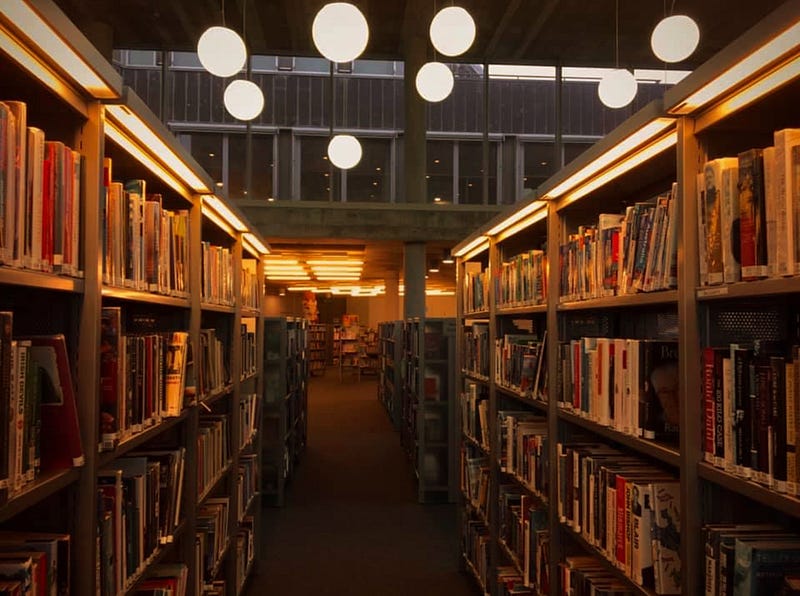
A rabbit possessed me as a child and would lead the way into many wonderlands. No, this wasn’t some demonic version of Alice In Wonderland’s The White Rabbit, but rather a little white bunny called Miffy — from the series of children’s books by Dick Bruna — that I discovered on the first trip to my junior school library. Space itself was not very big; a nine-by-twelve foot room (small even to a seven-year-old) with orange carpet and mustard yellow walls, but the bookshelves made it a place of wonder. I devoured the Miffy series quickly and then moved onto more advanced stuff — my first proper prose book being a book of dragon stories. Where The Wild Things Are followed to charm my imagination forever, and later came The Nature Of The Beast by Janni Howker — a story set in early 1980s Yorkshire, and involving a mysterious creature that terrorizes a rural community all ready plagued by unemployment. This book was the first piece of reality-based prose for me, and it’s still a favorite of mine.
In 1985, I joined the children’s section of my then local library, in Coolock, North Dublin. This was a huge step up, as I could now borrow up to three books instead of one, and for a longer period (yay). My very first finds were The Big Book Of Animal Stories (with a painted lion cub on the front cover) and How To Make Monsters, a guide to creating your own paper gorgons, ogres, and other mythical beasts (a delight for a monster and art-loving kid). I remember the first book more though, as my dad said that I absolutely had to read whatever I borrowed. And so taking his advice literally, I read those animal stories out loud for the next week — until I finally drove my mam bonkers, and she told me to quit reading to the whole planet. With my fear of library jail quickly forgotten, I resumed reading silently — on subjects as varied as ancient history, mythology, nature, the supernatural, and Asterix The Gaul. Three books I clearly remember were The Hamlyn Book Of Ghosts (which I borrowed repeatedly), an illustrated biography of the Bee Gees (in which everyone was weirdly portrayed as anthropomorphic animals), and a beautiful little book of Norse myths with watercolor illustrations (that I’ve never been able to find again). I eventually grew bored with the children’s section, and so, was delighted when I finally joined the adult library after three years. In this once forbidden space, I found books on science fiction, fantasy, horror, photography, art, and cinema . . . a biography of Steven Spielberg being particularly special, as it opened up the world of filmmaking to me. The library itself was rather dull by daytime, though on a clear evening, the dusk light could suddenly make it a mysterious, if magical place. Coolock Library was refurbished in late 2019 and now looks wonderful, though part of me will always miss that faded old interior.
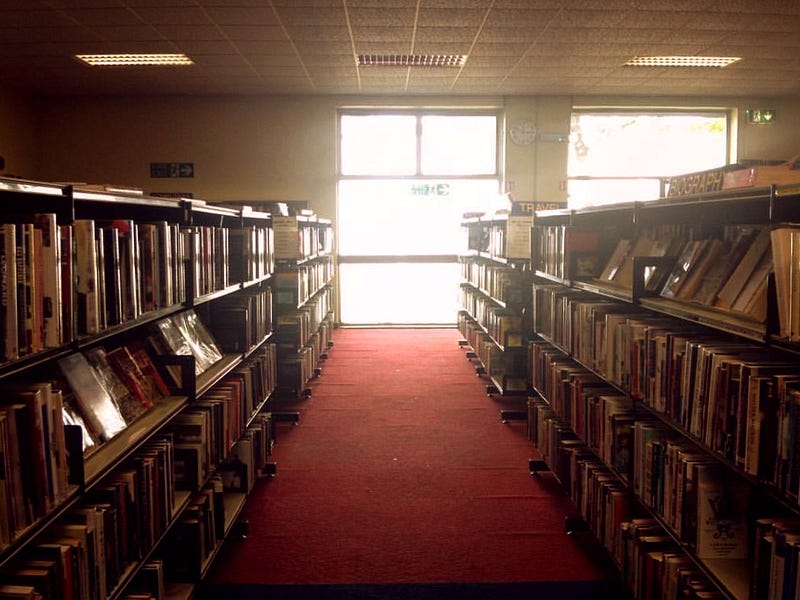
I started my second-level education in 1988, although it would be a while before I checked out Chanel College’s upstairs library. It was much larger than my previous school library, but strangely found more use as a spare classroom — I can still remember going there after school and finding few, if any other browsers among the bookshelves, my only company usually being whatever teacher was on desk duty. Still, the place was a refuge for me (especially during a later period of being bullied, as my tormenters were not exactly deep thinkers, and so wouldn’t be caught dead in a library), and I discovered amongst other things, The Ghost Hunters Road Book (which further instilled a love of all things spooky), The Hardy Boys series (which now seems badly written, but their mystery elements appealed to me at the time) and The Lord Of The Rings trilogy (I had already read The Hobbit via first-year English class.)
By the time I started college in 1993, my love for libraries had begun to fade, being replaced by those things all older teenagers/young adults suddenly have an interest in; the opposite (or same) sex, music, fashion, drink, etc. While my love of books lingered, I was now haunting Dublin city bookshops far more than my local library and had also discovered comics and graphic novels (these also attracting the artist side of me). So places like Hodges Figgis, Waterstones, and Forbidden Planet became my go-to spots for fresh reading experiences, though the obvious difference between a library and bookshop is that you can’t read the contents of a bookshop for too long; just in case some suspicious employee comes over and ask if you’re actually going to buy that damn book.
It wasn’t until 2002 that I finally returned to a library (Coolock) and borrowed books for the first time in a decade. I had also joined the Central Library in Dublin City; an upstairs space in the Ilac Centre shopping mall that I had actually discovered back in 1993 (on a college drawing trip), but had never visited again until passing curiosity made me return. The Central Library is a real maze compared to other libraries, though of course has (like all good libraries) a rich atmosphere and friendly, knowledgeable staff, and it’s still my favorite library— even if I don’t visit it so much anymore.
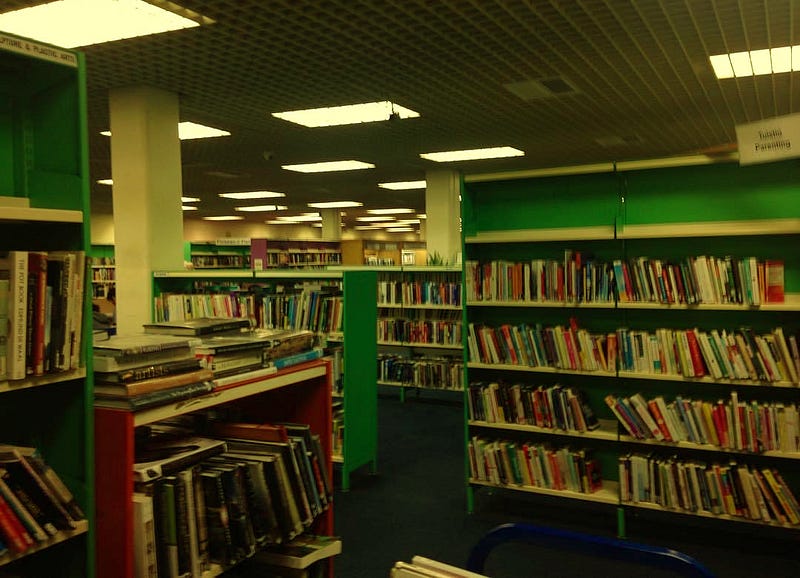
I now live in Westmeath, and call Mullingar Library my local one of choice; a small, yet open space in a huge modern council building. The current pandemic has made trips there less frequent of late — depending on lockdown restrictions — but it was the first place I visited after exiting our first major lockdown last year, the only difference now being the need for masks, hand sanitizers, and social distancing. Though like many libraries, Mullingar Library isn’t exactly bustling with people; the resulting quiet being a godsend for any browser, reader, or serious social distancer.
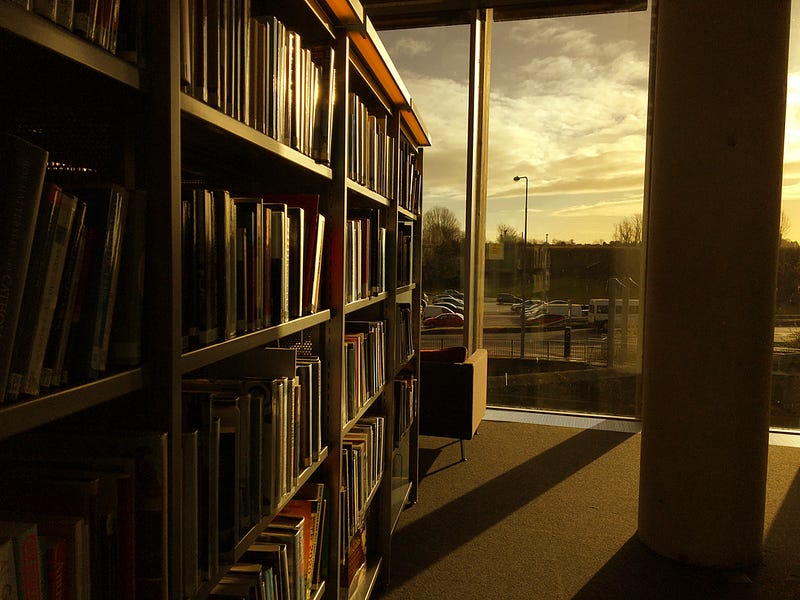
But that said, this quiet also makes me nervous for the future of libraries . . . I mean, will people someday just stop visiting them altogether? As we increasingly download ebooks to our Kindles and iPads, and libraries themselves now offer this (free) option to their patrons, forsaking the need for physical books or visiting physical libraries. And while I think the ability to download content from home is a very good thing, especially during the pandemic, I just hope it never becomes our only option. Or, is the point of a ‘library’ to just offer a reading experience to those who want it, even if the actual building may someday become fully virtual? Most libraries now have those machines that enable quick-and-easy checking in or out of books, rather than the old-fashioned way of having a librarian stamp your books, and yes, that is obviously a godsend for both library staff and patrons (and again, far safer in the current pandemic), but I hope it never gets to a point where the human element disappears entirely, or indeed an actual building/space. For public libraries are also community spots, and offer places for people to not just read, but meet the study, research, have quick access to technology, music, home media, and are even spots for artists to exhibit their work (I myself have had exhibitions in both the beautiful converted church setting of Rush Library, Dublin and the lovely town library in Castlepollard, Westmeath). I can still remember years ago when the children’s author, Terry Deary, made some idiotic remarks about libraries; on how they were ‘no longer relevant’, had ‘had their day’, and that an ‘entitlement’ to read books for free was bad for the bank balance of clearly struggling authors like himself. Well, many folks like myself (including other authors like Neil Gaiman and Julia Donaldson) were naturally appalled, and at a time when many public libraries were (and still are) being shut for good. No, we must never let that completely happen to these temples of knowledge, imagination, and community . . . or it will be a very sad day for society. So please encourage your children (or grandchildren) to always follow that white rabbit or teenage vampire, or talking ninja duck into those lush wonderlands of literature and libraries — to keep them alive for both current and future generations.
Thanks for reading! This article was inspired by/a spin-off to my earlier article My Haunted Imagination.