
“Love, Victor” Continues to Shine in Season Two
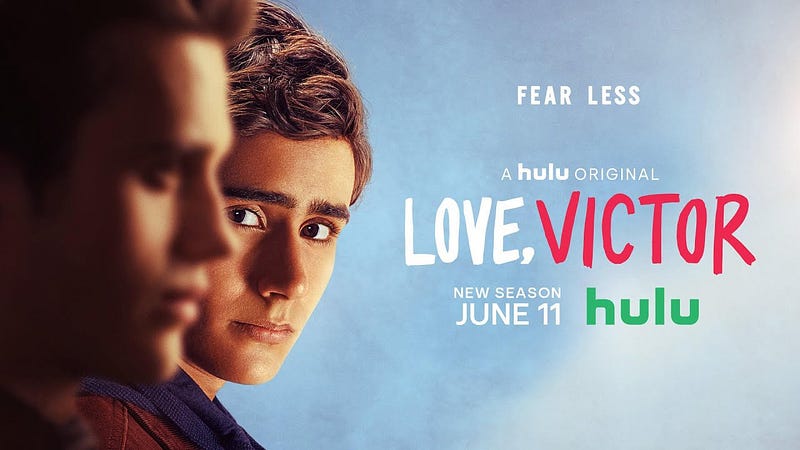
The ten-episode second season of the Hulu hit teen dramedy that spun off from a landmark big screen film is a charming and moving return to Creekwood. Although there are some missteps, the show by and large continues to effectively explore important thematic territory — particularly the journey of a mother struggling to accept her son’s sexuality.
A Brief Recap of the Origin of Love, Victor
In 2015, Becky Albertalli wrote a young adult novel called Simon vs. the Homo Sapiens Agenda. The book (which I am embarrassed to admit I still have not read) was released to great acclaim, being feted with multiple award nominations and wins.
In 2018, out-and-proud director Greg Berlanti (best known for creating iconic, soapy primetime television series like Dawson’s Creek and Brothers and Sisters) and screenwriters Isaac Aptaker and Elizabeth Berger brought the film to the big screen. There was a great deal of buzz around the film given that it was the first time Hollywood film in history centered on a gay teen romance. The film was a modest critical and commercial success, grossing $66 million worldwide (several times its production budget) and receiving a 91% approval rating on Rotten Tomatoes.
In 2019, the film’s screenwriters pitched a spin-off series to Disney called Love, Victor and it was given a straight-to-series order. The show eventually premiered in June 2020 on Hulu, which was somewhat controversial given that it was originally set to air on Disney+ but was deemed “too adult” (which was presumably code for “we are afraid Disney+ viewers will be uncomfortable with homosexual themes.”) Nevertheless, it got a big marketing push on Hulu and was warmly received with a fresh and juicy Rotten Tomatoes score of 92%.
Within weeks of Season One’s release, the show was renewed for a second season. Although many suspected that the premiere of the second season would be delayed due to the pandemic that shut down Hollywood for most of 2020, it premiered right on schedule. All ten episodes debuted on Hulu on June 11 and reviews have been enthusiastic, with the show obtaining a perfect 100% critical approval rating on Rotten Tomatoes.
Click here to read my article about Love, Simon
Click here to read my article about Season One of Love, Victor
Love, Victor: Season Two Review
[Author’s Note: The remainder of this article contains spoilers about the second season of Love, Victor. If you have not seen it and wish to, I recommend you bookmark this article and return to it after you have completed watching it.]
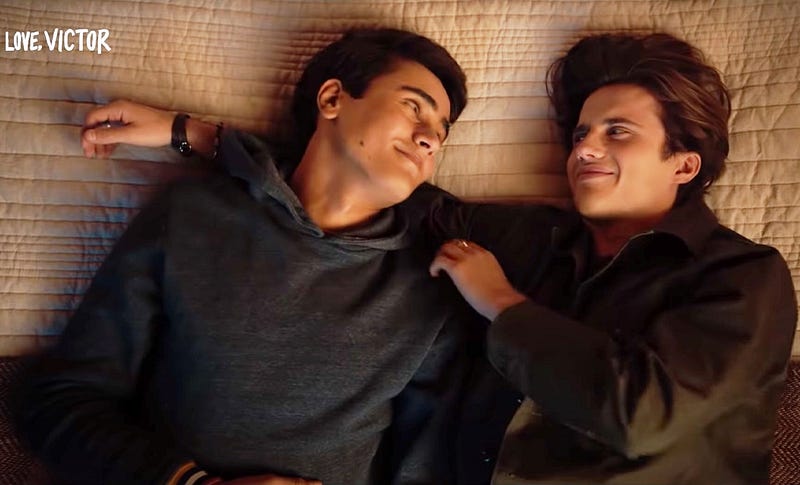
Although the Season Two premiere picks up the moment the first season left off — with Victor telling his family he is gay — the season feels a bit like a soft reboot given how nearly every character has a markedly different storyline than in the prior season. Whereas Victor spent the first season struggling with accepting his sexuality, figuring out how to extract himself from his relationship with his girlfriend Mia (Rachel Hilson), and exploring his sexuality through his lust for his coworker Benji (George Sear), he spends the second season navigating what it means to be out in high school and in a serious romantic relationship.
Perhaps the most powerful element of Victor’s plot line is how he feels stuck between two words. He is “too gay” for his basketball team (more on that later) and his conservative family (more on that later, too) but not gay enough for out-and-proud Benji and the stereotypes of his classmates. Michael Cimino plays the conflict exceedingly well and turns in another string of terrific performances. Midway through the season, Victor cautiously loses his virginity to Benji only for his life to get thrown for a loop by the arrival of Pilar’s new friend Rahim (Anthony Keyvan). Rahim is still closeted at home due to his fear of how his traditional Muslim parents will react, but he has a much more developed gay identity than Victor. Cimino and Kayevan have tremendous chemistry and Rahim is an excellent contrast to the moody and somewhat self-centered Benji. The insertion of a love triangle into Victor’s journey may seem like an unnecessarily soapy addition, but it worked for me. It develops fairly organically, generates drama, and facilitates the exploration of nuanced themes and character dynamics.
The season does have a significant misstep in terms of its portrayal of the homophobia Victor faces on the basketball team. A team member complains that he is uncomfortable with Victor using the locker room with them and the coach addresses it by asking Victor to change and shower separately. Victor defiantly quits the team but is wooed back in an unrealistic, cringe-inducing show of solidarity from the remaining teammates that seems ripped from the very worst episodes of Glee. Although this is a real and important issue that I am glad to see the show address, the writers shy away from the darker and more complicated aspects of the plot line and resolves it far too patly. The majority of queer teens still experience very real physical threats and hatred and the writers seem uncomfortable with exploring that. Thankfully, everything else in Victor’s journey this season mostly rings true.
While Victor is going through this exhilarating but painful journey, his parents are also navigating a great deal of turmoil. Having decided to separate in the previous season finale, we see them go on remarkably contrasting paths. Victor’s father Armando (James Martinez) gets an apartment and tries to bond with his kids. In order to support Victor better, he begins to going PFLAG meetings. There, he finds a role model in Simon’s dad Jack (played by Josh Duhamel, in a wonderfully unexpected tie in from the film) and finds a single mother to romance.
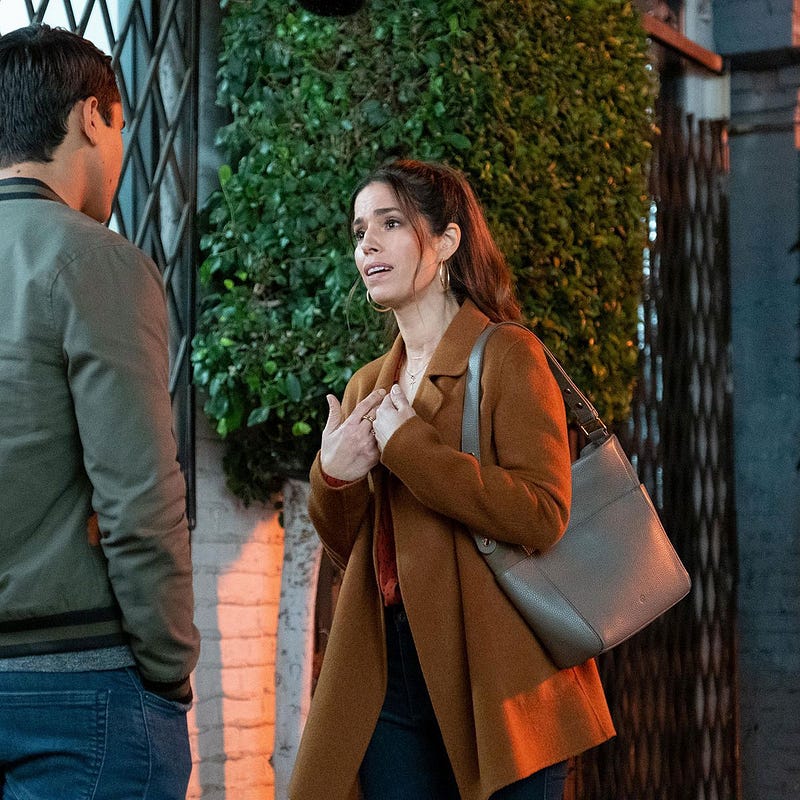
In stark contrast to her husband, Victor’s mother Isabelle struggles enormously with her deeply entrenched homophobia, misguidedly seeking guidance from the church and failing enormously at being there for Victor. As was the case with Season One, Ana Ortiz all but steals the show with her empathic and nuanced performance. The fact that she can be so endearing and compelling even as she behaves so unsympathetically is a testament to her skilled performance. Beyond her raw and authentic performance, the subplot is notable for how well it humanizes the struggle for many people — especially those brainwashed by conservative religion dogma — to accept people who identify as LGBTQIA+. I appreciate that the writers did not have Isabelle change her mind and heart over night, but rather have it unfold over several painful and awkward episodes. It makes her finally coming around all the more powerful. Love, Simon and Love, Victor are perhaps at their very best when addressing the adjustment of parents to their children coming out and both should be required viewing for those with newly out children.

Victor’s ex-girlfriend Mia also goes through some significant turmoil of her own. She is still coming to terms with her breakup with Victor and the fact that her father Harold (Mekhi Phifer) is getting remarried and having another child. Refreshingly, the show avoids making the stepmother the villain (although it threatened to at first) and rather focuses on Mia’s complicated relationship with her father. Their dynamic is played very well by Hilson and Phifer and is exceedingly more sophisticated than you usually see in a teen romance. In particular, it explores the rarely depicted phenomena of how members of minority communities who achieve great success and respect often feel oppressed by the pressure and expectations that come along with it. Throughout the season, Mia also finally gives into the affections of devoted jock Andrew (Mason Gooding). They don’t make a particularly interesting couple, but the actors have strong chemistry.

Perhaps the most surprising and dramatic subplot of the entire season involves Felix. At the beginning of the season, his as-yet-unseen mentally ill mother (now played superbly by Breaking Bad’s Betsy Brandt) is in the midst of a severe depressive episode and has stopped going to work. As a result, they are behind on rent and risk getting evicted. He shares his situation with two people in his life who have markedly different reactions. His girlfriend Lake (Bebe Wood) goes into “fix-it” mode, helping him make money for rent and using her family connections to find top-of-the-line help for his mother. Meanwhile, Victor’s sister Pilar (Isabelle Ferreira) — who harbors an enormous crush on him — simply tries to be there for him emotionally. As things become strained with Lake, he becomes closer with Pilar and a(nother) compelling love triangle is born. Although the plot line veers dangerously close to vilifying mental health and social services professionals in a manner that is counterproductive, it is emotionally powerful throughout and rallies for a strong ending.
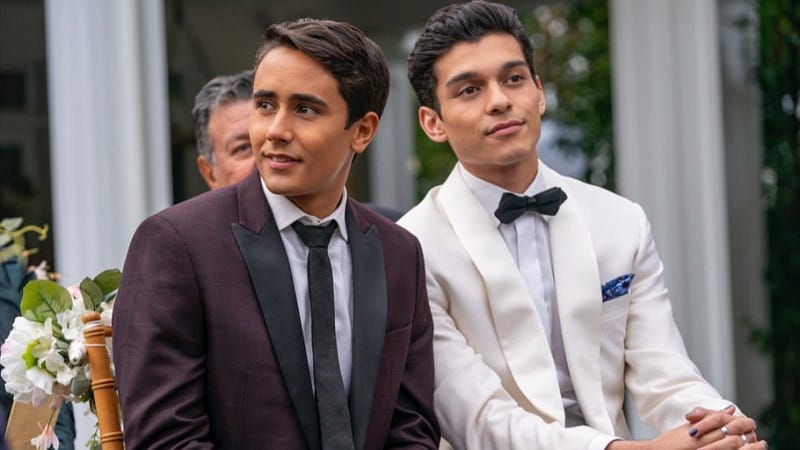
Just as in the first season, everything leads to a supremely melodramatic and romantic season finale in which all of the plot lines come to a head. The centerpiece is Mia’s dad’s wedding and there are countless heart-stopping and heartbreaking moments in the well-executed half hour. Mia confronts her dad about taking a job across the country after explicitly telling her he wouldn’t and she sets off with Andrew to find her estranged mother who recently re-initiated contact. At the urging of his recovering mother, Felix forgives Lake but realizes it is Pilar that he truly wants to be with. Isabelle finally embraces Victor for who he is and the love and growth she displays wins Armando back, with the implication that they will get back together. And, in the season finale’s only unsuccessful element, Lake appears to start a romance with Andrew’s ex-girlfriend Lucy. It’s not the fact that Lake might be bisexual that’s the problem as that would be fairly fitting with the character; it’s the fact that it feels so rushed and out of left field.
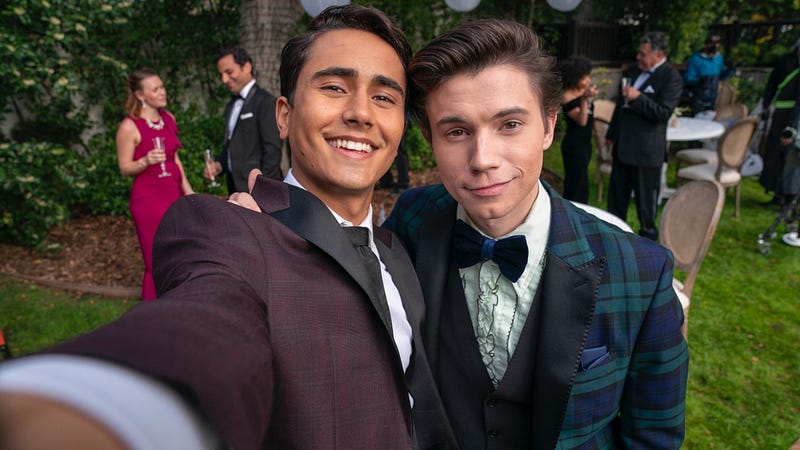
The main attraction of the finale, however, is the Victor-Benji-Rahim love triangle. Benji, angry with Victor’s reaction to the revelation that he is in AA (also a bit out of left field), declines to go to the wedding with Victor. Not wanting to go alone, Victor takes Rahim. However, when Isabelle goes to Benji and apologizes and tells her how much Victor loves him, Benji decides to show up at the wedding only to see Victor and Rahim romantically slow dancing. The episode ends on a cliffhanger as we are left wondering whose house Victor is going to. My money is on Rahim, not only because that seems to be where the season was heading, but also out of sheer hope given what a more engaging and entertaining character Rahim is than Benji.

Ultimately, the second season of Love, Victor is ever-so-slightly weaker than the first, primarily due to missed opportunities like the basketball plot line and the aforementioned out of left field developments that feel rushed and soapy in a way that this show should be above. But second seasons are notoriously tricky for shows to pull off as the creative teams are tasked with the competing demands of continuing the storylines and themes of the first season while also veering off in fresh directions that will keep viewers engaged and set the show up to go on for multiple seasons. And considering how many show’s second seasons go spectacularly off course, Love, Victor’s is a real winner. It remains a remarkably affecting, well-acted, romantic, and charming exploration of issues related to sexual orientation, gender, socioeconomic status, culture, and religion. The cast is uniformly superb and the production values are excellent. It avoids going too dark or mature for its target audience while remaining largely truthful and authentic. It injects humor without becoming a cynical satire littered with meta-humor and heightened reality.
I will most certainly be eagerly awaiting the inevitable third season of Love, Victor. In the meantime, I will certainly continue to reflect on how — despite its imperfections — it fills an enormous gap in the television landscape and how much it would have meant to me had it existed when I was a closeted teenager.
Follow the author of this article on Medium and Twitter and check out other articles about LGBT media: