
“Love, Victor”: A Precious Pride Month Gift
One month ago today, a streaming series spinoff of the groundbreaking big-screen teenage romantic comedy premiered on Hulu. And it was a lovely escape from one of the darkest Pride months in history.
2020 was supposed to be a landmark year for Pride. New York City was set to host a 50th anniversary celebration of the first Pride Parade in June and huge events were set up all over the world. But with the havoc wrought by COVID-19 this year and the stunning and long overdue racial reckoning that erupted in the U.S. in June, Pride events were moved online or canceled altogether. Typically, I participate in some sort of outside festivities and use the month to make a renewed effort to catch up on LGBTQ books, music, movies, and television series I have missed. This year, however, Pride — both the celebration and the emotion — were far from the forefront of my mind.
That’s what made the arrival of Love, Victor so special for me.
The high school-set series is a spinoff of the groundbreaking 2018 romantic comedy Love, Simon, which marked the first time a major Hollywood studio released a teenage romantic comedy with a gay lead. The release of that film impacted me immensely and my reflections on what it would have meant to me had it been released when I was a teenager resulted in my most resonant and well-received article to date.
Click here to read my article on Love, Simon
But like any sequel, spinoff, revival, or reboot of a property I adored, I approached Love, Victor with a healthy level of skepticism and cautious optimism. I was delighted to discover that it created something wholly new, expanded the universe and themes of the film in beautiful ways, and inched us closer to more inclusive representations of intersectional identities on the small screen.
Below, I briefly review how the show came to be, provide my review of the first season, and then share some concluding personal reflections.
The Road to Love, Victor
In 2015, Becky Albertalli wrote a young adult novel called Simon vs. the Homo Sapiens Agenda. The book (which I am embarrassed to admit I have not read) was released to great acclaim, being feted with multiple award nominations and wins.
In 2018, out-and-proud director Greg Berlanti (best known for creating iconic, soapy primetime television series like Dawson’s Creek and Brothers and Sisters) and screenwriters Isaac Aptaker and Elizabeth Berger brought the film to the big screen. There was a great deal of buzz around the film given that it was the first time Hollywood film in history centered on a gay teen romance. The film was a modest critical and commercial success, grossing $66 million worldwide (several times its estimated $10–17 production budget) and receiving a 91% approval rating on Rotten Tomatoes.
The film resonated deeply with members of the LGBTQ community that finally felt seen on the big screen. Although it faced fair criticism for focusing on a white, affluent, cisgendered male living in a progressive town and featuring a fairy tale ending, it was an undeniable milestone for LGBTQ inclusion on the big screen and it contained some deeply powerful moments. (I recently rewatched it and the scene where Jennifer Garner Emily talks to Nick Robinson’s Simon about his sexuality for the first time still sucker punches me.)
In 2019, the film’s screenwriters pitched a spin-off series to Disney called Love, Victor and it was given a straight-to-series order. The show eventually premiered in June 2020 on Hulu, which was somewhat controversial given that it was originally set to air on Disney Plus but was deemed “too adult” (which was presumably code for “we are afraid Disney Plus viewers will be uncomfortable with homosexual themes.”) Nevertheless, it got a big marketing push on Hulu and was warmly received with a fresh and juicy Rotten Tomatoes score of 92%.
Love, Victor: Season One Review
[Author’s Note: The remainder of this article contains spoilers about Love, Victor. If you have not seen it and wish to, I recommend you bookmark this article and return to it after you have completed watching it.]
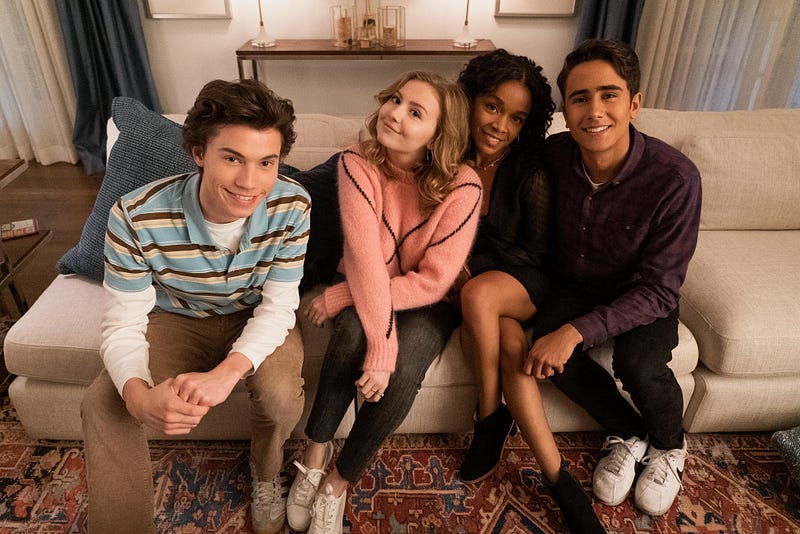
Love, Victor is set at the same high school (Creekwood High in the suburbs of Atlanta, Georgia) as the parent film, but takes place a few years later. It focuses on a largely new set of characters, albeit with several clever tie-ins to the film. The main focus is on the Latinx Salazar family, which just relocated to Creekwood from Texas for reasons that are not entirely clear — even to the children. The family is comprised of Armando (James Martinez), a loving but frustrated father dripping with machismo; his long-suffering wife Isabel (Ana Ortiz); their precocious young son Adrian (Mateo Fernandez); their moody teenage daughter Pilar (Isabelle Ferreira), who has taken the move particularly poorly; and their son Victor (Michael Cimino), a big-hearted, sexually confused perfectionist. As the title suggests, the show primarily focuses on Victor.
In the pilot episode, Victor contemplates creating a new life for himself by coming out as gay on his first day of school. But several factors get in the way, including his own fears and insecurities, aggressively friendly new neighbor Felix (Anthony Turpel), flirty popular girls Mia (Rachel Hilson) and Lake (Bebe Wood), bully Andrew (Mason Gooding), and his troublemaking sister Pilar. The Vice Principal of the school (Natasha Rothwell, reprising her hilarious role as the theater teacher from the film but sadly for only one episode) tells Victor about her favorite Creekwood memory — the moment Simon embraced his true identity as a gay man and met his pen-pal Bram on a ferris wheel during the school carnival. Victor takes to social media and tracks down Simon, who becomes his pen-pal and mentor through this dramatic process.
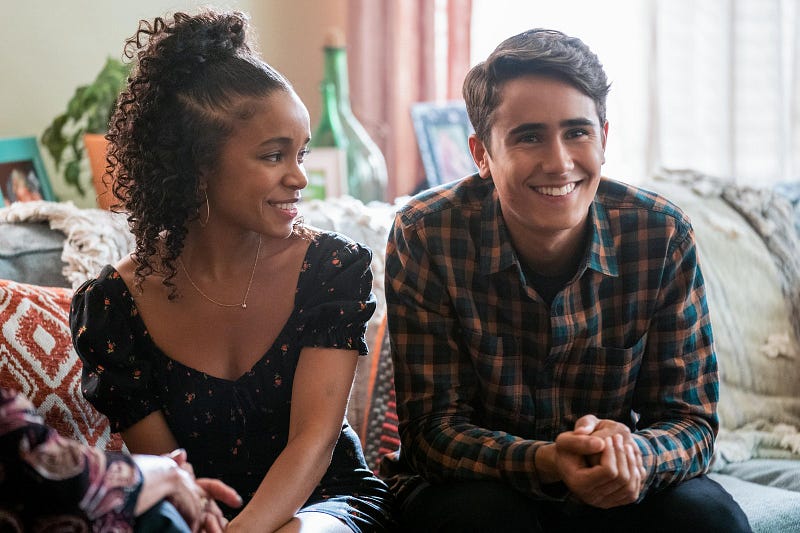
As Victor, Michael Cimino is a revelation. He is impossibly handsome, charming, and intelligent, and he manages to sell every aspect of his complex character. The journey that he goes on through the season’s ten episodes is a remarkably nuanced one that delves deep into many of the issues that Love, Simon dealt with (internalized homophobia, heterosexism, unrequited love, fears of parental rejection, bullying) and many that it didn’t (primarily the intersectionality that comes from Victor’s deeply Catholic and traditional family). But what makes Love, Victor so remarkably effective is how well it fleshes out the characters that comprise its large ensemble.
The highlight of the supporting cast is undoubtedly Rachel Hilson as Mia Brooks. She is a beautiful black teenager who seems to have it all — a rich father who spoils her, the school hottie lusting after her, good grades, a sterling reputation, and a fashionable best friend. But inside, she reels over her father’s chronic absence, abandonment by her mother, and other demons. Hilson nails every moment and looks poised for a long healthy career.
As Victor and Mia’s respective best friends Felix and Lake, Anthony Turpel and Bebe Wood start out as a bit one-note and grating but quickly become lovable, three dimensional characters with wholly satisfying arcs of their own. As hot jock Andrew and Victor’s out-and-proud coworker Benji, Mason Gooding and George Sear are strong, but never truly get the textured material that the others do.
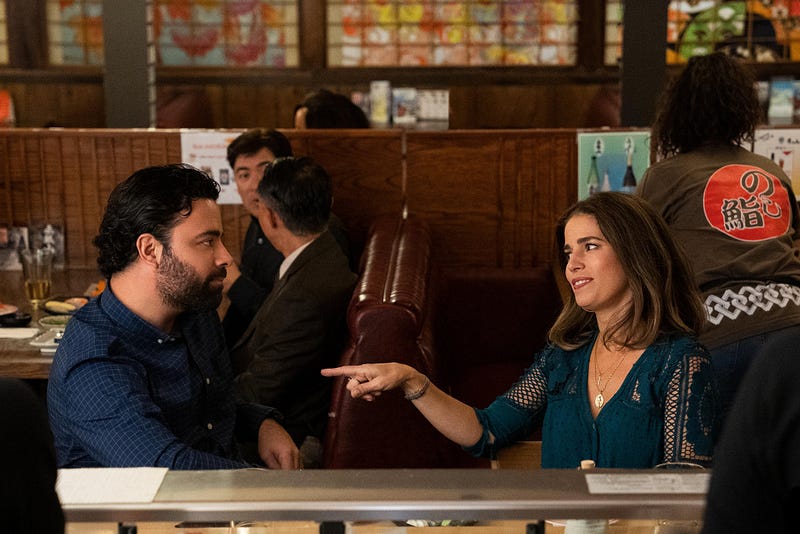
Although, the intra- and interpersonal drama of Victor and his friends is a major driving force of the season’s comedy and drama, Victor’s home life is not an afterthought as it is in so many teen comedies (and, ultimately, the parent film). She may at first appear to be a cliched moody teen, but even Pilar deepens and matures by leaps and bounds throughout the season. And the slowly unfolding interpersonal trauma shared by Victor’s parents is handled exquisitely and realistically. James Martinez and especially Ana Ortiz (who first rose to acclaim with her role on Ugly Betty) are utterly terrific.
It should be noted that Love, Victor is not some revolutionary, prestige television series. It is largely a teen romance that is squarely aimed at that age group. In terms of artistry and nuance, it exists somewhere on the continuum between Saved By the Bell and My So-Called Life. (Sorry, I’m now 36 and my only reliable television references are from the 1990s). In fact, it is straight-laced and conventional enough that it could have made a natural home at Disney Plus as originally intended. (Ultimately, I am glad it was not on Disney Plus, though, because on Hulu I was able to enjoy it without concerns about censorship and with minimal objections from the anti-gay contingent.) But, unlike most other teen shows it fully commit to its premise and its message. It almost never devolves into slapstick, preachiness, or soap opera antics, but instead opts for heartbreaking emotional realism and the occasional big laugh that is genuinely well-earned.
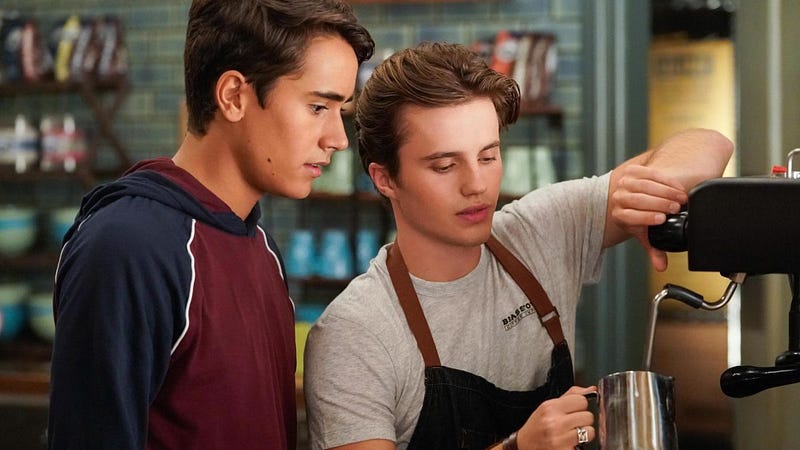
One of the most notable aspects of the first season is how consistent it is. With the exception of an inevitable but uneven and contrived episode that takes place in New York City with Simon and Bram, the season is a string of consistent winners. It is remarkably well paced, with revelations and emotional climaxes spaced apart expertly.
And then there’s that final shot that says it all.
In the final scene of the season finale, Victor backs down from telling his family that he’s gay, but then musters up the courage and does it. And the show ends without us seeing or hearing anyone’s reaction but rather lingers on his face, with the mixture of terror and pride that comes with owning your identity. It may feel like a cheap cliffhanger to some, but in my mind it underscores the major message of the series. Even though Victor spends virtually all of his time preoccupied with what others will think, say, and do, ultimately all that matters is whether he is true to himself. Whether he finds someone who loves him back is important, too, but ultimately secondary. (I have written about this notion before, particularly when I reflected on my own experience coming out in this article.)
Concluding Thoughts
I received Love, Victor as a Pride month gift from Hollywood (and Hulu in particular). It certainly provided me a welcome escape from the deluge of devastating news, but it also did much more. It expanded on the important but flawed Love, Simon in ways that made it more inclusive, nuanced, and meaningful. It allowed me to reflect on both what my journey to authentically living as an out gay men was and what it could have been in another place and time.
I have no idea what the future will hold for this unlikely franchise. I would love to see an additional season or two of Love, Victor, that continues the journey of these endearing characters. I would also love for it to spawn off a universe in which we get to follow the coming out journeys of characters of different gender, sexual, racial, and ethnic identities. Love, Simon and Love, Victor were a tremendous start, but there are so many more diverse queer love stories to tell.


