
Love Thy Neighbor, But Don’t Judge Them!
An India-Pakistan Tamil Brahmin wedding story from 1939
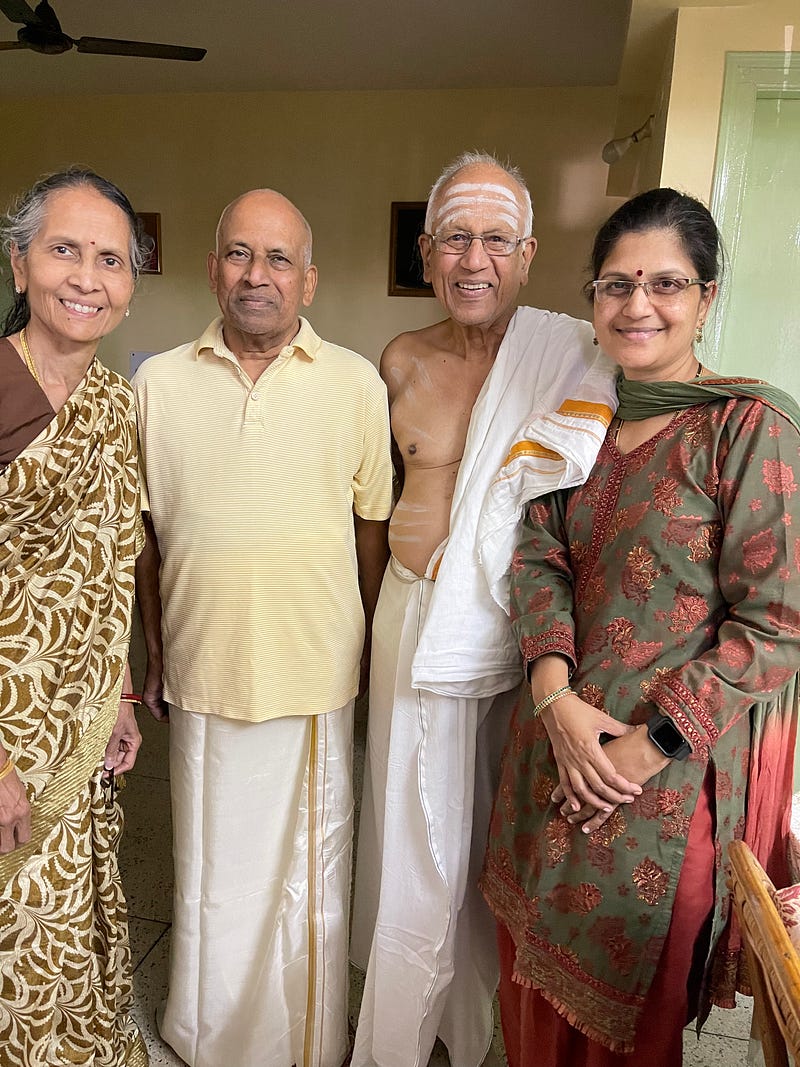
My uncle, aged 72, is here in my city Jamshedpur, India, for some dental work at the expert hands of my husband and myself. His dental treatment’s doing very well, well enough for him to spill some stories about his mom and dad, my paternal grandparents.
Funnily enough, I have never heard these stories from my dad, who’s eight years older than my uncle, his brother. Looks like the sit-at-mom’s-knee stories were reserved for the youngest son.
Whichever roundabout way I might have gotten to this story, here it is for all of you.
The best punishment to someone who’s hurt you is to do them such kindness that it shames them- Tirukurral
The Penicillin Story
In 1939, my grandmother and grandfather, aged 16 and 31, were both in Karachi.
Karachi is over two thousand miles away from Thanjavur, Tamilnadu, where my father’s family is originally from.
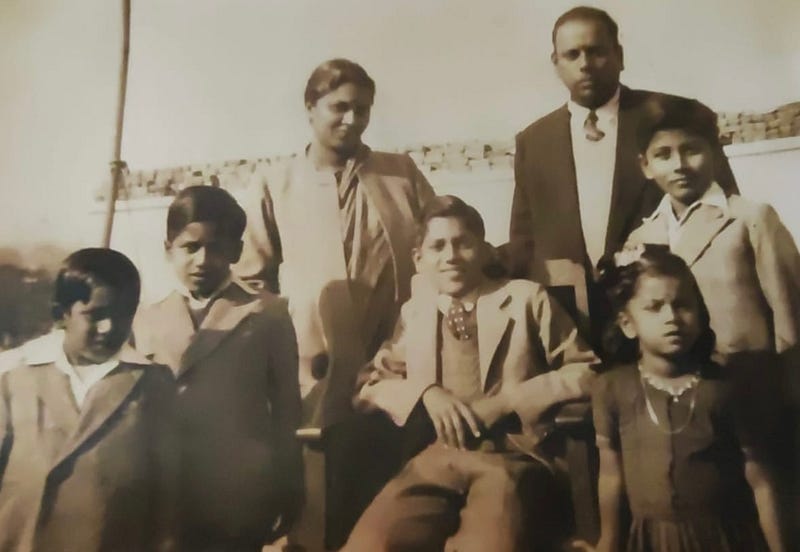
Karachi’s so far away from Thanjavur, it is now in Pakistan! It is no longer in India.
It is always a bit weird for my generation, which not only grew up in post-partition India, but after the 1965 and 1971 wars with Pakistan, to hear the stories of a city we can no longer visit. Pakistan and India have a complicated history and we Indians can’t just go over there on a tourist visa.
Anyway, back to 1939.
My grandfather was a resident of Karachi for some years, as he worked as a manager for the Carlton Hotel.
My grandmother’s father was new to Karachi. He had just been transferred there by the Indian Army, for who he worked as a quartermaster.
As soon as my grandmother reached Karachi, the local community decided that this boy and this girl should get married to each other.
Hindu Brahmin Aiyars in (Muslim) Karachi? Let’s get them hitched!
The reason was that they were of the same religion(Hindus); also, they were Aiyars; that is to say South Indian Tamil Brahmins. Within the Aiyars, there are sub-castes. They both belonged to the Ashtasahasram sub-caste.
Karachi was (and is probably still) a predominantly Muslim area, and to find two people of the opposite gender, who were not only unmarried but of marriageable age, that is Hindus who not only spoke the same language but were also the same caste, was quite a rarity.
It was too much for the matchmakers of Karachi. At every Tamil social event — weddings and Tamil festivals like Karthighai and Pongal, my grandmother and grandfather were thrown at each other’s heads in hopes that they would start liking each other and want to marry each other.
The lady with the lamps
My father described a Karthighai event his mom used to talk about. She carried down a tray of lit oil lamps (for the festival) when my grandfather first laid eyes on her.
I can imagine her, dressed in Kanjeevaram silk, face aglow from the lamps she carried and from the hectic activities of an Indian festival, descending the stairs. I could imagine my grandfather, at the base of the stairs, surreptitiously turning to see the woman who would later become his wife, while pretending to pay attention to whatever his hosts were saying!
Waiting for Big Brother to get married
My grandmother and grandfather did start going out with each other. But they didn’t get married even though everyone wanted them to. Mainly because my grandfather had an older brother who wasn’t married and who took his own sweet time — 2 years — to choose a girl and get married.
The neighbour who coined the term Royal Romance
In those two years, my grandmother and grandfather went out. This was so frowned upon by my grandfather’s neighbour that he referred to their harmless dating as a Royal Romance.
My grandfather did not like the expression, “Royal Romance” when used to describe his behaviour toward my later-to-become grandmother.
Married, just before the Second World War
Well, my grandparents did get married, in 1941.
The sick child, the son of the neighbour who labelled my grandpa’s dates as a “Royal Romance.”
In 1942, World War 2 was raging. Meanwhile, the same neighbour was hunting high and low for two things:
1. Penicillin
2. Blocks of ice
The neighbour’s s son was very sick! But neither penicillin nor blocks of ice were easy to find in Karachi. Ice was hard to find because refrigeration wasn’t common. Penicillin was hard to find because of wartime scarcities.
It was a sad situation. The child’s life hung in the balance.
At this time, since my grandfather worked for the Carlton Hotel, he had access to both penicillin and ice.
Air force pilots would frequently stay at the hotel. For my grandfather, procuring penicillin was easy. To him, it was just a matter of asking one of the pilots to bring a package of twenty tablets of penicillin. He could also easily provide two blocks of ice from the hotel’s stores.
A handover of the precious penicillin and the ice — and a bridge burned.
As soon as the penicillin arrived, my grandfather went to the neighbour’s house with the twenty penicillin tablets in his pocket (brought to Karachi by a Royal Air Force pilot, who was a Carlton Hotel guest) and the two blocks of ice. He gave them to the neighbour.
My grandfather said:
Here’s the penicillin you’ve been hunting for! Also, here’s the ice! In return, you must never come to my house. Not even to thank me.
My grandfather did not want to pretend to like this person anymore. He disliked his neighbour intensely — because he had poked his nose in my grandfather’s business and had made him and his wife an object of gossip.
A takeaway? Don’t judge thy neighbour!
So many years later, my takeaway is not about the Royal romance, penicillin, or even the ice. My takeaway is that we should avoid poking our noses in other peoples’ business. I mean, just because we have antibiotics and ice handy for when we fall sick, that’s no reason to be judgmental— over anything at all!