
Love Is a Dance of Neurotransmitters: Neuropsychology of Love
Love according to psychology and science
Nature has imposed its own set of rules to love. We can glimpse at love from different angles and describe it with different words to make sense of it.
Love will always be more than the sum of its parts. There are innumerable ways to love. Here, though, you will read about romantic love from a more scientifical point of view.

Love in Psychology
According to Sternberg’s Triangular Theory of Love, love is made up of three components: intimacy, passion, and commitment are required to reach consummate love. Consummate love is the epitome of love — ideal love.
Different combinations of these components yield different types of love. For example, if there is commitment but not the other two, we have an empty love. Akin to an arranged marriage, this type of love lacks intimacy and passion.
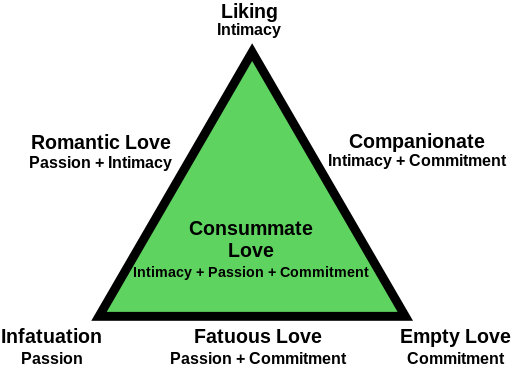
Intimacy is not sexual though. It is knowing and liking each other through connectedness and bonding.
Passion is the most overt part of love. It is what we as young define as love; what we want to feel. As we learn the hard way though, passion doesn’t equal love— at least not consummate love.
Passion can be part of a greater love or the sole component. If we look at the triangle, passion itself can produce a specific type of love: infatuation. We may not feel intimacy or commitment, but we feel a specific type of love.
Infatuation can be the so-called love at first sight.
Fire of Passion
Relying on passion is like playing with fire. Passion can come like wildfire, combust everything, and leave nothing but ashes. Fire is at the mercy of meteorological conditions. Luckily, with the other components (intimacy and commitment), we can direct or contain it.
Bear in mind that when passion dies, consummate love can fall back into companionship.
As each component can fall into neglect, and according to Sternberg, it is easier to attain consummate love than to maintain it. Love is never static; it must be constantly set into motion.
Luckily though, components may overlap and help feed and maintain consummate love.
Love as Neurotransmitters
Those who believe in materialism — in the philosophical sense — assert that everything exists in the form of matter. Following this line of thought, love is nothing but neurotransmitters lighting up regions in our brains.
Crudely said, love is nothing but a part of mother nature’s long game to preserve our species. Ultimately, what we feel is a result of dopamine, oxytocin, serotonin, adrenaline, and nerve growth factor.
To further support this argument, there are neurotransmitters that perform the action of intimacy, commitment, and passion — components of Sternberg’s triangle.
Serotonin
Because antidepressants increase serotonin, it is often labeled as the happy molecule. Yet, in the initial stages of love — more specifically lovesickness — we torture ourselves by overthinking minute details.
Serotonin is responsible here, but it is reduced though. This leads to an obsessive-compulsive-like state.
At the start of a relationship, when we are insecure about whether things will work out or not, we worry and sweat over small details because of reduced serotonin. As the relationship solidifies, this may stop being a problem as serotonin rises.
Dopamine and Nerve Growth Factor
Long intervals without our special ones are like a substance withdrawal. Once our special someone is present, dopamine rewards that behavior. Thus, reinforcing wanting to be with that person.
Romantic feelings may be contributed to another neurotransmitter. According to The Neurobiology of Love an article published in a scientific journal
“the concentration of nerve growth factor appears to correlate significantly with the intensity of romantic feelings.”
Oxytocin
Commitment can be argued that it is more sociological than biological. But there is a hormone for that. Oxytocin may increase the chances of committing to someone.
Oxytocin is released in many ways, but two mechanisms contribute to bonding with our partners. The first is after an orgasm. The second is by simply spending time with them.
More oxytocin creates a positive loop. After producing more, we want to be more and more with our partners, thus producing more of this hormone.
This hormone also plays a role in commitment; in marmosets treated with oxytocin, it was found that they spent significantly more time away from strangers.
In humans too, another study concluded that it influences men to keep a monogamous relationship. Increased oxytocin may result in males keeping a greater distance from female strangers.
Conclusion
I just covered romantic love in biological terms. There are innumerable ways to love and innumerable things to love. We may love our family, friends, ideas, fate, or things beyond this Earth.