
Love and War in Ancient Egypt
Aida at the Lyric Opera of Chicago
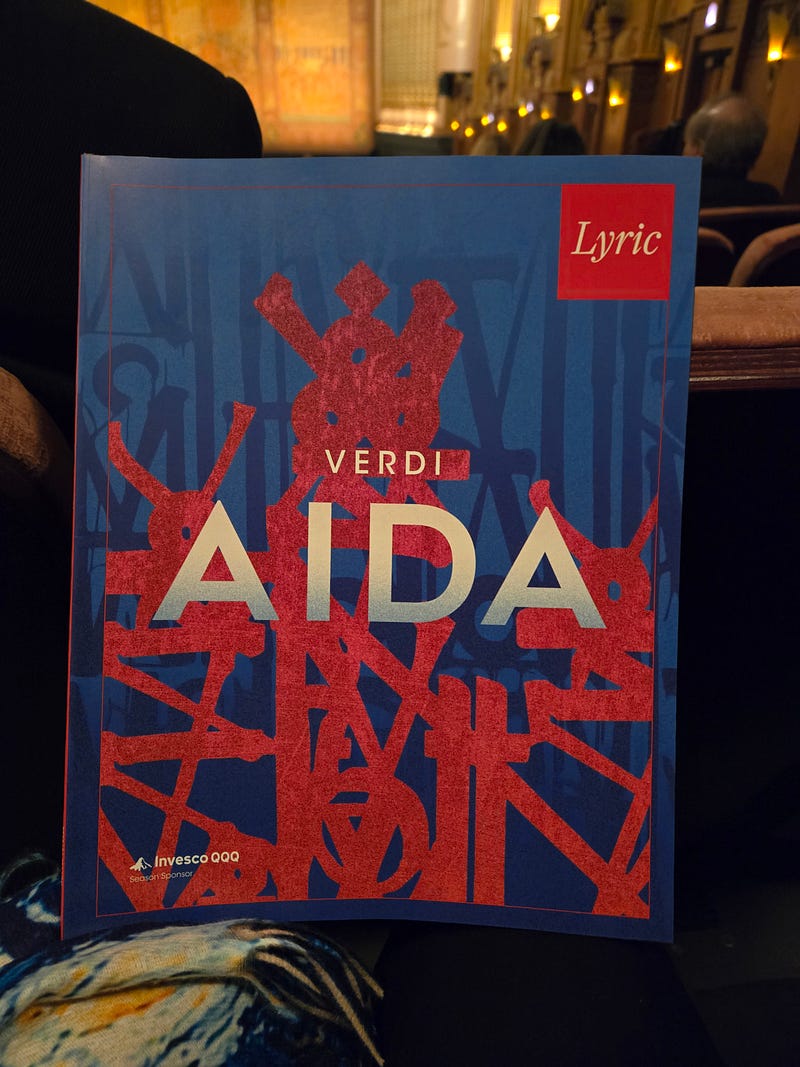
The first time I saw the opera AIDA (music by Giuseppe Verdi) was in the early 1980s at the famous BATHS OF CARACALLA outside of Rome.
I could not imagine a more spectacular setting, but I also couldn’t have imagined that entire families would show up with children and grandparents, that they’d be eating snacks and joyfully singing along to the famous Triumphal March, or that an elephant would march onto and across the onstage.
I might be misremembering the elephant, but was anyone else at that performance? Were there horses instead? It was all fantastic with acrobatic dancers, fabulous costumes, and brilliant singing. I recall a warm night, a slowly darkening sky, and the musical chattering of Italian all through the overture.
I’ve attended several performances of Aida since then, the latest a few days ago at the Lyric Opera of Chicago. Aida is a tragic opera (which means you should expect death in the end) commissioned by a new opera house in 1870s Cairo, Egypt. Verdi declined the original commission (by Isma’il Pasha, viceroy of Egypt under the Ottoman Empire) to write an opera in honor of the opening of the Suez Canal, but after receiving a story idea from a French Egyptologist names Auguste Mariette, he proceeded to compose Aida.
The story is about a kidnapped Ethiopian princess who falls in love with the Egyptian general chosen to lead a war against her country. Both Aida and General Radames have to choose between loyalty and love. That must not have seemed like enough of a conflict, so add in the daughter of the Egyptian king, whose love for Radames is unrequited. It’s a big, pageantry-filled opera, but ultimately it’s the old story about who gets the man and who doesn’t.
The opera takes place long ago at a time when Egypt and Ethiopia were not fighting, but it could be argued that the overall theme of the opera is the horror of war; the choices people must make during a war, the terrible losses, the continued need for vengeance. I’ve been writing a lot about a war taking place currently, so it’s on my mind a lot these days. The subplot is the intricacies of love and how its betrayal can lead to jealousy and hatred.
Michelle Bradley is a wonderful Aida — I loved that she even walked with mincing steps, like a servant. We also had the pleasure of hearing her sing Tosca a few years before. Jamie Barton was fabulous as Amneris, imperious and demanding. Russell Thomas, who had played a number of roles at the Lyric, was also phenomenal (just listen to his Celeste Aida — it’s even better with full orchestra).
And I want to briefly mention Reginald Smith Jr, who sang Amonasro, the now-imprisoned King of Ethiopia and Aida’s father. He sang the role of the older, dementia-addled version of welterweight boxer Emile Griffith in the Lyric’s premiere production of CHAMPION earlier in the season. I’ll never forget the song in which he cradles his shoe, wondering about its purpose.
The costumes and setting were less magnificent than previous versions of Aida but adequate, and neither of us understood the pattern of curtains, floor, and program — circles and crosses — maybe it was reminiscent of war’s chaos.
I had some issues with the dancing — loved the female lead with her voluminous sleeves and long flowing hair. She captured the stage from the eight technically proficient male dancers who didn’t seem to be in the same opera as everyone else. I’m not well-versed enough in the art of dance to understand what about the choreography left me cold — was it the costumes? The stylized movement of hands and feet? The constant running hither and yon?
I liked when the dancers moved large swaths of cloth in a crisscross pattern to resemble a jail, and when they carried in the female dancer. I enjoyed watching their rippling muscles and the physical strength of their jumps and pirouettes, but otherwise, it felt like they were holding our attention during musical interludes. It was soooo unlike my first performance of Aida outside of Rome when audience members signaled purveyors of food to bring soothing ices and carbonated drinks directly to the seats.
Seriously, did I misremember that part of the evening over forty years ago? Were people selling snacks in the aisles? Was everyone singing along? Also, is it possible that there were two elephants?