

Losing Weight on the Same Number of Calories as Before
This is pretty cool!
Let’s assume: John eats 2000 calories a day according to the Standard American Diet (SAD), and maintains his weight — day to day he experiences no gain and no loss of weight. For the sake of the example, let’s also say that John does no exercise beyond his normal daily life.
If John changes his diet and eats 2000 calorie a day on a ketogenic diet, and he keeps to the same daily life as before, will John lose weight?
The answer is yes — maybe you guessed this based on the title of this article.
If you understand why the answer is yes, go read another article, your work is done here. If you think it’s impossible because of, well, physics — keep reading.
Defenders of the “energy balance” theory of weight management like to refer to the First Law of Thermodynamics to support their view. The thing is, the First Law of Thermodynamics is not violated by the scenario above. Physical laws are laws that can’t be broken.
The assumption that the Energy Balancers make in the scenario above is that when John is maintaining his weight (on the SAD) he is expending 2000 calories per day — so he is in “energy balance.” 2000 going in, 2000 going out. A perfect balance means no gain or loss. For the Energy Balancer, it’s all about the calories. And in this part of the scenario, the assumption is probably true.

But then they generalize: if the number of calories going in stays the same, the resulting “calories out” will stay the same and therefore, John’s weight will stay the same regardless of the composition of his 2000 calories. So, if the conditions described in the second half of the scenario are true, a decrease in weight could only occur if the First Law of Thermodynamics was broken. Since that can’t happen, John cannot lose weight in the scenario described above. QED! thinks the Energy Balancer.
But John can lose weight in the second part of the scenario above. The fact that he can doesn’t mean the First Law of Thermodynamics is wrong — it means the Energy Balance Theory of weight management is wrong.
Here’s how John will lose weight and not violate the laws of physics.
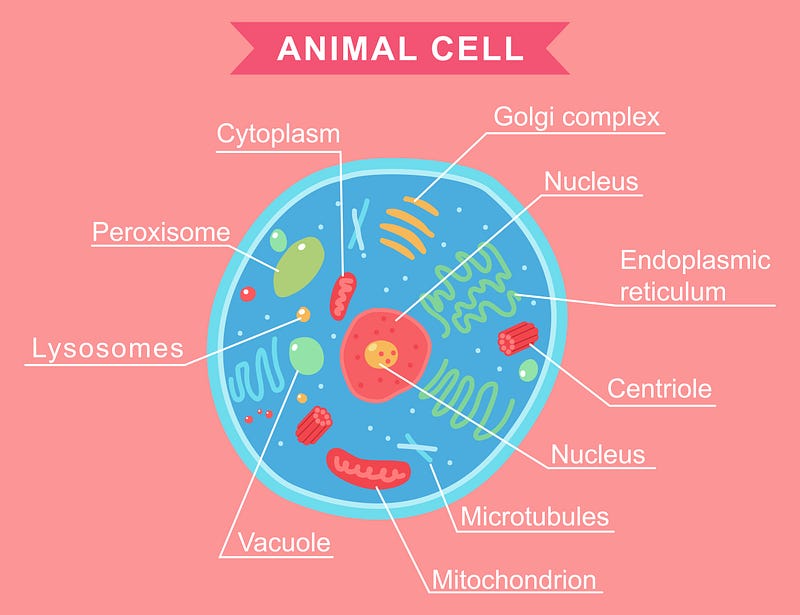
Weight loss happens at the level of the mitochondrion — a little energy transformer inside our cells. This is where nutrient energy (in the form of glucose or fat) gets converted into the chemical energy our cells need to do their work keeping us alive. This energy transformation is called metabolism, and the chemical energy used to keep us alive is called ATP (Adenosine triphosphate). While it’s impossible to estimate the exact number of mitochondria in the body, we have about 40 trillion cells in our body and, on average, each cell that isn’t a blood cell, has between 1000 and 5000 mitochondria — some have up to 10,000.
There are two general ways to describe the metabolism that occurs inside mitochondria: Coupled and Uncoupled.
Coupled metabolism describes the process when mitochondria are using the least amount of nutrient energy necessary to make enough ATP to get their work done. Coupled metabolism is very efficient.
Uncoupled metabolism, as you can imagine, describes the process when mitochondria are using more nutrient energy than they need to make the ATP necessary to get their work done. Uncoupled metabolism is very inefficient. The mitochondria are, essentially, wasting nutrient energy.
On the SAD, mitochondria will be engaged in coupled metabolism in both muscle and adipose (fat) tissue. It is within this uniformly coupled metabolism that John maintains his current weight with 2000 calories. Calories in = calories out.
After a few days of 2000 calories on the ketogenic diet, John’s resting insulin level drops for most of the day (due to the low carb load in his diet), causing him to metabolize fat into ketone bodies (I won’t get into why this happens, but it is a necessary result of low insulin levels).
Now the mitochondria have a third form of nutrient energy to use: Ketone bodies.
When muscle cells metabolize ketones, they basically continue coupled metabolism. There are some indications that they are a bit healthier than when they are using either glucose or fat as nutrient energy, but overall, they still only use the nutrient energy necessary to make enough ATP to get their work done.
For fat cells, however, it’s a different story — and his is where things get interesting! Metabolism in fat cells becomes uncoupled when ketones are the nutrient energy source. That is, metabolism in fat cells becomes inefficient; mitochondria in fat cells use more nutrient energy than necessary to make enough ATP to get their work done — inefficient to the tune of using twice the nutrient energy to create the same amount of ATP they made when coupled.
So eating 2000 calories on a very-low-carb/high-fat diet results in expending more energy to get through the day than when eating 2000 calories based on the Standard American Diet (with its relatively high carb load and low amount of fat, which prevents ketones from being produced and used as nutrient energy by mitochondria).
John’s fat cells, under the influence of a ketogenic diet, will be so inefficient that he will lose weight while eating the same number of calories he did on the SAD. The Laws of Physics are preserved, and John will lose weight while NOT eating at a deficit, nor exercising to create a deficit. With enough data for an individual, one could construct a diet where weight loss would occur even while eating at a surplus of calories relative to a weight stable producing number of calories. But that’s for another day…
Thank you for reading this article — hopefully it contained something you found useful.
If you aren’t a member of Medium but are thinking of joining, please join through my page! If you do sign up to Medium through my page, some of your membership fee goes to me (but you still pay the normal membership price).
With a paid membership to Medium, you will get to read more of my work plus you get unlimited access to thousands of Medium writers. And it’s only about $5.00 a month!
I wrote a book about nutrition, metabolism and weight management where I cover topics like this in more depth — but not so much that you need an advanced degree to understand it! See my profile page for more details, if you are interested.



