
Losing My First-Ever Muay Thai Fight Taught Me 5 Brutal Lessons
#2 Never underestimate your competition

“Kill, kill, KILL” screamed my mind as his left cross vibrated through my skull.
I retaliated with a thundering right shin kick into his rib guard.
As he took a timeout to adjust his guards, I paced — with a drumming heart and twitching muscles.
Taunting me, he played defensively — landing light low kicks and solid left hooks.
But drunk on adrenaline, I street-fought — swinging haymakers and high kicks in vain.
One warning for rash fighting. Two warnings.
As the bell sounded, I knew I had lost.
As he bear-hugged me, I felt disappointed and ashamed — but strangely elated.
Those 4 minutes in the ring taught me more than what 4 months would.
I want to distill those brutal insights into 5 valuable life lessons.
1. Don’t Fall Prey to The Dunning-Kruger Effect
With my long reach and powerful high kicks, I’d breeze past my sparring partners.
In my head, I was Badr Hari lite — “gifted” and destined to be a great fighter.
I had aimed to become India’s best Welterweight kickboxer in 2 years!
LOL.
The sheer delusion makes me cringe — I have years to go before I dream of surviving a pro-fight.
It’s classic Dunning Kruger — the less you know, the more you think you know.
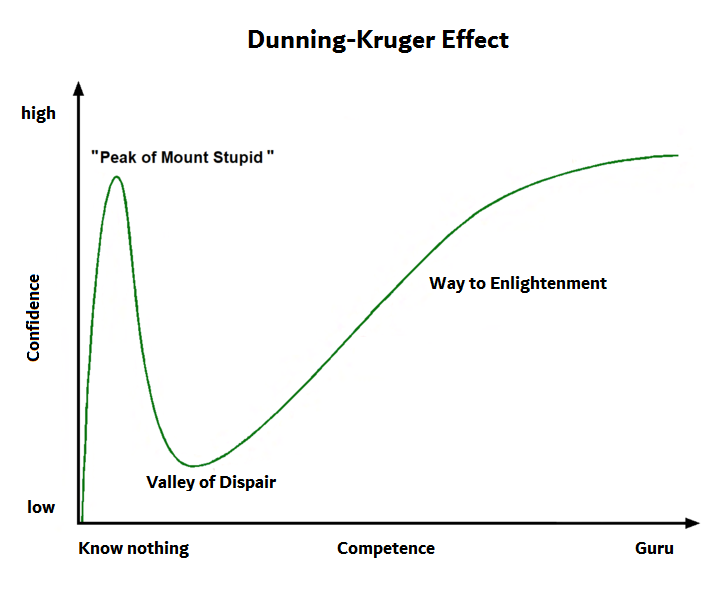
The fight dragged me down from Mt. Stupid’s peak into the valley of despair.
Only now’s begun the journey of building real fighting competence.
“The more you know the more you realize you don’t know”
— Aristotle
To build true competence, have a Beginner’s mind — ignore what you already know and seek what you don't.
2. Never Underestimate Your Competition
Shorter. A smaller frame. Soft-spoken. A genial face.
Easy win — or so I thought.
When the fight started, his genial face turned grave, and he taunted me dauntingly.
Overconfident, I’d slacked on my training, ignored strategizing, and binged Assamese street food.
My opponent, on the other hand?
Mentally noting my reach and guessing my high kicks, he’d planned his moves. He’d eaten right. Trained hard. Visualized the fight.
After the fight, he asked my coach and me what he, the winner, could have done better.
That’s a pro in the making right there. As a seasoned boxer once told me,
“Always go into the ring assuming you’ll lose.
Careful defense >> Rash offense. ”
Overestimate your competition — you have nothing to lose and everything to gain.
3. Take Serious Things Seriously
Munching sugary bars. Sleeping in. Slacking on training. Gobbling oily junk.
A serious fighter wouldn’t dare do that 2 days before his bout.
After weeks of grueling training, being in a new city shouldn’t have been an excuse to slack off.
I lost because I didn’t give the fight the respect it deserved — when you trivialize serious things, you get trivial results.
“A professional believes if a job is worth doing, it is worth doing well. An amateur believes if a job is worth doing, it very well may be worth doing badly.”
— Robert Littell
Be it relationships, business ideas, or gym workouts, give them the respect they deserve.
A pro grinding it out there will beat you if you don't.
4. Don’t Double-Guess Your Master
As my kicks turned lethally powerful, I stopped listening to my coach.
Using my (ignorant) judgment, I scoured YouTube for ways to make them even stronger.
Bending the knee and snapping it later 2Xed my kick power — but they became slower and easier to detect.
On the fight day, my coach discovered this during pad work. He shook his head with a dejected look.
It was too late to unlearn the technique — and my opponent saw the kicks coming from a mile.
Only 2/10 kicks landed. With my coach’s technique, I could have landed at least 7.
Thanks to Dunning Kruger, we think we know something our coach/mentor/master doesn’t know.
But it's best to trust their knowledge until you attain a certain level of expertise.
“You can’t become the master of anything until you become the master of your ego.”
— Napolean Hill
When you study/learn/work under someone, cull your ego and listen to them.
5. Don’t Fear Your Fear(s) — Lean Into Them Instead.
As I set my groin guard and the bell rang, an electrifying pulse jolted through my spine.
Drunk on a cocktail of fear, excitement, and nervousness, I never felt more alive.
Fear-triggering situations bring out your truest self.
They’ll trigger self-insights and teach you lessons in a way few other things can.
“Your fear is the sharpest definition of yourself. You should feel it virtually constantly. Fear needs to become your friend so that you are no longer uncomfortable with it.”
— David Deida
Fear shows the boundaries of our comfort zone — so when you’re afraid, you know you’re at the edge of your current limits.
You don’t need a full-blown fight to conquer your fears. Face them one by one:
- Rank your top 20 fears from outright terrifying to mildly uncomfortable.
- Start with the least ranked one — and work towards facing it regularly.
- As you get comfortable with it, move on to the 19th one.
- Rinse and repeat.
Don’t rush this process or set deadlines to conquer your fear(s).
Every day, tippy-toe at the end of your comfort zone — and peer into the dark chasm of the unknown.
Over the years, your small comfort zone will expand into a vast empire of pure potential.
The less you fear, the more you live.
A Quick Recap for Your Memory
- Don’t be a Dunning-Kruger — assume you know lesser than you think.
- Overestimate your rivals — and work accordingly.
- Don’t take serious things trivially — treat them with respect.
- Ditch your ego — and listen to your master/mentor/coach.
- Don’t fear your fear(s) — gradually get comfortable with them.
Experience is the hardest kind of teacher. It gives you the test first and the lesson afterward.
— Oscar Wilde
Godspeed, my friend!


