
POETRY IN TRANSLATION
Lorca’s ‘La Monja Gitana’ Retranslated
A free adaptation from his Gypsy Balladry, and reflections on the process
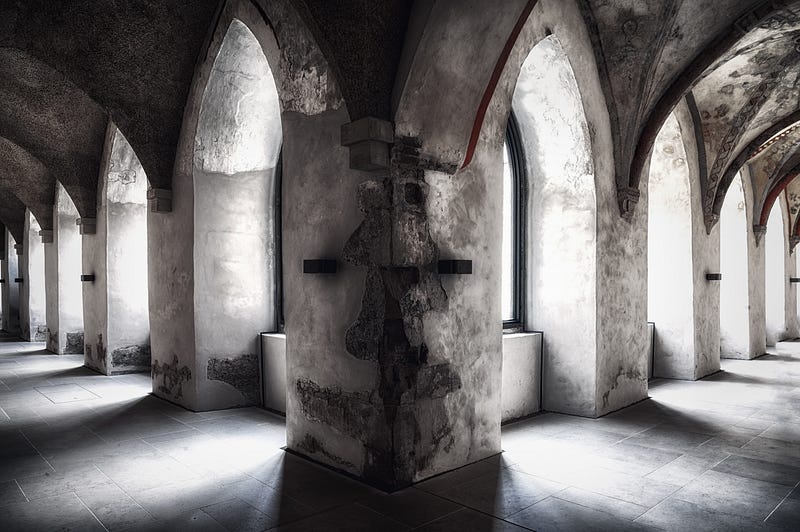
Writing poetry is a demanding task. Translating it is somewhat easier in one sense — the bones are already there — but harder in another. You have to sculpt the flesh back onto them, to create a pleasing, if rudimentary, clay likeness. Rather than a hideous Frankenstein’s monster that mocks the poise and grace of its model.
Much of what breathes life into a poem — the meter, the rhyme scheme, the sounds of the individual words themselves, how they taste in the mouth and caress the ear — will almost certainly not work as well or in the same way in a different language. You must find some way of creating an equivalent effect in the mind and heart of the reader, while reflecting, as far as you can, the style and sense of the original poet.
It’s a painstaking and time-consuming process, and not one that I often tackle, despite the artistic appeal of the challenge it presents. Last night, though, I found myself reworking the closing lines of Goethe’s verse drama Faust for a comment on a piece by Natasha MH, the ending of which reminded me of his reference to ‘das Ewig-Weibliche’, the ‘Eternal Feminine’. I was in an Auerbachs Keller frame of mind, which may have helped. Or hindered. Natasha encouraged me to continue, but I knew that my German was now far too rusty to make it feasible.
Translating Spanish, however, is my day job. I remembered that years ago I had started work on a version of El Romancero Gitano for a literary translation competition, and must still have La Monja Gitana almost finished somewhere in the deepest cloisters of my hard drive.
I dug it out, dusted it off, and set to work, completing, revising, polishing. I’m fairly pleased with the outcome, and its theme of neglected femininity and desire also chimes to a degree with the piece that started the whole ball rolling.
As my subtitle suggests, it is a deliberately free adaptation. There are plenty of more literal renderings available, in print and online, many of them perfectly acceptable to the ear. But I wanted to write something less constrained by the precise meaning and structure of every single line, a work that felt a little more like an independent creation.
In translating poetry you’re damned either way. If you stick to the exact same meter and rhyme scheme, translate every term literally, if will be horrifically stilted. A crutch to a help someone learning the language as they hobble their way through the original, but not something you would read of itself for pleasure.
If, on the other hand, you give yourself freer license to transcreate, you also sacrifice the poet’s authentic voice, without — by definition — creating a fully fresh and original work in its place. The task is perhaps similar to playing a cover version of a classic song. You have to make it your own, while allowing the genius of the first incarnation to shine through. And hope it ends up more towards the soaring Hendrix Watchtower end of the spectrum, than a slice of Madonna Pie, destined for the dustbin.
Essentially what I’ve done is to abandon the strict octosyllabic metre of the Spanish romance, or ballad, opting instead for short lines of seven, eight or six syllables that simply feel like they offer a satisfying rhythm. I’ve also made some of the contrasts between the vibrant, organic life and colour of the world outside, and the cold, hard, penitentiary geometry of the convent, more explicit.
Most of us thankfully now live in a world where it is not commonplace for young women to be confined against their will in religious institutions to tame their dangerously free-willed spirit. In Lorca’s day, and his Andalusian homeland, that was very much a reality, and so I feel it needs some of the imagery to be laid on a littler thicker to make it more apparent to a modern reader.
I may have gone too far with that — I’m sure many Lorca scholars would be horrified. But that is rather the point — they are scholars familiar with the whole poetic and social context. This is meant more for someone unversed, so to speak, in the milieu from which Lorca speaks. There are also a few terms where I had to take greater liberties.
The ‘araña gris’ is an image that got the better of me. ‘Araña’ is both spider and ‘chandelier’, and here seemingly has the latter meaning: a heavy, ornate light fitting suited to the Baroque architecture of the convent. But it inevitably carries some of the scuttling menace of the spider as well, especially as the place is implicitly likened to a jail, whereas ‘chandelier’ suggests a sumptuous palace.
I opted for ‘cobwebs’, which is not what it actually means. It does, though, reflect a sense of lifelessness, and straight-lined, geometrical forms, which contrast with the swooping flight of the birds, representing light and freedom. Again, I wanted an extra syllable, so turned Lorca’s ‘pájaros’ into ‘starlings’, because their iridescent feathers fit in with the effect of the light split by the window glass into its seven colors. They also have that sense of unpredictable riotousness which works well here.
I’ve likewise made heavier use of alliteration, which feels naturally sonorous in English, while ditching the unfamiliar Spanish assonance. And I slipped in a couple of puns that I cheekily couldn’t resist (crewel/cruel, sew/sow). I suspect that an academic editor would knock those on the head immediately, but again, they feel like a natural device in English, and I think add to the sense of contrast between two realities that lies at the heart of the poem. Plus, it makes up for losing the double meaning of the araña.
So here it is. I hope you enjoy it.
Links to the original and to the piece which gave rise to this little project may be found below.
The Gypsy Nun
For José Moreno Villa
Silence of whitewash and myrtle.
Mallow in the meadows.
A nun embroiders wallflowers
On a backcloth of yellowed straw.
Seven prismatic starlings
Swoop through greying cobwebs.
The church growls in the distance,
A bear stretched on its back.
How beautifully, how artfully
She plies her crewel needle!
What joyous flowers she yearns
To sow in the yellowed straw.
Sunflowers! Magnolias!
Besequinned and beribboned!
Resplendent crocuses and moons
To drape the altar’s edge!
Alongside in the kitchen,
Five blood oranges sweeten.
The five deep wounds of martyred Christ
Cut deep in Almeria.
Two riders canter wildly
Across her novice pupils.
A final, stifled murmur
Billows out her blouse.
She gazes at the clouds and hills,
The parched and distant landscape,
And feels her sweet, verbena heart
Shiver into fragments.
The steeply sloping plains
Lie bright with twenty suns.
The rivers rear up, racing,
Before her dreamy eyes.
She turns back to her flowers though,
And in the breeze, light climbs up high,
Playing chess on the window bars.
Free translation by Matthew Clapham of the original poem La Monja Gitana, by Federico García Lorca.
Lorca’s original work, and a somewhat more literal translation:
And the article by Natasha MH: