
Looking Into The Eyes Of The News
I saw a lot of eyes last month.
The most recent eyes:
He looked so sad. Broken, almost. Even as he pushed me violently out of the room, I could see in his eyes that something in him was breaking, was in pain. I wanted to hug him, but I was focused on disrupting an event that featured a speaker who had stood proudly with Trump in front of a sign that has historically been used to hurt minorities, and was rooted in antisemitism.
The man pushing me was the brother of the man whose prison sentence was commuted by that same president.
We were friends. I’ve seen him painfully call out to God for his brother to be released from prison. When I was part of his community, we chatted regularly. I loved him. I love him.
When he violently pushed me out of the room, I saw us in a gulf, standing apart from each other. In worlds that would never touch. Our love connected us, but the pushing had to happen, and the sad eyes also had to happen.
I texted him after some time had passed, telling him I loved him and that I was still happy for his family. He texted me back, saying that he pushed me out to “save me from embarrassment” and that he loved me too.
I cried, knowing I loved him and that still, I’d keep making myself embarrassed, no matter how much he or anyone else pushed me.
Lots of eyes:
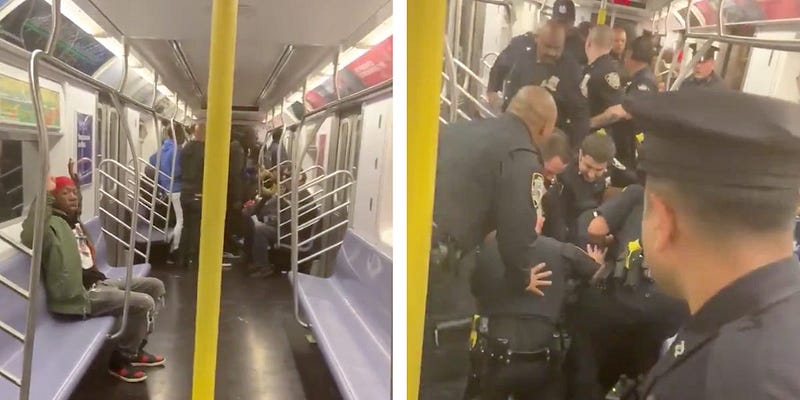
It was on the subway. A place where we generally don’t make eye contact, don’t connect with the eyes around us.
The first eyes I noticed were of the police. Three of them, pointing inside our car as it slowed down into the station, looking for someone. They found him, and started following us.
Then there were the eyes of the other people in the car. The young Black teenagers near me coming back from school who looked truly scared. Others simply looking around in confusion, vaguely becoming aware that they were about to be involved in a subway drama (not an unusual occurrence, so still, the eyes weren’t connecting with others).
Then the police again, as they caught up to us. Now more. Five or so. Eyes all looking in ours, scanning. Hunting.
Then another man walked up. Large and bulky. For some reason, it didn’t register at the time that he was a plain-clothed policeman. I thought maybe he was a witness.
His eyes turned angry. Dark. Like a storm had suddenly hit.
He pointed a finger into our car, clearly pointing out whoever they’d been looking for. He nodded.
I saw his gun, but at first didn’t register what it was. Just a black thing pointed at our window.
It was only when I saw the other eyes… the woman who was running away with her hands raised in fear, the people who had been looking away distractedly suddenly becoming focused, another woman laughing while her eyes reflected nervousness… and I heard the word “gun” that I started to understand what was happening.
The car cleared, and we ran to each side of the train. I had been videoing since this had begun, but I took a moment to peak out from the phone that separated me emotionally from what was happening and looked at the only person left in the middle of the car. A black teenager, his hands raised.
And his eyes.
Eyes that perceive they might no longer see shortly, that death may be imminent, look different than other eyes. There is no ego. There is no self. There is only terror.
He looked so young with those eyes. So helpless.
I looked through the window, and saw now multiple police with their guns out. Ready to storm.
The doors flew open, and the police swarmed on the young man with his hands raised.
The moment exists like a photograph in my mind. Because of the eyes.
The first man who rushed in, a large man seemingly triple the size of the person he was coming to tackle, had eyes of anticipatory anger. The kind that said, “You’re already guilty, and I can’t wait to tackle you.”
The eyes were hateful, there is simply no other way to describe it. Full of malice and a kind of excitement, made for a moment where he could tackle someone who posed no threat, who was cooperating.
The others came in, their eyes as diverse as their makeup. Some similarly angry, some nervous, none guilty.
For a moment, they cared only about the teenager they had come in to tackle. Ten or more police, all surrounding him, despite the fact that he was on the ground, despite the fact that he was cooperating.
Then we were pushed out. I was still recording. People started coming up to me to ask what was going on. Most of them happy, almost. Excited. Something exciting had happened! They were on the other train, or waiting in the station, so they just saw men rushing in. They didn’t see the eyes. They didn’t see the fear. They didn’t feel the trauma.
Finally, the teenager was taken away, hands cuffed behind his back. Eyes of defeat, but perhaps also relief.
No eyes:
I was used to seeing his eyes. He had just left Brooklyn for Berlin. He was my best friend.
His eyes are always laughing, like the whole world is just kind of funny. Even the hard, dark things. Especially the hard, dark things.
He was in Halle, Germany on Yom Kippur. In the synagogue with his wife (also a friend) and community.
A gunman had come to kill them. Every single person praying in the synagogue there was a target, from the children to the elderly. My friend, his wife, his infant daughter, his community, the Jews of Halle.
The security door kept the shooter out. He went on a shooting rampage, killing a woman, Yana Lange, who had reprimanded him for making noise outside of a house of worship and a customer at a halal doner kabab shop.
My friend and his family and his community, unlike so many others who have been targets of such shooters, survived.
I called my friend up after this happened.
We had been exchanging texts. We usually joked about even the darkest things. I wasn’t sure how to deal with it, but then he made his own joke. I joked in response. It was dark. It was sad. It was funny.
I tried to imagine his eyes, and I couldn’t see them as laughing anymore, even as I couldn’t imagine them not laughing either.
He picked up the phone.
At first, it started off with the same tone, his voice. The jokes. Then, quickly, serious. There was no need to pretend.
As it went that way, I remembered his eyes when he’d turn serious. I imagined him speaking to me, with a smile quickly followed by a frown.
He described the trauma they had all been going through, how surviving a shooting doesn’t make you miraculously okay: that there are consequences that may last a lifetime. I didn’t know how to support him besides to listen: how does one support someone who’s gone through something they can’t even begin to comprehend?
All I knew was that, inevitably, my friend’s joking eyes had dimmed, if only for a bit, if only in this moment. And that broke my heart enough.
Her eyes:
Wide open. Like a doe’s eyes, looking at an upcoming car. Both disbelieving and afraid. That same look she gives me every time the fear hits close to home.
She had quit Facebook, so she didn’t know about it, and I kept it from her for a week because I didn’t want to see those eyes, because I couldn’t handle it.
But at some point, the guilt of not telling my wife that our daughter’s Jewish school had been vandalized overcame my fear of seeing those eyes.
So, there they were, looking back at me. I didn’t really have any words of comfort besides stuff like, “Well, this stuff happens here,” which, I think was pretty much the opposite of comforting.
We hugged, and we stood there silently for a bit.
And that was it.
Another day of being a Jew in Brooklyn.
All the eyes:
Every single one of those eyes, even the ones I didn’t see, are etched in my mind. They will be looking at me for the rest of my life. They all tell a different story, but they were my windows into the kind of experiences that so often are twisted and turned around by the reaction from the outside, the narratives that are built after the fact.
Not many people will have to look in their wife’s eyes as they tell them their daughter’s school was vandalized. Even the most sympathetic don’t have that in their minds. All of it reminded me that there were people looking into loved-one’s eyes in every traumatic, painful situation, telling them stories they would rather be kept secret.
The Halle shooting caused even more pain for my friend when he discovered that people around him had suddenly forgotten to simply care about him and his community.
Maybe if they had seen his eyes, heard his voice (actually listened, I should say), they might have acted differently.
The vandalism in Brooklyn became just another antisemitic incident in Brooklyn targeting Orthodox Jews.
Millions of eyes eventually watched my video of the policeman arresting the young man. None of them, none of them could see the eyes. They saw the tackling. They saw the arrest. They didn’t see the eyes.
And yet, I could tell the ones who knew what the eyes looked like. Because they had experienced these things. Because they had seen them. Because what I shared was just one story of many.
And when I went to protest the rabbi, I myself hadn’t been prepared for the eyes. I was prepared for the eyes of anger. The eyes of surprise.
I didn’t expect to see sad, heartbroken eyes.
I wouldn’t change a thing. I’d still have walked right in. Still would have called the rabbi out. Still would have been okay with being pushed.
But they eyes were a reminder: none of this was abstract. It was as human as anything.