
Looking for World Piece(s) of Music: Dr. K Sees Japan
Part 1 — Noh? Yes!
I studied musicology at Stanford. No, not the Prince type (may he rest in peace), the real deal. I even got a doctorate in it. Although I had no formal training in the area, I was asked to teach World Musics — India, Indonesia, and of course, Africa, in my first job out of grad school. It was clear I was asked to teach about music from cultures of color because I’m a woman of color. Didn’t matter that my research area was 16th-century Italian dance and all my formal training is in Western classical music. But that’s a tale for another day, perhaps accompanied by a shot of Maker’s Mark. Okay, then. But, hey, just because various admins wanted me to do something for the wrong reason doesn’t mean I couldn’t do it for the right reason, which is to learn and teach. To expand musical knowledge for myself and my students.
Sitting firmly astride my metaphorical thoroughbred horse named Making Lemonade, out of Lemons, by Necessity, I cantered along, merging the agile strength of my musical passion with the long distances of societal presumption into a lifetime goal of witnessing the music I taught, live and in-person, in its appropriate cultural context. I started applying for campus grants, periodically racing away from the status quo, toward cultural adventure.
Pam and I met as junior high classmates in Clarksville, Tennessee. Although white and black, respectively, in the year just after desegregation began, we bonded over our commonalities of being army brats, interested in music, with college-bound dreams in the community adjacent to Ft. Campbell, Kentucky, home of the 101st Airborne “Screaming Eagles.”
Eons later, when our high school graduating class had its 20th anniversary, she got my email address from the Northwest High School mailing list. She had joined the Navy to pay for Radcliffe, where she earned a Master’s degree in history, and married a fellow officer who had been raised in Asia. With their nordically blond children Pam and her husband had settled in Japan and had been living there for thirteen years.
I mentioned in passing that I had always wanted to visit Japan as part of my life goals. I’d seen opera at the magnificent La Scala in Milan, English choral music at the impressively staid Brompton Oratory, Russian ballet in Balanchine (and Stravinsky)’s adopted homeland of New York, funk in a dope-filled auditorium in North Carolina, electronic music at CCRMA (pronounced “karma,” of course) in California, gospel in sincere country churches throughout the South, so my European, Contemporary, and African American music courses were in good shape, but as for World Musics . . .
I had seen every live performance of traditional Japanese music that I could in the U.S., and I folded and cut paper into origami and kirigami figures in my spare time. I’d participated in an Obon festival when friends and I vacationed in Hawaii. And, in California, I’d shocked my friend Jean Nakamoto’s young nephew Chris with the amount of blazing hot wasabi I could eat with my bento box. So, cherry-blossom thoughts wafted in my head as Pam responded, “Come on down,” in true Tennessee fashion. I grabbed a grant, hopped a plane, and galloped West.
I wanted to see three ancient theatrical genres: Bunraku, Kabuki, and Noh. I would have made theater reservations from the States, but the same Japan, known for its technology, offered little in online ticket sales. Once there, Colin, Pam’s Cornell-bound and Japanese-fluent son, was a real trooper, calling Japanese theaters to find reservations. Having seen none of these famed types of theater in his entire Japan-based life, he was stunned at how hard it was to get tickets.
おおお
After the rambunctious quality of Kabuki theater, I wondered how I would react to Noh drama, one of the most ancient continuing forms of theater in world history. Men play all the characters, although this was not always the case. During thirteenth-century beginnings, women were once part of Noh but, just as in Shakespeare’s time a few centuries later, medieval Japanese (men) considered theater dangerous to the moral character of women. I’m not sure why, but out they went.
Centuries later, off I was going to see this iconic theatrical tradition, from which all other major musical genres like Kabuki and Bunraku (puppet theater) have borrowed. Watching Noh, with its elaborately gracious costumes, masks, and movements so elegantly deliberate and stylized, seems like gazing at life through a slow motion lens.
Although the program contained a synopsis in English, the theater was so beautiful, and the performance so expressive that I would have enjoyed myself even if I had understood nothing. The theater was built of polished wood sparsely decorated with evocations of nature, like the calm green needles and gnarled branches of a Japanese byobu [pine tree], embossed on the rear stage wall. The musicians sat in plain view downstage, remaining virtually motionless until it was time for them to play. And even then, the actions necessary for performance never undermined the ongoing sense of stasis.
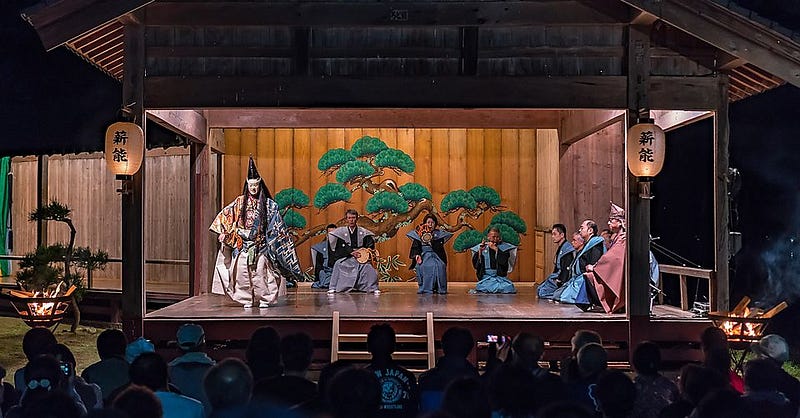
Before the central event, Noh tradition requires a lively prelude. With a plot that could have come straight out of an old I Love Lucy episode, a craftsman’s teacher comes to his home for a visit. The former student’s wife answers the door. Once the husband’s sensei identifies himself, the wife immediately panics. She knows her husband does shoddy work, but since he’s the only game in town, people have no choice but to buy his wares. Since she doesn’t want the teacher’s visit to last long enough for anyone to experience his skills and find out how bad her husband’s work really is, she tells the sensei the first thing anybody would think of under the circumstances — “my husband’s dead.” Really?
Unfortunately she hears hubby coming in through the back door, so she races back to explain the situation, convincing him to pretend that he’s his own ghost (Did I say you have to suspend disbelief? Well, I meant to). Hubby agrees and, while wifey quickly returns to entertain their guest, who is wondering what all the ruckus is about, the craftsman changes into the traditional kyogen ghost costume — wild hair and bright colors, as opposed to the calm sedate colors that living people wear. His costume convinces the teacher of his ghost-hood, causing the sensei to scurry away. This kyogen was served up as a comic appetizer before the more serious main course.
おおお
The main Noh story for this performance concerned a chimera (a mythological creature with the head of a lion, body of a goat, and tail of a serpent). Having been shot down by Minamoto no Yorimasa, the Emperor’s archer, the monster Nue has lost his magical powers and suffers, his essence entrapped in the body of a humble boatman. The prayers of a kindly Buddhist priest free Nue’s spirit, allowing him to sink peacefully into the abyss of dark waters, clutching the moon to his breast.
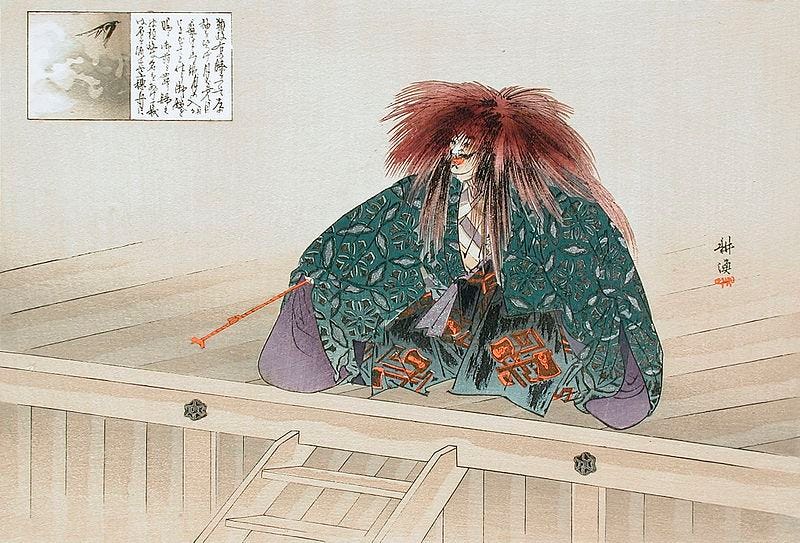
This rather stark tale unfolds ever so slowly over the period of three hours because everything in Noh moves at a perfectly glacial tempo. This customary adagio allows the audience to pay the fullest attention to the plethora of fine detail that is integral to Japanese tradition. The instrumentalists even start their notes in a slightly offset fashion, which allows listeners to experience the timbre of each instrument individually.
The masked actors enter with a purposefully languid gliding, suriashi heel-toe step that contrasts with the occasional foot stamp when expressing anger. Unlike Kabuki with its spacious costumes, the restrictions of the tightly wrapped Noh costuming require the utmost in physical control and subtlety. When costume changes become necessary, the kōken [stagehands] come right out onstage while the action continues. As in Kabuki, their somber black clothing, worn without masks, instructs the audience to ignore them.
Dressed in traditional voluminous soft gray hakama pants with a broadly winged sleeveless jacket (kataginu) over a basic black kimono, three drummers and a flutist make up what is called the hayashi ensemble; they accompany the action, or inaction. The music they perform pays homage to Japanese traditions of control and subtlety.
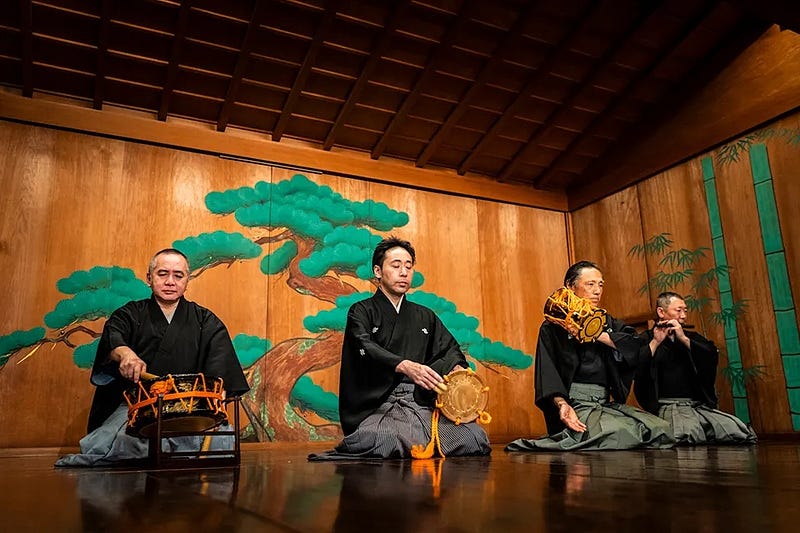
The nohkan, a small extremely high-pitched bamboo flute is the only melodic instrument, aside from the voices, although is role is significantly rhythmic. The three drums, only sparingly used, are held at differing levels relative to the body. The musician with the ko tsuzumi, an hourglass-shaped drum considered to be female, holds it on his shoulder with one hand, striking it with the other. Interestingly, the pitch of this “female” instrument is lower than the “male” o tsuzumi, a larger hourglass-shaped drum which the player holds at his hip with one hand and, with the other, raps it with a thimble-covered finger, producing a high sharp pitch. The o tsuzumi drumhead is so tight and the paper thimble so hard, that the o tsuzumi sound resembles a woodblock more than a drum. The final percussionist uses two thick ceremoniously wielded sticks to play the taiko, a shallow two-headed drum supported by a frame. Throughout the sections in which the drummers play — often only a single strike after long periods of silence — they call out signals (kakegoe) to one another. While this is a traditional part of Nohgaku performances, the kakegoe, like the kōken, are meant to be politely ignored.
The combination of minimalist plots, instrumental simplicity, elegance of costuming, and unhurried movement are often thought (by the Japanese) to be too challenging for the abbreviated American attention span. Sports writer Wright Thompson posits a similar conceptual disdain in his appreciation of cricket test matches, notoriously slow games that can last several days. In his essay for ESPN’s Outside the Lines website, Thompson observes with all-too typical American arrogance that:
Test cricket revolves around noticing and appreciating nuance, which is a good idea in theory, but also quaint. Actually, quaint is probably a bit generous. Anachronistic is a better word.
He furthers the idea of U.S. culture as uncultured and impatient, or perhaps boorish is a better word, reporting a conversation he has with an Indian who has come to London to watch the 2000th England v. India Test Match. I can imagine the smirk on the Indian’s face as he mentions the American he had met the day before. That American had continuously complained that cricket was not as good as baseball: “He left after an hour.” By then, Thompson is beginning to get it. He begins to understand our relationship to many parts of the world:
There are two meanings to “American.” There’s the physical being, i.e., me. Then there’s the idea of us. The blitzkrieg of culture. Whatever starts in America sooner or later ends up around the world. It’s in India now, swallowing the measured game of cricket. I feel like the advance scout for an army that will ultimately destroy everything around me.
As Chaka Khan sang with funk band Rufus, he’s on the right track, but the wrong direction. Thompson swerves to all-too-common zero sum thinking by saying that people (read: Americans) don’t have five days, five hours, or even five minutes to be disconnected from the modern world.
Traditional Japanese performances brought to the U.S. typically have at least an hour cut from performance time. When I’ve inquired about this, concert producers consistently express their doubts that American audiences accustomed to 30-minute sitcoms interrupted frequently by commercials could “sit through” a full-length program. But the number of Americans in the Tokyo audience made it clear that they have misjudged at least some of us and I, for one, am glad of our ability not only to notice, but to seek out and “appreciate the nuance” of Noh: the shiori, a movement where a hand slowly passes before the eyes as a physical metaphor for tears being shed; the lentissimo suriashi, that famed sliding step that encapsulates the action of Noh.
Granted that Americans attending such a performance in Tokyo had already made this choice; in speaking with audience members after the performance, we unanimously found Noh to be controlled, graciously serene, with understated energy. As a matter of fact, Noh is a snapshot of one important side of Japan culture: controlled, graciously serene, with understated, but unmistakeable, energy.