
Looking for World Piece(s) of Music: Dr. K Sees Japan 2
Kabuki Hai!
Before the magisterial drama of Noh, I’d been ready for Kabuki. Just as he later did with Noh, Colin, my friend Pam’s Cornell-bound and Japanese-fluent son called Japanese theaters in Tokyo to find reservations for shows. Although he had lived near Tokyo most of his life, he was amazed that almost all Kabuki dates anywhere were sold out. He’d never been to see Kabuki theater (I was initially shocked, opening my mouth to criticize until I recalled that I had lived about the same distance from Nashville for about the same amount of time and had never gone to the Grand Ol’ Opry until I was practically middle-aged. Mouth firmly shut). Finally, at the Grand Kabuki Theater, the most famous in the land, there was one seat left; I snatched it up.
Now I had to get to the theater. This would be my first trip to Tokyo, approximately 45 minutes from Pam’s home in Hayama by Japan Rail. I would be going, as Rumpole of the Bailey says, “alone and without a leader.” Pam walked me to the bus stop, down a congested hill full of microscopic intermingling streets , scattily explaining the return directions. Little did I know that I had missed a few steps, but more on that later. It was easy getting to the train station on the bus. The station was easy to spot, even though this was my first time seeing it in daylight. There’s a massive building with the bustling-people look that is common to major train stations worldwide.
Inside, the station was pristine. Having experienced train stations in many parts of the U.S. and Europe, I considered Japan’s stations to be one of the public transit wonders of the world. People stood neatly in line, sneaking peeks as this apparition amongst them. As a woman of average American height of 5’6” in a nation where the average female height is 5'2", I thought I might as well change my name to Gulliverina and have done with it. Not to mention, as a black woman, being the only “fly in the buttermilk” (another one of those Southernisms I used to think was ridiculous until I had cause to use it; I begin to think we’ve all got parts of our cultures that we don’t appreciate until tosses us in the drink where we need those parts to process and survive).
One thing, though. I’ve been stared at by people of other races many many times (including in my home state deep in the heart of Dixie where, as a black woman, it’s never a good thing), so I’m a bit of an aficionado of stares. The muted Japanese stares were kind. Whenever I looked at my map, someone would gently pad over and ask if I needed help; the chance to practice English seemed irresistible. Depending on the kindness of these strangers, I finally located which of the four tracks I was supposed to be on, all the while hanging on like grim death to my train guide and my blessed copy of Lonely Planet: Japan.
Once I arrived at the correct stop in Tokyo, I found the subway station just outside the Japan Rail Building. Getting the subway ticket was a bit confusing even from the “English” machine, but after a few false starts, I finally got to the Nagatacho subway stop.
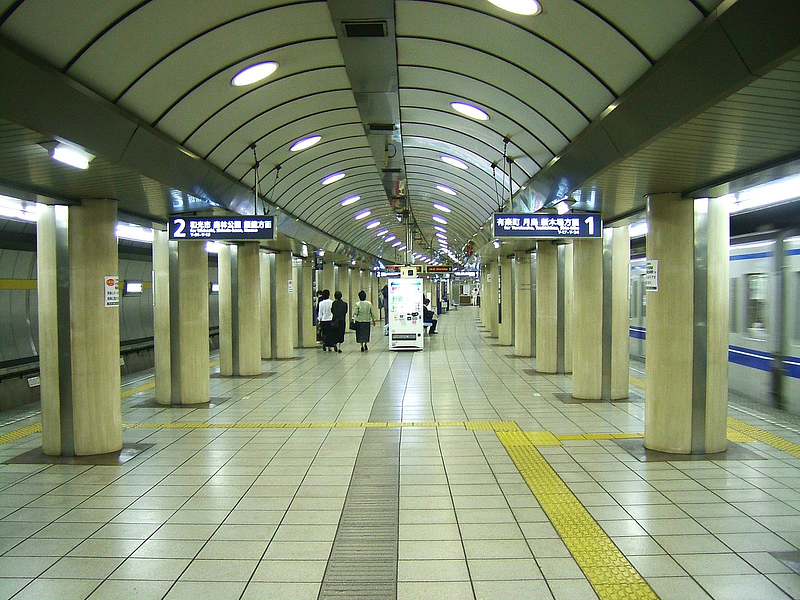
You might be surprised to find that maps and addresses in otherwise well-ordered Japan are confoundedly vague. After wandering aimlessly for quite a while in tree-lined environments that might have been lovely had I not been too lost to see, I was forced to use one of my practiced Japanese sentences. “Rokuritsu, doko desu ka [Where is the Grand Kabuki Theater]?” I asked a police officer, bowing lightly with fingers crossed behind my Lonely Planet. Thankfully, he used many gestures to point the way. I finally saw some signs and discovered the front of the Grand Kabuki Theater.
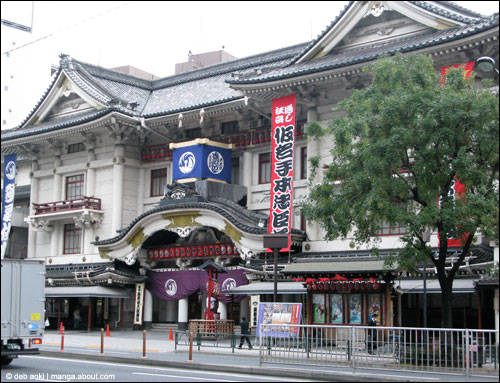
The façade is indeed grand, and stately as well, built from white stone with a traditional irimoya curved roof. Red and gold trim frames the pillars of the entryway. Once inside I purchased my ticket (giving thanks on the altar of AMEX) and an English guide receiver. Amazing numbers of kimono-clad ladies tripped lightly to their seats, their fans fluttering like magnolia leaves in a spring breeze.
Then, just as my excitement was building, I had to sit through a long, rather tedious introduction where young Kabuki apprentices perched on chairs pretended to be in a classroom. The introduction explained aspects of the style — dress, walking, dancing, et al. To the uninitiated, I suppose this was helpful since Kabuki, a singular art form, borrows from many traditions. Different colors, costumes, and hairstyles represent different emotional states. Different modes of walking and dancing represent different social classes: slow glide equals upper class, skittering steps equal servants, wide-legged stamping equals attitudinal gods. And the use of very few props, like the fan, is governed by traditions of class and gender.
From a formal standpoint, there is also the “play within a play” structure where myths and history combine and comic relief is only a pratfall away. This introduction was apparently an attempt to make the program more accessible, but the whispered conversations (among English speakers) and the parts of the program that were being pointed to (among the Japanese) revealed that most of the people were already well-versed in the art of Kabuki. We were ready for the real deal.
Given the ”accessible” intent for this show, I knew I would only get a sampler — only an hour and a half or so (3–6 hours being the norm). The spacious theater had a spare elegance. The highly polished wood stage floor and the painted flat panels that framed it gleamed as the house lights dimmed, igniting murmurs of excitement.
First, the chobo [singer and shamisen player] were spotlighted stage left. Then, suddenly, great thunder and lightning effects created by the offstage sound effects ensemble called the debayashi startled us into attention. The myth-based story of the evening’s performance, Act IV of a five-act play from the 17th century, painted women as devious temptresses and men as naive fools easily led astray by a pretty face — thinking with their . . . (oops, family publication).
Narukami, the main character, is basically a good guy, but members of the Imperial Court have foully betrayed him, so he decides on a little payback. Actually, to quote James Brown, it’s “the BIG payback.” Speaking of the Godfather of Soul, the bright colors, big hair, and general outrageousness of Kabuki often brought JB to the front and center of my consciousness as I watched its cultural counterpart.
Back to the story. Narukami, who has now taken religious orders, ropes off the rain dragons in a cave high in a sacred mountain and a drought ensues. Rather than apologize, the emperor’s people decide to enlist Princess Taema to seduce him. Pretending to be a widow seeking to cleanse herself of all carnal desires, she plies this innocent monk with the first alcohol he has ever tasted, and gets right down to business (fast forward: Kabuki is never graphic, so we see no details). Later that evening, as Narukami lingers in the afterglow, Taema sneaks out and cuts the magic cord, thus releasing the dragons.
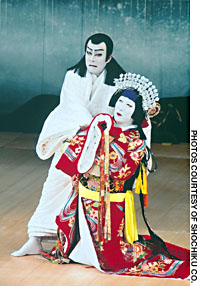
This is when it gets really good. When Narukami discovers Taema’s treachery, all hell breaks loose as his ravening anger creates his alter ego, THE THUNDER GOD. While Narukami goes through his costume and makeup change right there on stage (as with a lot of historic Japanese theater, you’re supposed to pretend you’re not seeing this), a comic interlude featuring several buffoonish “monks-in-training” takes place. There’s a lot of Chinese acrobatics-style tumbling and slapstick falling about, but the “monks” scamper off as the Thunder God appears.
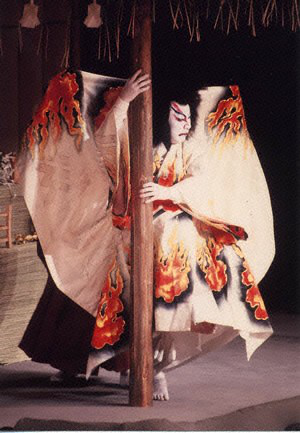
From the sedate creamy white of his former clothing, his robes now blaze with splashes brilliant red and black. From neat long hair hanging down his back, a black bristle of rage now surrounds his head. From the subdued and modest steps of a humble Buddhist monk, he now comes stomping on stage with the power of The Terminator, King Kong, and the Rock all combined. HE. TAKES. OVER.
Dressed in the black that instructs the audience to pretend they’re invisible (a longstanding part of Japanese culture, considered to be part of good manners), the stagehands come up behind Narukami and do something I’ve never seen in Western theater. They lift the train of his dramatic robes, spreading it like a peacock array of feathers to form a backdrop for one of the Thunder God’s most threatening, yet heroic mie poses. Powerfully, he raises his arms to the heavens with long sleeves draping down, cocks his head, swivels it into a fierce profile, crosses his eyes, and freezes in place.
After a stunned pause, the audience goes wild!
Finally, the Thunder God exits via the hanamichi, a raised flower-lined walkway spanning the distance from stage right through the audience to the rear of the theater. Major characters, who often come from generations of actors, traditionally make their initial entries and dramatic exits in this famed manner.
There were so many aspects of live action Kabuki that I had never seen before, even on video. The comic relief, the chobo musicians onstage, and the enthusiastic audience reaction are just a few things that contributed to my exhilarating education. Added to this, the perfection of costuming, music, and movement honed over centuries caused an excited buzz that lasted me all the way back through subway and train rides onto the bus in Hayama where somehow, despite assiduous attention, I missed my stop.
As I later realized, the culprit was pronunciation. Yes, pronunciation. Like the Italians, the Japanese linger on double consonants in an almost glottal stop kind of way. I had been so busy trying to learn the words that my ear had not yet picked up on the subtleties. I now know that there is a huge difference between hearing hayamasho gako (one “k”), which is what I had been listening for and hayamasho gakko (two), Hayama bus stop, which is what the driver said.
That night, I walked back in the dark and began the long trudge back up a hill that, in the intervening hours, had transformed into Narukami’s mountain. I must have taken a wrong turn because I ended up at a Shinto shrine full of tomb markers. Fortunately Pam had lent me her local cell phone, so I called her at home. Five minutes later she and Colin found me sitting on the graveyard wall.
Next episode: Dr. K Sees Japan, Part 3: Showtime at the Kabuki-za