Looking For Hope
The search for signs . . .
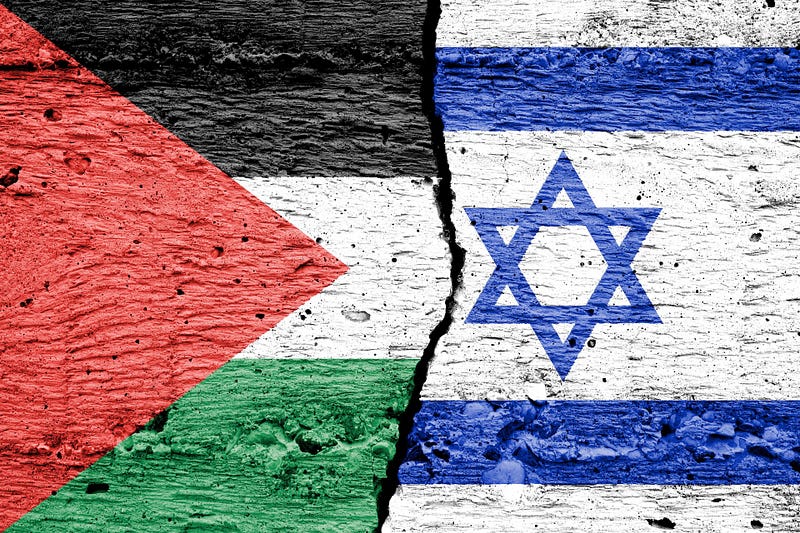
Before beginning a discourse on the recent events in the Middle East as well as the U.S., I’d like to make it clear that a member of Hamas is not synonymous with someone who is Palestinian. A citizen of Gaza or the West Bank is not the same as a member of the terrorist organization known as Hamas or Hezbollah. Also, there is a difference between being Jewish and being a Zionist.
The past week has been eventful. Hostages exchanged, temporary cease-fire in Gaza, a flicker of hope perhaps. The image of a 17-year-old Mia Leimberg with her small dog, still alive after 52 days being held by Hamas in Gaza, gave hope to thousands that maybe, just maybe, Hamas is not made up of sociopathic life-haters. In all, 105 hostages from the attacks on October 7 were released in exchange for 240 Palestinian hostages, mostly women and children, that were being held by Israel.
Also last week Mosab Yusef, the son of one of the founders of Hamas (Sheikh Hassan Yousef ) spoke at the University of Michigan https://youtu.be/wpnvUIcvNUE?si=5ICm-f9Kc0M-H0eR, a Palm Beach Synagogue, and the UN about the terrorist organization he had once been a member of, emphasizing that even with exchange of hostages, a temporary ceasefire, a 17-year-old with her dog notwithstanding — the objective of Hamas is genocide, the elimination of the state of Israel. Nothing less.
Mosab defected to Israel in 1997. He worked as an undercover agent for Shin Bet (General Security Service) before moving to the U.S. in 2007. From his position of having been a former Hamas member, he pointed out that Hamas does not want peace, does not want to “co-exist” with Israel — does not want negotiation, compromise, collaboration. Thus the slogan “From The River To The Sea” implies that with Israel eliminated, the land from the River Jordan to the Mediterranean Sea would all be Palestine (shockingly, to me, is the fact that Amazon is selling anti-Israel “From The River To The Sea” T-shirts online!). He maintains that Hamas will not negotiate, compromise, nor stop short of it’s goal of eliminating the state of Israel and killing as many Jews as possible in the process.
After a brief outpouring of worldwide sympathy for Israel and the Jews who were killed (1200), terrorized, wounded or taken hostage on October 7, the government of Israel, under the conservative right-wing Benjamin Netanyahu, began retaliating against the atrocities committed by Hamas by launching rockets and bombing Gaza after alerting those Gazans in the north to move south to avoid the bombs. Hamas instructed the civilians to stay put, but many crowded the roads south in an attempt to save their lives. As the bombings began resulting in massive casualties, there was no attempt on the part of Hamas to offer (at first) the exchange of hostages in return for a ceasefire. The civilian casualties in Gaza are estimated at an incredible 15,000 or more. Hamas members are embedded among the civilian Palestinians, so it is impossible for Israel to target Hamas directly while sparing the civilians in Gaza, and so the civilian casualties are tragically considered “collateral” damage. It is this massive bombing of Gaza that has given rise to the widespread condemnation of Israel. As well as all Jews whether they are in favor of Israel’s reaction or oppose it. The criticism is that this reaction and retaliation is excessive, is overkill — literally.
As a result of this “overkill,” antisemitism has erupted around the world, including in the U.S., and has been immediate and astonishing considering the initial support of Israel as pledged by President Biden. It is almost as though the antisemitism is there, just beneath the surface, waiting for the surface to be scratched for it to erupt, in full bloom. In the U.S. the pro-Palestine demonstrations on University campuses and major cities has been alarming to U.S. Jews who are justified in having a sense of “deja-vu.” The Holocaust wasn’t that long ago (actually in my lifetime), and Jews around the world have good cause to be alarmed at the amount and degree of antisemitism that is showing up at this time. Yet again.
On December, 7, 1941, Japan executed a surprise attack on Pearl Harbor at a time when the U.S. was at peace with Japan — was actually engaged in talks with Japan’s Emperor with the objective of determining how best to maintain this peace. The U.S. President, Franklin D. Roosevelt, referred to December 7 as a “date which will live in infamy,” and declared war on Japan on December 8. The U.S. was at war with Japan from 1941 until 1945. What ended the war in the Pacific was the dropping of atomic bombs on the Japanese cities of Hiroshima on August 6 and Nagasaki on August 9, 1945, resulting in estimated civilian casualties of 135,000 in Hiroshima and 64,000 in Nagasaki. The war with Japan came immediately to an end, and Japan surrendered between August 10 and 15.
The U.S. has been criticized for using atomic weapons, with the rebuttal being that by ending the war many U.S. lives were saved that would have been lost had the war continued interminably. Were the citizens of Hiroshima and Nagasaki collateral damage?
In his talk last Tuesday at the University of Michigan, Mosab Yusef mentioned (at around the 56 min. mark) the historical fact of the U.S.’s use of draconian measures to end the war in the Pacific against Japan. My understanding is that he went on to imply that perhaps similar measures might have to be taken to eliminate Hamas, embedded as they are amongst the civilian Palestinians. That Israel will do what it has to do to eradicate Hamas. He even mentions the term “dirty bomb.” He goes on to say that the U.S., of all countries, would “get” the necessity of putting an end to the conflict, once and for all, that has existed for decades in the Middle East. After all, in the long run, it would “save” lives.
But would it?
Since October 7, I have personally felt that we, as a country, indeed as a planet, have not been in as much danger since the Cuban Missile Crisis. Too many major players have nuclear capability: Israel, Russia, China, Iran(?). In Ukraine as in Israel and Gaza more conventional weapons have been used up until now, but what would it take to tip the balance, especially when some of these countries have leaders whose sanity could and should be questioned?
I have a great fear. Not for myself, but for my children and my children’s children. For the planet, already beset by pandemics and global warming, species becoming extinct at an alarming rate. But most of all by what seems to be decrease of love and an increase in hate: Jews and Muslims, Republicans and Democrats, Sunnis and Shiites, whites and blacks, haves and have-nots . . . violence begets violence and future generations are radicalized.
What can one do, one asks. The sense of hopelessness is exacerbated by feelings of helplessness.
And yet, we each have a personal sphere of influence: immediate family, friends, neighbors, casual acquaintances. Feelings of helplessness can be mitigated by action. We can act within our personal spheres of influence. How? Be kind. As much as you can, approach life with an open heart. Don’t hold back expressions of affection. Don’t despair. Activate your love. Don’t give up.
Courage.