
Looking For A Way To Spice Up Your Little One’s Bedtime Story?
Here’s One Classic Fairytale That Links Directly To Alien Life!
And I’m giving it away right now: It’s “Goldilocks and the 3 bears”.
For those of you who’ve never heard of it before, here’s a quick summary:
A girl named Goldilocks skips into the forest one morning. Just as she wants to go home for breakfast, she smells something delicious. She follows her nose to a little cottage. 3 bowls of porridge are standing on the table there. Goldilocks tries the porridge: the first portion is too hot, the second too cold, the third one just right for her taste and she eats it up. The same goes for three chairs and three beds. While she’s asleep in the bed that felt just right for her, the 3 bears who actually live there come home. Goldilocks wakes with a start, runs out of the cottage, all the way back to her own home and never dares to go into the forest again.
The Goldilocks Zone
This pattern of something being “just right” as opposed to being either one of 2 extremes inspired scientists to nickname something in planetary science “Goldilocks zone”.
Essentially, it describes an area in a planetary system where liquid water could exist on the surface of a planet.
For example, our planet Earth travels around the Sun within the Goldilocks zone of our planetary system which we call the solar system.
(A planetary system is simply a star in the middle and one or more planets circling it.)
Liquid water on a planet’s surface is one of the main requirements that are needed to create life in whichever form (animals, plants, bacteria…)
Therefore, when scientists try to identify other planets where it would be worthwhile to look for alien lifeforms, they first check if a planet is in such a position to the star it’s circling that it could have liquid water on its surface.
(This can’t be measured simply by measuring the distance between Sun and Earth, because it depends on the size of the star, how hot it is, and the actual distance between those two.)
How to explain it to your child
- Step 1: Read “Goldilocks and the 3 bears” together and make sure your child understands the difference between something being “just right” or too much/not enough of something.
Of course this depends on your child but since parents are not only the experts for their kids but some of the most badass people in the world in general, I’m sure you know the best way to explain this to your little one.
- Step 2: Tell your child that the sun is very important for all forms of life on Earth. Nothing and no one would have water to drink without the sun and we all know that all plants and animals die without water.
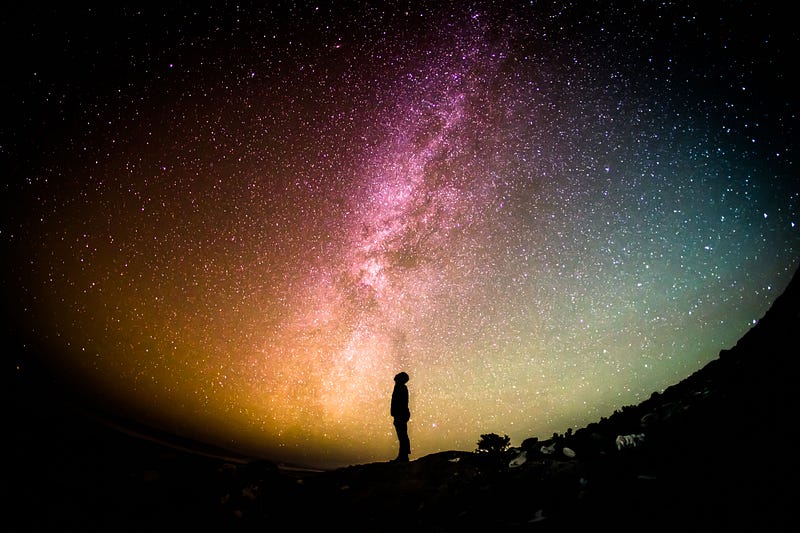
- Step 3: Take a look at the night sky together. Explain that most of the twinkling lights are objects similar to our Sun. Many of them have planets traveling around them. Earth is a planet.
- Step 4: Bring it all together: If Earth goes around the Sun on a route that makes it “just right” for plants and animals to exist here, then there’s a chance that the same thing happens on other planets that travel around other suns too.
- Step 5: Both of you (or all three or four or…), fantasize about what life on other planets under different suns could be like. What would the plants and animals look like? The landscapes? What would the weather be like? Would there be a life-form similar to us humans? How would they speak?
- Step 6: Go to bed with big smiles on your face.
How far from reality is this, actually?
For those of you who are taking care of more mature children, of course, you’re free to add
- more details (for example add bacteria as a life form because microbes are very likely the first kind of alien life humankind will find)
- or make it more accurate (liquid water is confirmed on several of Jupiter’s and Saturn’s moons which are way outside the Goldilocks zone and mostly covered with ice but, from a scientific standpoint, the most promising worlds within our solar systems for discovering alien life).
But all the information is true to the facts. I merely made it as simple and tangible as possible.
Besides, scientists come up with theories based on tiny bits and pieces of data, observations of the night sky (with things far more sophisticated than human eyes of course), or even assumptions that something has to be a certain way because it’s the only way that thing makes sense.
And then they try to prove their theories. But more often than not, the universe has surprised them!
So be the child beside your child and dream together. It’s the only way to find out where this is going to lead.
Want to read more fun, inspirational and educational articles? Follow the link below! You’re going to get access to each and every article on Medium. You’ll be directly supporting me as well as thousands of other writers. You can join a community of passionate readers and creators. It’s just $ 5 a month. Here you go:


