
Look up, and see Jesus
First United Methodist Church, Shelbyville, Tennessee, February 11, 2024
Mark 9:2–9 (CEB)
Six days later Jesus took Peter, James, and John, and brought them to the top of a very high mountain where they were alone. He was transformed in front of them, and his clothes were amazingly bright, brighter than if they had been bleached white. Elijah and Moses appeared and were talking with Jesus. Peter reacted to all of this by saying to Jesus, “Rabbi, it’s good that we’re here. Let’s make three shrines — one for you, one for Moses, and one for Elijah.” He said this because he didn’t know how to respond, for the three of them were terrified. Then a cloud overshadowed them, and a voice spoke from the cloud, “This is my Son, whom I dearly love. Listen to him!” Suddenly, looking around, they no longer saw anyone with them except Jesus. As they were coming down the mountain, he ordered them not to tell anyone what they had seen until after the Human One had risen from the dead.
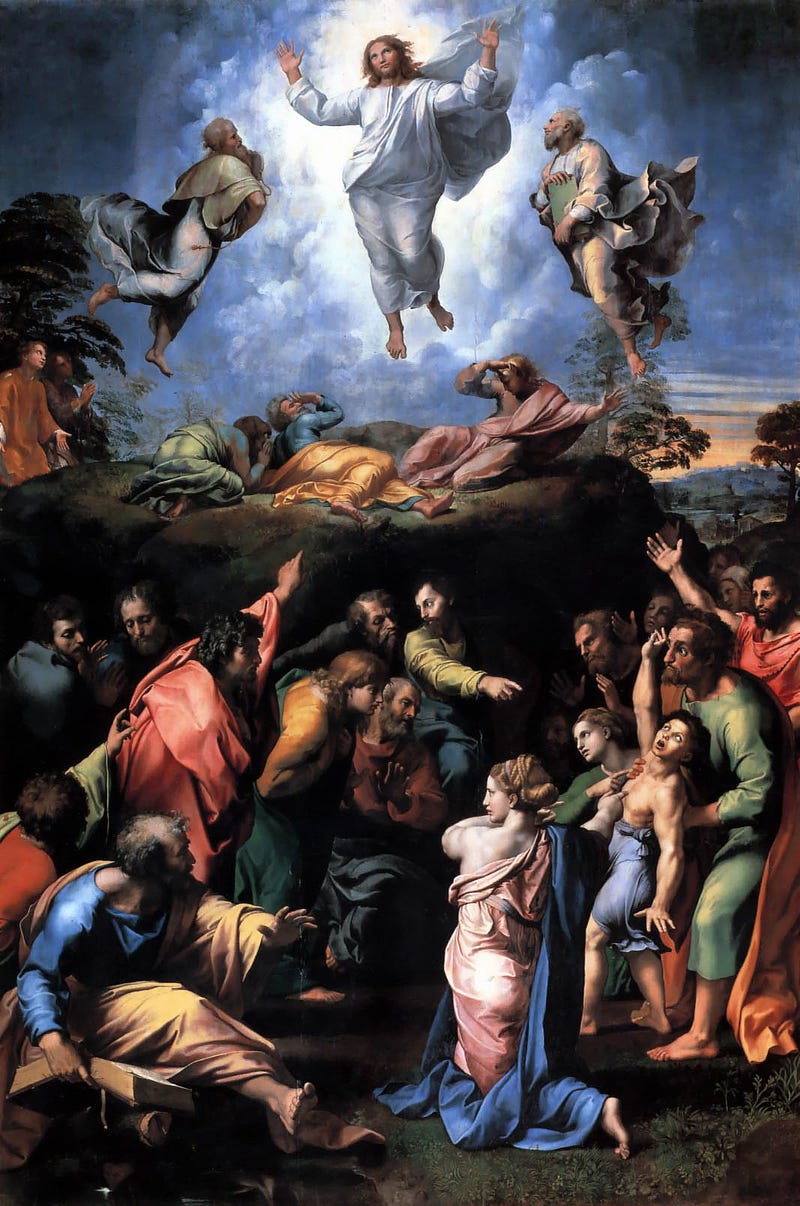
In the eighth chapter of Mark, right before today’s Lectionary passage, Jesus asks the disciples who he is, and Peter answers “‘You are the Christ,” but then Jesus tells the disciples he will be rejected by the religious leaders, and then killed, and then rise from the dead.
The disciples don’t know how to take this — obviously, given their reactions when it happened, they didn’t quite understand it or take it too literally. Peter scolded Jesus for saying such a thing, and that’s when Jesus scolded Peter, with the famous phrase, “Get behind me, Satan.”
Now, about a week later — Mark says six days later, Luke says eight days later — Jesus takes the three disciples who were closest to him and goes up onto a high mountain. The Bible does not identify the mountain.
Starting in about the Third Century, church tradition held that it was Mount Tabor, and there’s a Catholic church on Mount Tabor called the Church of the Transfiguration.
But, as the Bible commentator William Barclay points out, Mount Tabor is nowhere near Caesarea Philippi, where the events of the eighth chapter took place, and besides, during the time of Jesus, there was a fortress on top of Mount Tabor, so it would not have provided the kind of solitude that is implied here. Barclay said it’s much more likely that this took place on Mount Hermon, which is higher, nearer to Caesarea Philippi, and much more likely to have been unoccupied.
This is one reason why I’m not sure I’d be able to really enjoy a trip to the Holy Land. Every time the tour guide would say, “Here’s the exact spot where such-and-such happened,” I’d be crossing my arms and biting my tongue.
Whatever the real location, what happens on that mountain is perhaps the most amazing thing witnessed by the disciples during Jesus’ earthly ministry, along with maybe the raising of Lazarus from the dead. Suddenly, Jesus begins to glow. Now, with modern special effects, we’re accustomed to seeing things like this on TV and movie screens. But the disciples have never seen special effects. What they saw, in person, with their own eyes, right in front of them, was their leader, their teacher, their friend, suddenly bathed in white. Jesus’ clothes where whiter than any soap or bleach could make them. And then, suddenly, Jesus is flanked by two of the greatest figures in Jewish history — Moses and Elijah.
Moses, of course, was the great lawgiver. Elijah was the greatest of the prophets. They, along with King David, were the cornerstones of Jewish history, culture and religious belief. But there was no need for King David to appear on this occasion, because there was already a much greater king standing on the top of the mountain. The son and heir of David, but also the son of God.
So the disciples see Elijah and Moses talking to Jesus. It must have blown their minds.
We don’t know how they were able to identify Moses and Elijah. We would be able to identify Abraham Lincoln, because we’ve seen photographs of him, or even George Washington, because we’ve seen paintings of him. But no one alive in Jesus’ day could have known exactly what Moses or Elijah looked like. Jesus must have called them by name, and the nature of their conversation must have made it clear who they were.
We are not privileged to get any of that conversation, however. Wouldn’t you like to have heard it?
Many years ago, the TV personality and renaissance man Steve Allen had a TV show called “Meeting of Minds,” where he had actors portraying legendary figures from different moments in history, as if they were guests on a panel talk show, chatting (and often arguing) with each other, and with Allen, as himself, who was the host of the show. One episode that I remember had Martin Luther, Voltaire, Plato and Florence Nightingale as the guests. It came off as a natural conversation, even though the series had been carefully — and brilliantly — scripted by Steve Allen. The scripts from the show have been used in history classes, they’re so well-written. But here, we have actual Moses and actual Elijah speaking to actual Jesus. It’s not a play or a performance. It’s a real-life meeting of the minds.
Again, I really that someone had written down just a little of that conversation. Perhaps Elijah recognized Jesus as the fulfillment of the messianic prophecies. Perhaps Moses recognized him as the fulfillment of the law, the one true sacrifice that eliminated the need for symbolic sacrifices.
Mark tells us that Peter, upon witnessing the presence of the two legendary figures, didn’t know how to respond, and that Peter, James and John were all terrified. But the fact that Peter didn’t know how to respond didn’t keep him from responding. Peter was one of those people whose mind, and mouth, were always working. He suggested that they build three shrines — one for Jesus, one for Moses and one for Elijah — to commemorate the event.
Maybe this was just giddy excitement. But it may also have been what we would today call public relations. Hey, Peter must have thought, this will show everyone! This will prove to the scribes and the Pharisees and the Sadducees that Jesus is right, and they are wrong! This will prove to everyone, conclusively, who Jesus is. Once they see this, they’ll know that Jesus is the Messiah and they will have no choice but to appoint him as king and allow him to lead us in revolt against the Romans.
Peter is completely ignoring Jesus’ words from a week earlier about being put to death. Peter hasn’t learned a thing from Jesus saying, “Get thee behind me, Satan!” Peter is still thinking in earthly terms, of an earthly coronation, and perhaps of freedom from the Roman oppressors.
But God comes in a cloud and reminds Peter of what is truly important: “This is my Son, whom I dearly love. Listen to him!”
According to Barclay, in Jewish thought the cloud was a frequent symbol of God’s presence. Moses met God in a cloud. God entered the tabernacle in a cloud. God entered the Temple in a cloud. It was hoped that the return of the Messiah would accompany the return of God’s presence in the Temple, and perhaps that might be manifested by a cloud. So the cloud of God’s presence would be taken by Jews — like John, James and Peter — as an indication that the Messiah had come.
When the disciples looked up after God’s words to them, the scripture tells us that they saw no one else there but Jesus.
The confirmation that Jesus was, in fact, the Messiah was the most incredible news any Jew could hope to hear. But as Jesus and his three closest disciples are coming down the mountain, Jesus tells them they aren’t supposed to tell anyone about it, at least not until he had risen from the dead.
Jesus frequently told people during his earthly ministry not to talk about his miracles or the things they heard and saw. Part of that may be that Jesus, in his incarnated human form, was modeling the virtue of humility. Jesus had nothing to be humble about, and yet Jesus behaved often in a humble manner, telling his followers that they should do the same.
The time would come when Jesus would be fully understood to be the Messiah, and at that time Christians would be called upon to spread the news far and wide, but this moment was not the time for that type of display. Jesus revealed his true messianic nature to Peter, James and John, but he did not want them to discuss it or disseminate it until everything had come to pass.
It may also be that Jesus didn’t want the disciples to lead other people into misunderstandings or false expectations. Yes, he’d revealed a great truth to them, but it’s not clear that they understood it fully right away. Peter, James, and John may have had their own concepts of what Jesus meant when he said he would die and be from the dead. Jesus didn’t want the disciples to spread false ideas about the purpose and nature of his ministry.
When Jesus’ arrest took place, the disciples certainly didn’t act like they understood or remembered what Jesus had said about his own death. They did not act like they believed that this was all a part of a plan. They were terrified, and angry, and hurt. Peter, while Jesus was standing trial, was so afraid that he denied he even had any knowledge of Jesus. The disciples, in general, were diverted and distracted and confused by earthly ways of looking at things. We are sometimes diverted and distracted and confused by our spirituality, just as Peter, James and John were distracted by Moses and Elijah. Moses was the lawgiver, and sometimes we look to the law — to our supposed acts of holiness, the things we do or the things we righteously abstain from.
Elijah was the prophet. Sometimes we are distracted by looking at the future or wondering what lies ahead. But God tells us, “Jesus is my beloved son. Listen to Jesus.”
After the cloud, after God’s voice, the disciples, on their knees, looked up and only saw Jesus.
I understand they’ll be playing a football game later today in Las Vegas. For serious football fans, this is the league championship, the meeting of, in theory, the two best teams in the NFL. But for the rest of us, there are a lot of distractions as well. Will there be any clever ads? What about the halftime show? And, of course, the biggest distraction of all: Taylor Swift.
We get distracted by many things in our Christian walk. Ministries, fellowship, fundraising, you name it. All these things are important, but they are not Jesus. We may also be distracted by internal things — by our own worries and fears and expectations and hopes and dreams. They are not Jesus.
God spoke to the disciples, and when the disciples looked up, they could only see Jesus.
Many of you have seen the inscription at the lookoff point at Beersheba Springs Assembly: “I will lift up mine eyes unto the hills.” That’s from Psalm 121. Here it is in the Common English Bible:
I raise my eyes toward the mountains. Where will my help come from? My help comes from the LORD, the maker of heaven and earth. God won’t let your foot slip. Your protector won’t fall asleep on the job. No! Israel’s protector never sleeps or rests! The LORD is your protector; the LORD is your shade right beside you. The sun won’t strike you during the day; neither will the moon at night. The LORD will protect you from all evil; God will protect your very life. The LORD will protect you on your journeys — whether going or coming — from now until forever from now.
The disciples looked up, and saw no one except Jesus. Through all of our highs and lows, our struggles and triumphs, all that matters is for us to look up and see Jesus. But sometimes our experiences can be a distraction of their own.
It’s natural for us to tell stories about our experiences. It’s natural for me to talk about how much I enjoy my new hobby of oil painting. It’s natural for me to fret and worry about a kidney stone procedure and ask for people’s prayers. It’s only natural that we process our experiences, that we share our experiences with others, that we be honest about our struggles.
Elijah, and many of the prophets, were known for their honesty. They called it the way they saw it — or, more accurately, the way God showed it to them.
When we pray, we must pray honestly. If we’re angry at God, we need to admit that — to ourselves and to God. If we have doubts, we must be honest about them. We don’t need to dwell on or exaggerate negative emotions, but we don’t need to suppress them either. It is only when we are honest with God that God can lead us to a better place.
The Bible contains plenty of examples, in places like the Psalms, and the story of Job, and the book of Lamentations, of people struggling with God and being honest with God about their doubts and questions. The Bible doesn’t include those passages because God is wrong; obviously God is never wrong. But only if we are honest with God about our hurt and our anger and our struggles can we possibly hope to be in an intimate relationship with God.
Your closest friends or family members are the ones with whom you can be the most honest, and sometimes they’re the ones at whom you feel the most angry or hurt. There are people whose faith has been destroyed by the tragedy or struggle that has taken place in their lives. But if you are honest with God, you can find a way through. If you are honest with God, and then if you listen for God’s voice, you can find your way to the other side of those negative emotions. If you are honest, struggle can bring you closer to God. But if you dwell on your negativity, if you compound it, it can be a distraction that pulls you away from God.
We can be distracted by negative experiences, but we can also be distracted by positive experiences. Moses defined the law for the people of Israel. Obedience to the law was what God expected of them.
Today, we may not define our spirituality by the legalism of the laws of Moses, but sometimes we get fixated on our own kind of legalism. We pat ourselves on the back for our own church attendance, our volunteer hours, the books we’ve read. We compare ourselves to others. We look down at some people and we look up at others, rather than understanding and accepting that we are all sinners in need of God’s grace.
As strange as it sounds, sometimes our good works — if they’re the wrong kind of good works, or done for the wrong reasons — can be a distraction and can get in the way of our relationship to God.
It’s only natural for us to want to talk about spiritual experiences, about that great Bible study, or conference, or mission trip that we went to. It’s only natural to take pleasure in doing something good for your friend, or a stranger, or for your community. Like Peter, it’s only natural for us to get excited and want to share our joy with others.
But let’s never get so excited about putting up a tent for Moses and Elijah that we forget about Jesus. Let’s never get so attached to our own plans and ideas that we forget to listen for the will of God.
God says, “This is my Son, whom I dearly love. Listen to him!”
As you leave here today, look up — and see no one but Jesus.