
Long Ago, I Spent a Day at the Mystic Tintern Abbey in Wales
My A-Z of favorite travel destinations: T
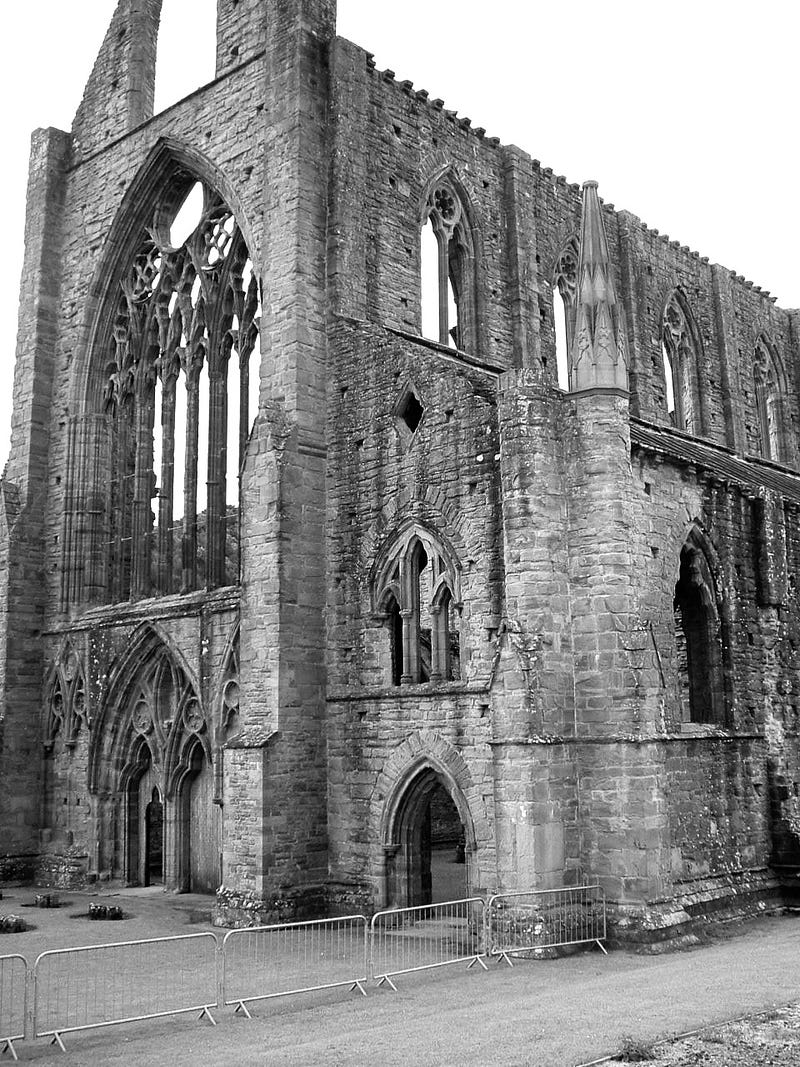
For some time, I’ve struggled with how to represent the majestic Tintern Abbey in words and pictures. In my photos, the reddish gray brick, though its real color, made Tintern seem too small, too of this world, when really this magic spot in Wales is eternal and infinite.
Now, I’ve finally caught a break with the Globetrotters November challenge, “Gray”:
When I switch my Tintern pictures to monochrome, meaning leaps out of them.
I’m transported back to that long-ago time, visiting Wales with my dad when I was 18 years old. Back then, I thought we’d stumbled upon a mystic fairy glen, where ancient creatures from Welsh legend made their home.
Tintern is a place where the mist settles lightly upon the land. It weaves in and out of the empty windows of the abbey ruins, where once there glowed stained glass windows, but now there is only stone and sky.
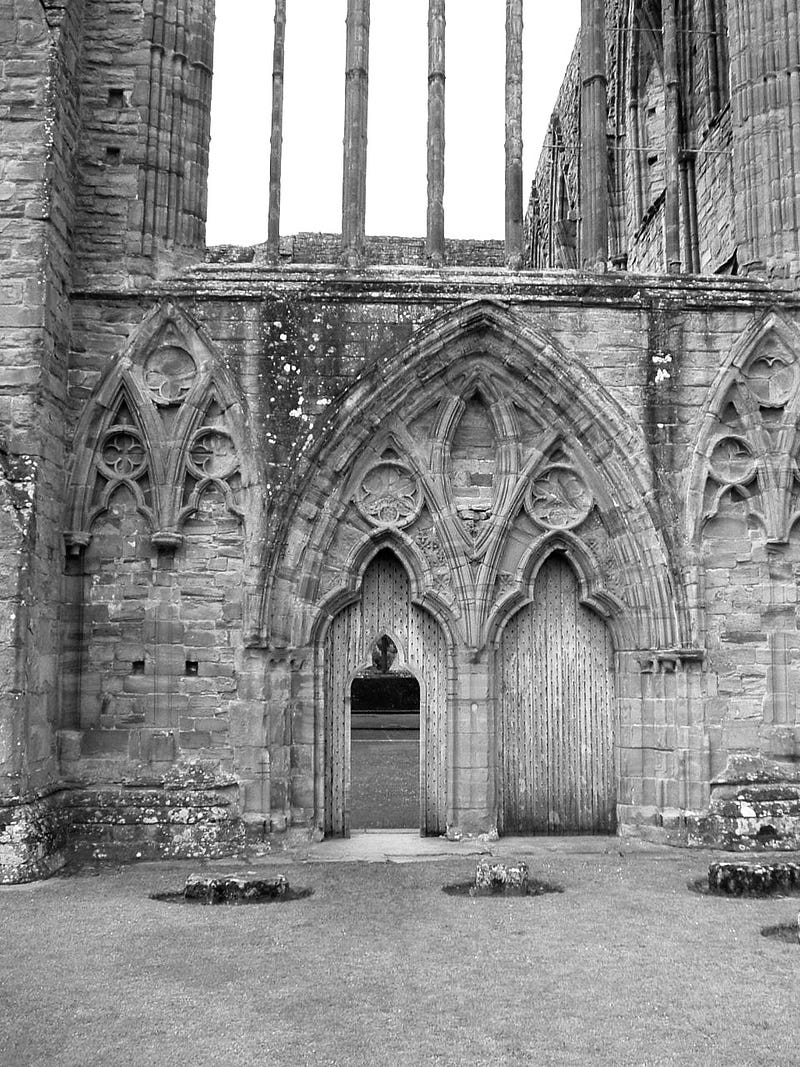
My connection to Tintern Abbey threaded back to my senior year of high school — which seemed so long ago, after all the brightness and blooming and darkness and gloom of my first year of college.
In English class, we studied the Romantic era poets — those writers like Coleridge, Wordsworth, Shelley, Byron, and Keats who created their art around the end of the 18th century and the beginning of the 19th.
It was William Wordsworth, that poet of ballads and daffodils, who led me here to Wales with his poem with the long title:
“Lines Composed a Few Miles above Tintern Abbey, On Revisiting the Banks of the Wye during a Tour. July 13, 1798.”
Tintern Abbey, I thought — what was this place immortalized with pen and ink? Wordsworth writes,
Five years have past; five summers, with the length Of five long winters! and again I hear These waters, rolling from their mountain-springs With a soft inland murmur.
He is returning to a place that pierced his heart in his younger days, which to him as well as to me seemed an eternity ago.
Here, in this “wild secluded scene,” Wordsworth finds that he has changed beyond recognition, morphing into a person who that younger self would no longer know.
Like I do now, looking back on my trip to Wales at the age of 38, Wordsworth tries to will himself to once again feel that youthful flame within his breast, to have that wonderful passion for nature which was to him “all in all”:
The sounding cataract Haunted me like a passion: the tall rock, The mountain, and the deep and gloomy wood, Their colors and their forms, were then to me An appetite; a feeling and a love.
Perhaps sadly for those of us feeling our own increasing age, he finds he cannot return:
That time is past, And all its aching joys are now no more, And all its dizzy raptures.
But sitting in his perch above Tintern Abbey, Wordsworth finds that he, his present self, has an even greater gift. With time, he has grown wise, and he can see a bigger picture of the earth and man’s place within it, and “a motion and a spirit” that “rolls through all things.”
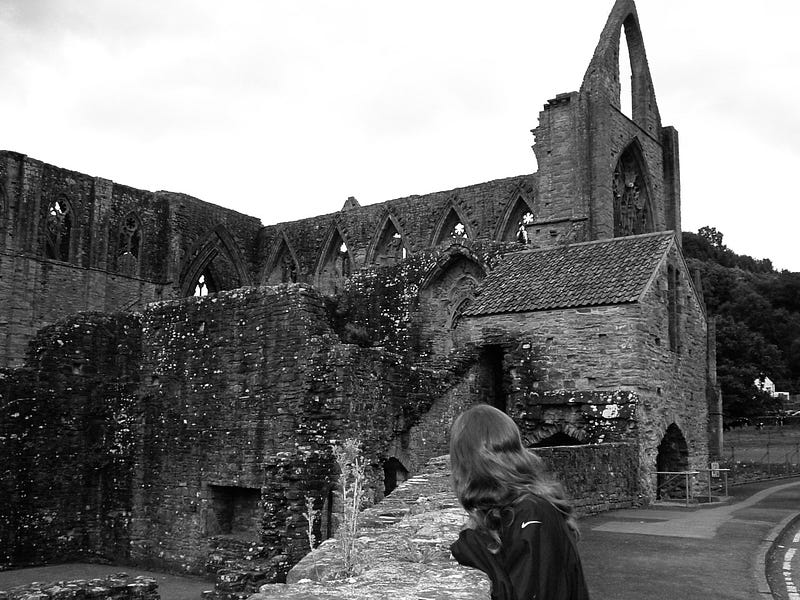
When I was 18, I wondered if I, visiting while still so young, could feel those dizzy raptures and aching joys.
I wanted to visit Tintern because of this connection to this poet I loved. Wherever I travel in Europe, I feel the awesome sensation of having walked where many great people have walked before, that because I stride in their wake, I can be great, too.
So I told my dad to point our car, rented in London, toward Wales.
As we approached the English-Welsh border, there seemed to be a hint of magic in the air of a different kind than I had felt when looking upon the ancient fields of England for the first time. We drove though the Forest of Dean, where leafy canopies engulfed the one-lane road and an old pub, the Saracen’s Arms, proclaimed its medieval origin.
And then, the road signs changed. They were written not only in English, but in the lyrical language of Welsh, in that cacophony of letters and sounds that confounds the eye and ear. Place names like Pwllmeyric, Mynydd-Bach, Abaty Tyndryn.
I breathed faster with anticipation as we rolled through the low Welsh mountains, descending into a forested glen. And then there it was, down in the hollow — Tintern Abbey.
Once magnificent and cathedral-like, it had fallen into ruin after the Dissolution of the Monasteries in the 16th century. Now it stood here, romantic, desolate, waiting for the return to its former glory that will never come.
We were the only visitors. The day was cloudy and dark, with the scent of rain in the air. It was so quiet I could almost hear the trees breathing. They were all around, carpeting the floor of the valley and the slopes of the hills.
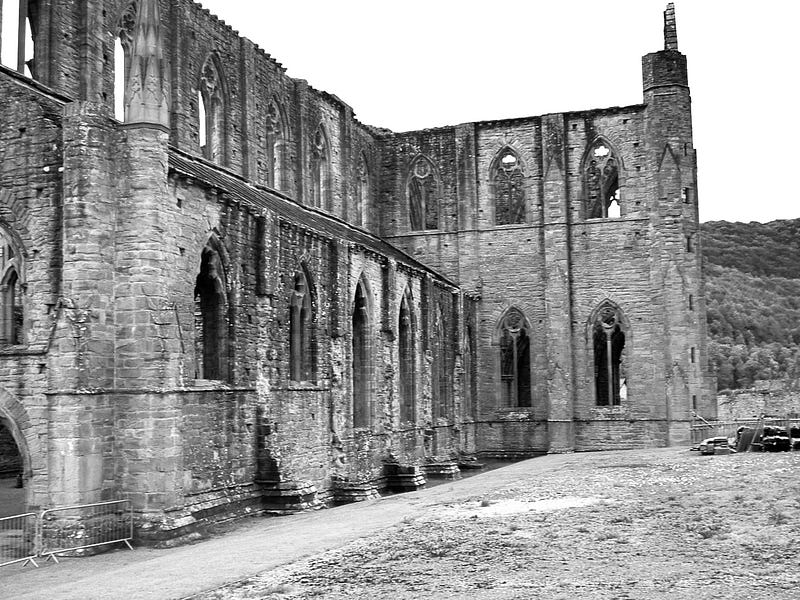
Though the abbey was ruined and lonely, I felt the same spark here as I did when I read the Wordsworth poem.
We could not spend much time there, since we only had a week in the U.K. and our itinerary called for driving all the length of England and up through the Scottish Highlands, but it was enough. The spirit of the place had seeped into me.
Back home, I would imagine that the misty fold in the mountains across from my house was a fairy land like that I encountered at Tintern Abbey.
Someday, I will have to write a poem about it, I suppose, making my thoughts and feelings immortal just as Wordsworth did that day in 1798 when he composed his lines above Tintern Abbey.
Thanks for reading, and thank you to the editors at Globetrotters (JoAnn Ryan, Anne Bonfert, Jillian Amatt — Artistic Voyages, Adrienne Beaumont, Michele Maize) for running a great publication.
I’ve been following Carol Labuzzetta, MS Natural Resources, MS Nursing’s journey on a Viking River cruise ship, which I’d like to partake in one day.
I love how Jillian Amatt - Artistic Voyages, a colorful person, writes about her travel experiences with the color gray:
This Tintern Abbey article is the 10th in my “A-Z” travel challenge undertaking (which I’m doing out of order). The list of my articles is here:


