
London’s Hidden Memorial to Heroic Self-Sacrifice
From graveyard to Postman’s Park to the ultimate altruism.
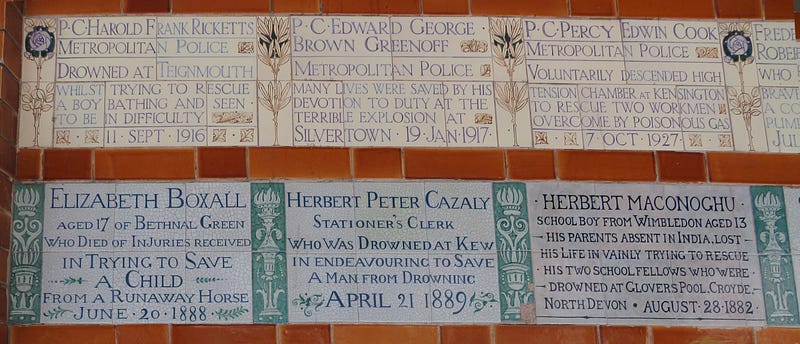
In 2009 the name of Leigh Pitt, in recognition of an incident two years earlier, was added to an unfinished Victorian memorial. It was the first name to be added in 80 years, and the reason it stands is due to a series of unrelated events.
At the core of modern metropolitan London is ‘The City’, sometimes called ‘The Square Mile’, occupying more or less the area the Romans enclosed with walls to create Londinium. It has a resident population of just under 9,500, and is dotted with small, quiet, public gardens which daily commuters (all 480,000 of them in normal circumstances) frequent to eat a packed lunch or stretch their legs mid working day.
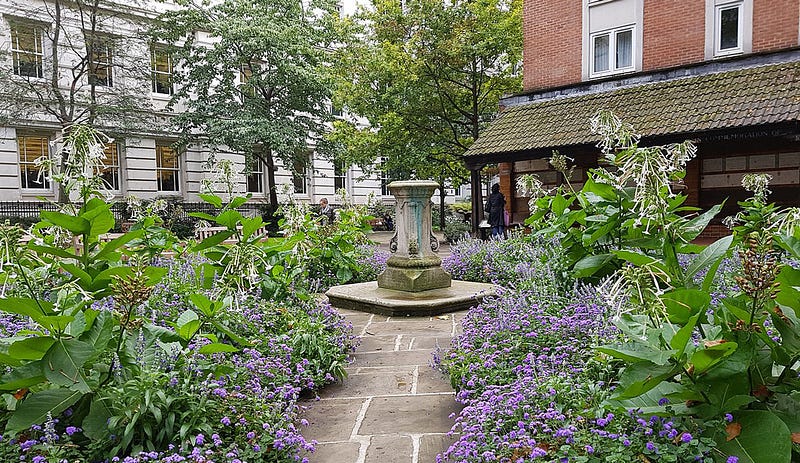
Postman’s Park is one of these gardens, created on the burial ground of the medieval church of St Botolph-without-Aldersgate, Aldersgate being the site of one of the original Roman gates into the city, ie The City. The fortunes of St Botolph’s church rose and waned down the centuries, surviving the Reformation, The Great Fire which razed over 50 churches close by, and serious disrepair, to be rebuilt in minimalist brick in the 1700s.
However, by the early Victorian period, a rapidly expanding London had become a major health hazard. Cholera and other epidemics were rife, but not until the Great Stink of 1858 was the need for drastic action accepted. As well as a new sewerage system, much of it hidden by constructing stone Embankments on the reclaimed shoreline of the River Thames, late medieval tenements were demolished, streets widened, and overcrowded graveyards closed and cleared. In an 1888 survey, St Botolph’s churchyard was found to be standing nearly five feet (1.5 metres) above street level.
Many graveyards were turned into gardens. Despite its rebuilt church occupying part of the site, St Botolph’s became known as Postman’s Park due to the proximity of the General Post Office and use by its workers. During this transition the Rev Henry Gamble took up his post. Already stripped of its parish, the church needed funds and a true purpose. He recalled a letter to The Times some years previously, and contacted its writer, George F Watts, a renown painter and sculptor.
To mark Queen Victoria’s Golden Jubilee, Watts had suggested a memorial, not to ‘great men of Empire’ as was usual for the era, but to the heroic actions of ordinary people while going about their everyday lives — the very people using the precincts of St Botolph’s on a daily basis. The idea hadn’t been taken up, but the Rev Henry Gamble considered it a concept both inspirational and an antidote to widespread drink and licentiousness. He offered space for Watts to fulfil his vision.
Watts jumped at the invitation. For years he had been obsessively compiling lists and scissoring news-cuttings, and he had a ready supply of candidates. His friend and ceramicist, William De Morgan, agreed to create tablet-tiles, and a 50ft open-sided cloister roof was erected to protect them, visible in the image above.
The first four tablet-tiles were in place for the opening of the park on 30th July, 1900, officiated by the Lord Mayor, and the Bishop of London. Another nine tablet-tiles were added in 1902. Eventually 54 were to be erected, commemorating 62 people.
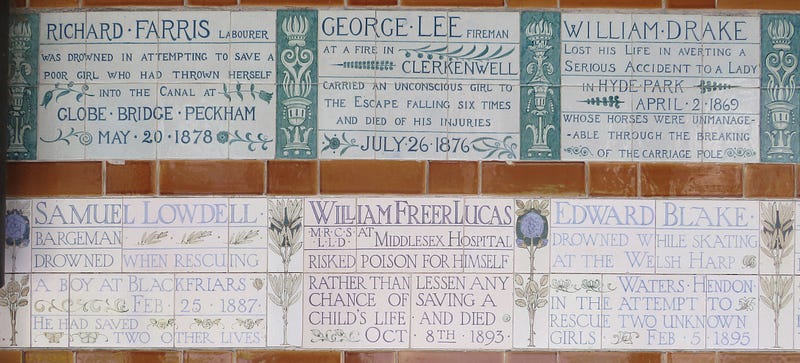
All the tablet-tiles are deliberately succinct in their detail; there is none of the sentimentality often seen on Victorian grave-markers. Watts’ intention was not to idealise the people named, but their selfless actions which, in most cases, saved a life at the cost of their own.
The surprise for the time was that those commemorated were not all men, but also women and children, the youngest eight years old. Perhaps it is this succinctness of detail — the mirror of a split-second decision — that modern viewers find so powerful.
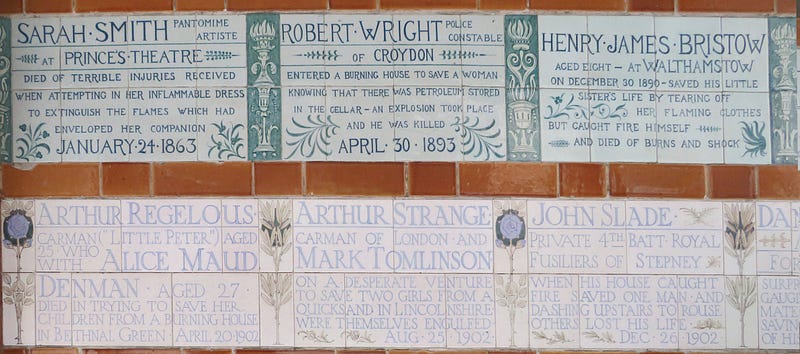
The memorial certainly affected John Price, seeking somewhere quiet and shady for his lunch just over twenty years ago. It pricked, and then gnawed, at his consciousness. Who were these people? What were the circumstances of their self-sacrifice? Like George F Watts before him, he became somewhat obsessive, even to directing him to a new career in academia. His eventual Phd in Modern History led him to answering these and other questions in a book, ‘Heroes of Postman’s Park’.
One of those questions was Why is the memorial half empty? Despite the 54 tablet-tiles erected, the space was designed for twice that number.
As with the city’s Roman wall, and St Botolph’s church and graveyard, time and events conspired against it. Watts was not a young man, and died in 1904 at the age of 87. His wife undertook to continue his work, but war was looming and interest waned. By 1918 self-sacrifice had taken on a whole new meaning. Four tablet-tiles were added as late as 1930–31, but again World War II showed that self-sacrificing heroism, of Londoners and the country’s population in general, was not unique. Nearly 80 years passed.
In 2007, hearing screams for help, Leigh Pitt dived into a deep-sided canal at Thamesmead to save a nine year old from drowning, which he achieved, losing his own life in the endeavour. Leigh Pitt worked as a printmaker in one of the financial institutions on the same street as St Botolph-without-Aldersgate. He spent time in Postman’s Park, as did his co-workers. It was they who raised the money and petitioned the authorities for a tablet-tile carrying his name and deed to be added to the memorial.
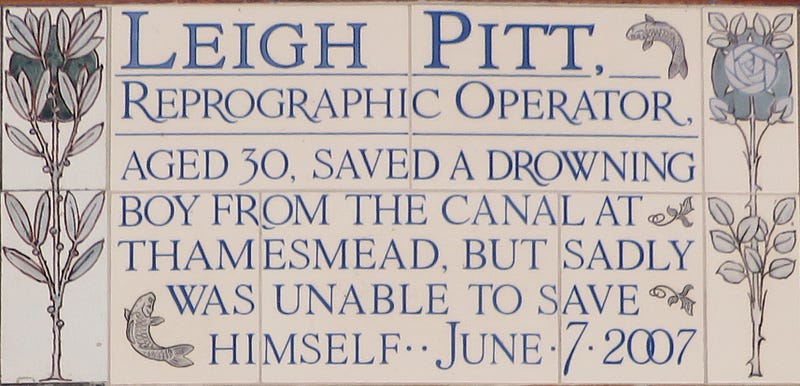
There are those who say it should not have been incorporated, and further petitions have since been refused. George F Watts envisaged and planned the memorial as a complete entity: he had the full 120 heroic sacrifices listed. He simply ran out of time to oversee the venture.
Personally, I appreciate the adding of Leigh Pitt’s name and deed, and hope others will be added. It stops the memorial from standing as a preserved museum piece neatly compartmentalised into the Victorian Age. Spanning the decades, the tablet-tiles as a group remind us all that, if the occasion arises, we too might be capable of a truly selfless, heroic, act.