
London Calling — The Clash
The Greatest Album Ever
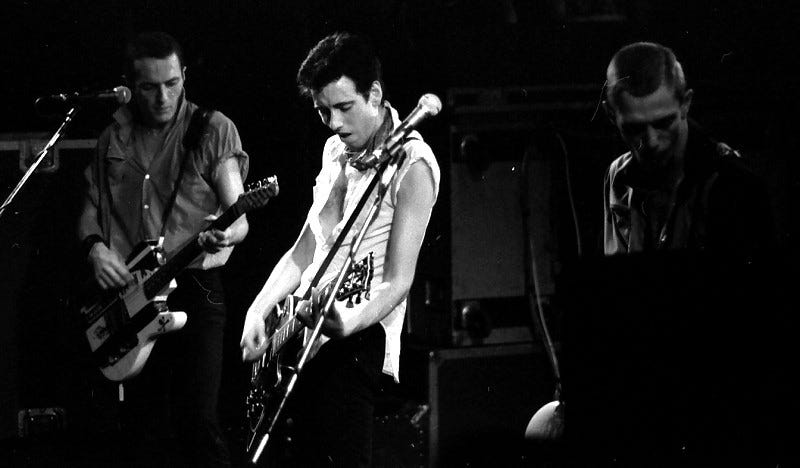
In the punk days, double albums were as rare as hen’s teeth — and for very good reason. The only bands at that time who produced double albums were hoary old rockers like The Eagles or Genesis. They were generally considered the most rockist thing on the planet, and let’s be honest — being branded rockist was tantamount to being cast into the seventh level of hell. Unthinkable. Utterly beyond the pale. Never trust a rockist.
So, in 1979, in the wake of the firing of Bernie Rhodes — their manager of 3 years — the Clash were at an impasse. They had no new songs and no rehearsal rooms. Their last record had been a cover version (“I Fought The Law”) and a damn good one at that, but new material was, as they say, ‘contractually obliged’, and their main songwriters, Joe Strummer and Mick Jones, were suffering burnout after an extended US tour and unable to write anything useful.
Two of their roadies found them a new rehearsal room in London, the Vanilla Studios. It was time to make a plan. The band got together and decided to ban fans from the rehearsal rooms so they could work without extra pressure.
This was an unusual move for a band as open and democratic as The Clash, but they felt that to work they needed a safe place to be creative in. So, fans were out. They also decided to stick to a work schedule — afternoon rehearsals, then five-a-side football, rehearse again, go to the pub and rehearse again. As I wasn’t there (nobody was!) I have no idea how that third rehearsal, after the pub, went, but judging by the quality of the final record I’d say it worked pretty well.
The last thing they did was guaranteed to piss off the record company (at this time, CBS) and it did. They asked Guy Stevens to produce the record. CBS had problems with his confrontational style, his drinking and his drug-taking.
Guy Stevens was a rock’n’roll original, having worked with Chuck Berry, Mott The Hoople, Alex Harvey, and others. The Clash had met him years earlier, when he had just served a prison sentence for drug offences, and they all got on well together, so they invited him to produce London Calling. A smart move, it turned out.
Once again, I’d say the quality of the final record proved The Clash right.
The Album
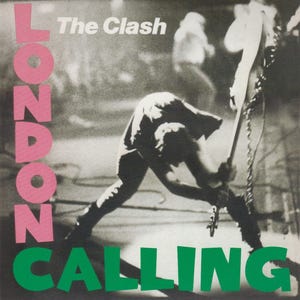
On 15th December 1979, the album was released. The content was so eclectic, the song styles so varied, no-one had any idea what kind of reception it would get.
It was a rapturous success. Every single track, from the first track on side one (“London Calling”, the first single from the LP) to the last track on side 4 (“Train In Vain”, not even included in the track listing printed on the album) is a classic. Everyone I know who loves this album has a different favourite track, from the post-punk rock of London Calling to the post-apocalyptic paranoid dub reggae of Guns of Brixton, they’ve all got their place in somebody’s heart. Personally, I can’t choose between the two I’ve just mentioned. Also, as I bought the record when it came out, I have always associated it with Christmas. “Brand New Cadillac” is, in my mind, a more evocative Christmas song than “Fairytale of New York”. Of which, more later in this series.
This album has been voted number 6 in Rolling Stone magazine’s top 500 albums of all time. For me, it can only ever be Number One.
London Calling Track Listing
Side One
London Calling, Brand New Cadillac, Jimmy Jazz, Rudie Can’t Fail
Side 2
Spanish Bombs, The Right Profile, Lost in the Supermarket, Clampdown, The Guns of Brixton
Side 3
Wrong ’Em Boyo, Death or Glory, Koka Kola, The Card Cheat
Side 4
Lover’s Rock, Four Horsemen. I’m Not Down, Revolution Rock, Train In Vain (uncredited in the UK).

There are so many genres of music here, reflecting all The Clash’s obsessions. “Brand New Cadillac” is pure old-fashioned rock’n’roll, while “Jimmy Jazz” is a brisk slice of old-school ska, verging on the kind of easy listening their parents probably listened to. The band’s (and especially Paul Simonon’s) love of reggae comes out in “The Guns of Brixton”, “Lover’s Rock” and “Revolution Rock”. All in all, this is a varied and important album.
Follow for the other 9 albums in my personal all-time top ten.