
Lockdown Fatigue
Lily loses her sense of humour
Cars squeal and blare horns, pushing through the rain towards something else. Home maybe, or work. The shops. Certainly not a friend’s house, to the cinema, to a pub. Those days are gone and almost forgotten. Do you remember, arranging to see a friend next week, booking a table and knowing that you’d be able to go for a meal? Not worrying that the restaurant would be forced to shut, that we’d all be back indoors, or even if it went ahead, that the person on the next table would kill you with a poorly timed sneeze.
It’s been winter forever, the skies barely lighten before darkness falls again, glowering under a mass of rain clouds, dark grey against the greasy bare branches of the trees. The grass looks sickly in the low, rain sodden light and the pavements are stuck with rotting leaves, slicked down by incessant downpours, unable to blow away.
I leave Amber at home, sulking under a blanket, and take my state-mandated exercise with as little enthusiasm as I’ve ever felt.
‘Why do you martyr yourself, Lily?’ she asked me. ‘Why don’t you just hide from the weather like everyone else?’
But I honestly think I’ll claw my own face off if I stay in the house for one day longer. Or hers, which would be even worse. She doesn’t deserve it, my moods, my stormy tantrums and rages. She’s a child of the south, all soft skin and blonde hair, made for eating cucumber sandwiches in the sunshine, or drinking Pimm’s in a park. Not this crazed half-life of clinging on to sanity with your fingernails whilst pretending you’re still normal to your colleagues over a web cam.
The wind scrapes through my hair, gusting a spatter of hard rain into my eyes, along with the exhaust fumes of the X1 as it chugs past, empty apart from a few nervous looking souls, keeping their hands to themselves and their faces covered.
My own mask is already damp with rain, rinsing off my skin and soaking my hair into rats’ tails which slap themselves around my face like a rebuke. I head towards the cemetery, which is looking suitably gothic behind the ostentatious Victorian gates. Memorials to other people’s loss and heartbreak are silhouetted against the sky, looming at rakish angles as the earth under them sinks into the space where flesh used to be.
Marching through the gates, I notice the sound of traffic fading out behind me, and, taking my mask off outdoors for the first time in days, I breathe fresh air. Air which is filled with the smell of rain, last autumn’s fallen leaves, and mud. Brown, brown, brown, the trees, the earth, the paths. The graves mix it up a bit by adding some grey, just for a change of scene.
A robin is watching me from the beech tree up ahead, cocking its head on one side and beckoning me further in. I follow it, past the moss-covered tombs, the dark yew dripping with the skeleton of the wild clematis which once scrambled over it so freely. A fox has its den in a glade beneath, yellow eyes watch me from the gloom, as further and further I go, into the grounds.
The robin starts to sing, and I step through a door, into another time. The trees rustle in a light spring breeze, sunlight sparkling off their fresh green leaves. Over on the hill, the ancient cherry tree, planted to honour someone long lost and whose name has now fallen from the stone left to mark them, is in full bloom. Garish pink blossom froths over its dark twisted limbs. Around my feet, violets have scattered themselves amongst the daisies and the sun is warm on my face.
I take a deep breath, full of green grass, honeysuckle and roses, and sit on a fallen branch. Squirrels play in the pine above, chasing each other and thumbing their noses from rival trees. There’s a blackbird, singing a song of lazy days and plentiful food, and behind me a mouse gathers seeds amongst the dry earth by the roots. If I turn too fast it pauses, hoping I won’t notice it; it’s so small, so easy to miss.
A light gust of wind sends the unmown grass swaying and shimmering beneath it, butterflies flutter above, dancing amongst the cornflowers and poppies. I lean back on the branch and close my eyes, listening to a bee humming its way merrily in and out of the foxgloves, which loom amongst the ivy under the old oak tree to my left.
So many people have stood here and wept. So many people have felt their lives halt, in an instant, as the unthinkable happens and they bury their mother, their father, their lover or child. There are huge memorials, hulking tombs to beloved wives and husbands, identikit stones for the soldiers, only the insignia and their names are different. Tiny graves, for Grace or Isobel, Catherine or Richard, Samuel or Mary who died before their third birthday, a larger one for the only son who drowned over a century ago.
Over by the laburnum are angels who commemorate the two little girls murdered by the same man. There are tiny headstones marked only with initials, and there are dips in the ground whose wooden crosses have long ago rotted, but their sunken remains are still visible. So many inscriptions to lives cherished, and now forgotten. All that remains are the chipped facades of loss amongst the trees and flowers, covered in moss and ivy, their edges softened by time.
The sun beats down on my skin, turning it flushed and pink, and the breeze lifts my hair and carries birdsong to my ears. The mouse has got bored and gone home to sleep, but a raven stalks around my feet imperiously, asking me what I’m doing there, taking up its space. The squirrels watch and laugh, throwing nuts at us from the trees. I feel my muscles relaxing, my shoulders sinking back down from around my ears and my breathing slows to a gentle rhythm, filling me with peace.
Eventually I struggle up, brushing cherry blossom from my hair, and wander back down the path towards the entrance, my steps lighter and my skin tingling. My hair is warm and lifting over my shoulders as the south wind plays with it.
As I walk back through the cemetery gates, the cars hurtle past, swooshing on the rain-soaked street, their headlights reflecting off the tarmac and blinding me. I scrape my soaked hair from my forehead, splat my mask back across my mouth, and head to the shop at the end of the road.
Amber is cooking dinner when I get home, a thick Hungarian stew that she learned from her mother which warms your bones and is filled with paprika, red wine and cinnamon. ‘Feeling better?’ she asks me, smiling.
‘I love you,’ I tell her, handing her the roses and wine. ‘I’m sorry I’m such a moody cow.’
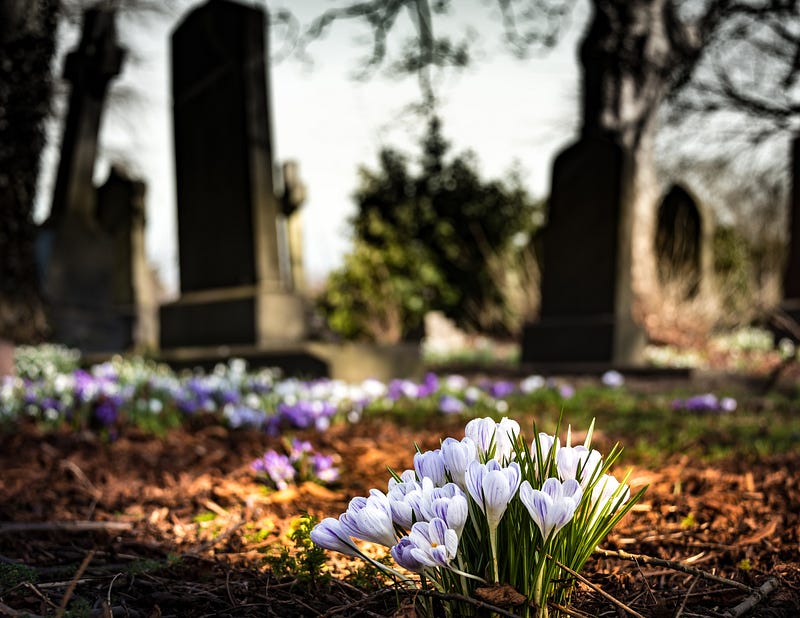
She kisses me and everything’s alright again. As I set the table, I tell her about the crocuses and primroses which are pushing their way up through the black mud outside, and she tells me about friends she’s caught up with while I was out. Rosa’s pregnant, and Matt is engaged. There’ll be a wedding to look forward to next year, or the year after, whenever it’s possible.
We tuck into dinner by candlelight, drinking red wine and laughing together about stupid things we’ve seen in the papers, or jokes our friends have texted, and I feel the weight lift from my shoulders.
This will pass, as it always has and it always will, but, for the first time in weeks, I feel that we will be here to see it when it does.
Svetlana Smith 2021


