
LLM Apps : Why there is no Prod ready RAG w/o Distributor : 1
In LLM Apps, why no Prod-ready RAG sans Distributor? Next part we will build it.
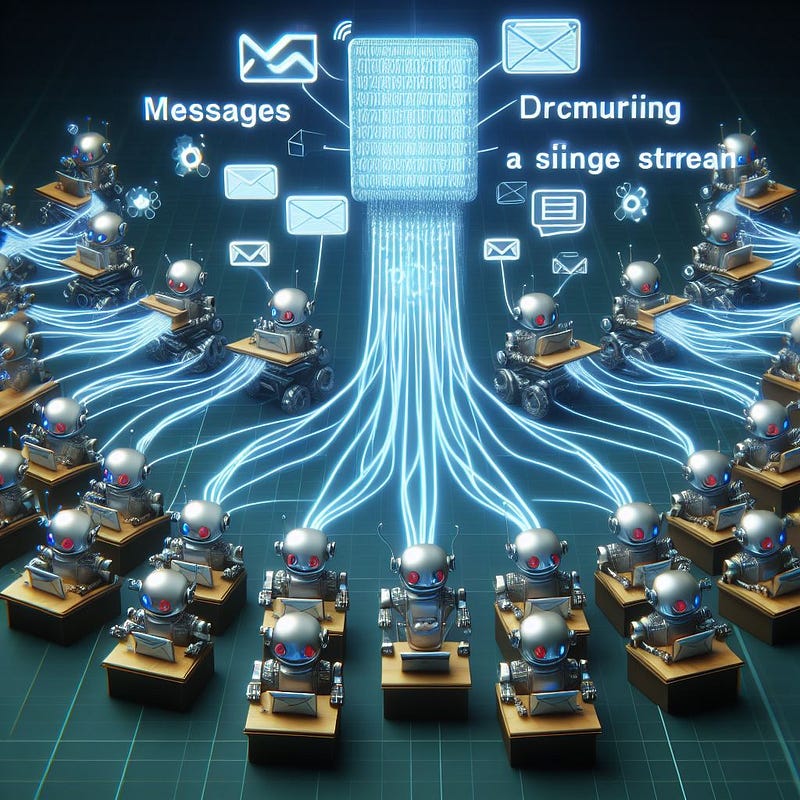
Retrieval-Augmented Generation (RAG) models offer unprecedented capabilities in natural language processing. However, achieving production-level performance and versatility with RAGs demands a powerful distributor component to intelligently coordinate various models within the overall system.
What I mean by Distributor

I am envisioning a distributor as a system component with multiple key functions.
- Intelligent Management of Multiple Models : Emphasis is on deploying various RAG models — or other specialized language models — each potentially having strengths in different:
- Knowledge domains (e.g., a finance RAG, a legal RAG)
- Task types (e.g., summarization-focused vs. detailed report generation)
- Query/Event Routing : The distributor is responsible for analyzing incoming queries or events. Using NLP or some key conditions, it determines the most appropriate model or models to handle a specific request.
- Load Balancing : Beyond merely understanding queries, the distributor ensures incoming requests are spread across models to prevent one model from being overwhelmed, optimizing computational resources.
- Potential for More : additional capabilities like ensemble techniques (combining outputs from multiple models) and dynamic model selection based on performance metrics.
Why It’s a Distributor?
Let’s connect this to the idea of distribution:
- Distribution of Work : This component distributes incoming queries, ensuring workload is spread effectively across your array of models.
- Distribution of Expertise : The distributor is aware of the specialization of each model and distributes requests according to those areas of expertise.
Let’s design Distributor

In the realm of software architecture and design, patterns serve as invaluable tools for solving recurring problems efficiently. Among these, the Content-Based Routing design pattern stands out as a versatile and powerful approach to managing message flows within distributed systems. For designing our Distributor, we will use and delves into the intricacies of Content-Based Routing, exploring its principles, implementation strategies.
At its core, Content-Based Routing operates on the principle of decoupling message producers from consumers, thereby promoting flexibility and scalability within distributed systems. By basing routing decisions on message content, rather than static routing rules, CBR facilitates dynamic adaptation to changing system requirements and conditions.
Design Considerations
- Rule Complexity : Start with simple rules for maintainability. Complex rules often warrant a dedicated rules engine.
- Performance : The CBR may become a bottleneck. Pay attention to message inspection logic and rule evaluation optimization.
- Error Handling : Define strategies for mismatched rules or routing failures (e.g., dead-letter queues).
- Observability : Implement logging and monitoring to track routing decisions and troubleshoot issues.
Key Aspects
- Dynamic Routing : Leverage external data sources like databases or configurations to make routing decisions on the fly.
- Content Enrichment : Before routing, the CBR can modify or add metadata to the message, simplifying downstream logic.
Core Mechanics
The Content-Based Router (CBR) performs these essential functions:
- Message Examination : The CBR inspects specific fields, headers, or even the entire payload of incoming messages.
- Routing Logic : It applies a set of predefined rules to evaluate the extracted message content. These rules may include:
- Simple checks (e.g., if a field contains a specific value)
- Pattern matching (e.g., regular expressions against text )
- Complex criteria (e.g., a range, numerical comparisons)
3. Targeted Dispatch : Based on the rule evaluation, the CBR forwards the message to the appropriate endpoint, channel, or downstream processing component.
So, in conclusion why to build “Distributor” for RAG using “CBR”
A sophisticated distributor is the key to unlocking the full potential and overcoming the limitations of Retrieval-Augmented Generation models for real-world applications. Content-Based Routing provides the cornerstone for such a distributor. This is why:
- Overcoming Specialization vs. Accuracy Trade-off:
- Problem: Single RAG models struggle to maintain peak accuracy across diverse domains. Specialists are needed (e.g., financial RAG, medical RAG).
- CBR Solution: The distributor analyzes query content. Rules route queries to models specializing in matching domains, maximizing accuracy.
- Efficient Resource Management:
- Problem: RAG retrieval components are computationally expensive. Scaling one monolithic model across various domains is inefficient.
- CBR Solution: Queries are triaged. Only the most suitable RAG model(s) are triggered, conserving resources. Example: If the query isn’t finance-related, why overload the financial RAG?
- Handling Fluctuating Workloads:
- Problem: Spikes in traffic could overwhelm specific model types if query types aren’t evenly distributed.
- CBR Solution: Load-balancing rules within the CBR spread requests across replicas of specific model types, preventing bottlenecks.
- Enabling Seamless Evolution:
- Problem: RAG systems need agility to adapt. Adding new RAG models for new domains creates deployment management overhead.
- CBR Solution: Updates involve mainly the CBR’s routing rules. Individual models are isolated, ensuring less disruption and promoting continuous delivery practices.
- Dynamic Ensemble Techniques
- Problem: No single model might provide a “perfect” response in all situations.
- CBR Solution: CBR goes beyond simple routing. It identifies queries where combining outputs from multiple RAGs improves the answer. It becomes the orchestrator of an ensemble.
Additional Considerations
- Fault tolerance: Well-defined CBR error rules direct messages if individual models fail. This boosts overall system resilience.
- Adaptability: CBR configurations evolve independently of model code. The RAG system responds quickly to changing business needs or usage patterns.
Conclusion
The Content-Based Routing pattern provides the architectural backbone for a distributor in production-ready RAG systems. It addresses core challenges of scaling, specialization, dynamic model use, and adaptability. Without intelligent CBR-based orchestration, the practical deployment of RAG technology, despite its enormous potential, would remain elusive.