
Living the Mindful Life
9 practices to embrace in your everyday
The last two years have had an impact on all of us — normal life, as we knew it, came to an unexpectedly long and abrupt halt.
Life became so unpredictable. One seemed to live with constant uncertainty and the fear of not knowing what tomorrow would bring.
But it is the global pandemic that lead me to voluntary work with the Centre of Mindfulness Studies here in Toronto, where I participated in a transformational mindfulness training course — it was my introduction to the work of Jon Kabat-Zinn, the pioneer of MBSR, Mindfulness-based Stress Reduction Therapy and a name synonymous with mindfulness.
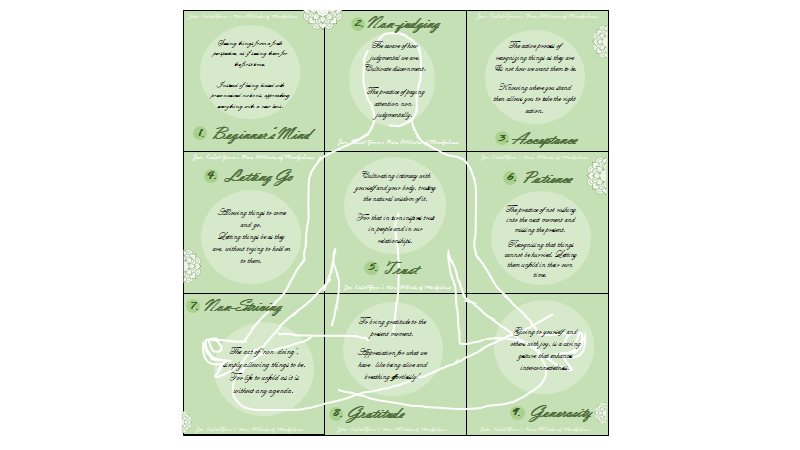
The 9 mindful practices as taught by him have provided the perfect framework for bringing about change from within. I share them below, with the hope that you find them as helpful as I did, in cultivating a healthy mindset, free from excessive worry with a focus on the present moment:
1) Beginner’s Mind
A key starting point: It is the practice of seeing things from a fresh perspective, as if seeing them for the first time. In other words, approaching everything in life with a new lens instead of viewing them through our tunnelled vision of preconceived notions.
If you are stuck in the rut of your own fixed ideas & opinions there is no scope for novelty and growth. Imagine viewing your children with fresh eyes every day, instead of through already-formed opinions and labels.
2) Non-Judging
Our tendency to judge, which seems to come naturally to most of us, creates a veil in front of our eyes. It is important to recognise this tendency to judge, but not be imprisoned by it.
If we could just observe our judgements, acknowledge them, and not ‘judge the judging’, ironically, we might actually be on the path to becoming less judgemental and living life more authentically!
3) Acceptance:
It is the active process of recognising things as they are & not how we want them to be. We get so caught up in trying to change things to suit ourselves, that we don’t allow them to just be. Acceptance, especially of unpleasant or negative occurrences, thoughts and emotions is not easy.
Consider pain. Before you can actually deal with the pain, you first need to accept it and allow it to be. That is the first crucial step towards healing. Once you know where you stand, you can work on how to change the situation and take the right action.
4) Letting go:
Letting go goes hand in hand with the preceding practice of acceptance. Only if you accept and recognise things as they are, will you be in a position to let them go instead of trying to hold on to them. In other words, allowing things to come and go. During the course of our lives, it is inevitable that we will experience both the pleasant and the unpleasant.
We have a natural desire to cling to positive experiences and to push unpleasantness away. Cultivating the habit of letting go, though a very difficult practice to master, is most therapeutic.
Hard as it may seem, it is a natural part of life to receive and then release, letting go. Our breath reminds us of that … every time we take a breath in, we have to let it go, otherwise there would be no room for the next breath.
5) Trust
The mindful practice of ‘trust’ entails cultivating an intimacy with ourselves and our bodies, trusting the natural wisdom of it. We take our body totally for granted, till something goes wrong.
Be mindful and notice how beautifully our body supports our life…how our breath takes care of itself, our organs take care of our metabolism & the biology of being alive.
The more we can learn to bring trust to ourselves, the more we can learn to bring trust to everything and being in our lives: other people, our relationships & nature.
6) Patience
Patience can be very healing and restorative, but requires a lot of work. It is the practice of recognising that things cannot be hurried, but unfold in their own time.
The growth process of a butterfly is a prime example of this: If we try to rush the process, instead of allowing the chrysalis to metamorphize, the butterfly does not develop properly. Patient struggle is part and parcel of its journey to becoming a well-formed butterfly ready for flight.
Similarly, we need to pause and be where we actually are, working our way through different phases, instead of trying to rush through every moment, pushing our agendas.
7) Non-striving
The 7th practice of non-striving is the act of ‘non-doing’, an engaged restraint from action or effort - closely connected with the practice of ‘Letting go’. It is the realization that wherever we are in life is good enough, simply allowing life to take its course.
Let life unfold as it is, without trying to escape, or without an agenda to follow. One way of cultivating this habit would be introducing short periods of stillness and quiet throughout the day by closing your eyes or intentionally refraining from looking at your screens. Just a few minutes is enough to center your energy and produce therapeutic effects.
8) Gratitude
We tend to take so much for granted in our lives. There is a strong need to bring gratitude to the present moment, realising how blessed we are to be alive, with our body working in perfect harmony: to be thankful for having eyes that can see, ears that hear, hands and feet that work!
Being mindful of these blessings is so important. However, we normally only come to this realisation when something goes wrong, an injury for example which propels us into actually thinking about and counting our blessings. The practice of gratitude keeps negativity at bay and fosters a spirit of contentment with life.
9) Generosity
Finally, we have the practice of generosity — giving our time and attention to ourselves and others, showing that we care, enhancing the feeling of interconnectedness.
Bringing joy to others, striving to give people what would make them happy is known to have many physical and psychological benefits. It doesn’t have to be anything grand; it can be something as simple as smiling at a stranger, who for all we know may have been having a bad day and could really use a kind, friendly smile.
The key to staying calm and grounded is to bow down and accept where we are in life’s journey, non-judgementally and with compassion. Have faith that your life will unfold exactly as its meant to.
For more details on each practice and a visual representation please check out my Instagram : @unravellingyourmind.
If you enjoyed reading this, here’s another one:
I’m so grateful and want to thank these wonderful souls who have been instrumental in helping me find my voice on Medium —first and foremost, Rachael Nixon, who nudged me towards this platform and has been so helpful, Caitlin McColl who published my first piece in her publication, Mindful Mental Health (please check it out if you haven’t already), & the incredible Keri Mangis and Elizabeth Gordon, who have been so supportive and guided me in navigating this, at times overwhelming, platform. Do check out their inspiring words.
A version of this article was first published in the Elephant Journal. Revised and edited for Medium.