avatarFreddie's Lost Treasures

Free AI web copilot to create summaries, insights and extended knowledge, download it at here

3578

Abstract

quote id="5e30"><p>“This 12-month record is exactly what we expect from a global climate fueled by carbon pollution,” Dr. Andrew Pershing, vice president for science at Climate Central said. “<b>Records will continue to fall next year, especially as the growing El Niño begins to take hold, exposing billions to unusual heat.</b> While climate impacts are most acute in developing countries near the equator, seeing climate-fueled streaks of extreme heat in the U.S., India, Japan, and Europe underscores that no one is safe from climate change.”</p></blockquote><h1 id="f7b6">Is This Just Weird Weather, or Climate Change?</h1><p id="2bab">One of the biggest (and dumbest) arguments against climate change is that these temperature extremes can just be chalked up to “weird weather this year”.</p><p id="732c">While it’s true that some variation is caused by cyclical weather patterns (see El Nino above), there is now a measure of how much of our exteme climate is likely to have been caused by humans through fossil fuel and other emissions.</p><p id="5282"><a href="https://www.climatecentral.org/tools/climate-shift-index">The Climate Shift Index</a> was created to show just how much influence human activity has on weather.</p><blockquote id="ef7b"><p>The CSI is a categorical scale, with the categories defined by the ratio of how common (or likely) a temperature is in today’s altered climate vs. how common it would be in a climate without human-caused climate change.</p></blockquote><p id="62b2">To simplify this, let’s look at another number.</p><p id="a456">Of the 7.8 billion people who experienced warmer than average temperatures this year, the weather for 7.3 billion of those people was 300% more likely to have occurred due to human activity.</p><p id="55c8">In other words, it is 3x more likely that the GHG emissions caused warmer temperatures than other natural causes, like El Nino.</p><p id="1394">Now, I understand that many people will find this a) difficult to understand and b) hard to believe because humans, as a species, have a tough time with probability based math. We like things to be black and white, right and wrong; not a set of possibilities that might, could have, or probably will cause global warming.</p><p id="35cb">But think of it this way.</p><p id="feb1">The 1990’s Bulls had a 300% increase in the probability of winning when they had Michael Jordan on their roster each night.</p><p id="1aac">Could they have won without Jordan? Absolutely they could have. Just like areas of Earth could have seen these higher temps without GHG emissions.</p><p id="2028">Is it likely to happen every night? Probably not. Just like the global higher temps are unlikely to be seen without GHG emissions.</p><h1 id="ac38">Impacts Beyond Humans</h1><p id="b910">As I’m sure you are aware, climate change impacts all living creatures on Earth, not just humans. However, we are blindly ignorant of the mechanisms of this negative impact.</p><p id="6cc5">I’ve written before about how high heat impacts the <a href="https://readmedium.com/climate-change-will-kill-the-weakest-and-youngest-of-everything-66f16ed8afc8">young and weak first</a>, and the <a href="https://phys.org/news/2022-11-climate-endangered-african-wild-dogs.html">African wild dog is no exception</a>.</p><p id="73ff">Wild dogs normally give birth at a time when the pups can be raised in cooler months. But the higher temps have pushed that back by about three weeks, forcing them to give birth later and later each year.</p><p id="9a97">At first glance, that’s not a big deal, ri

Options

ght? The babies are born later but still raised in the cooler months. The problem is that the seasons of cooler temps is not only getting pushed back later, but it is also ending sooner.</p><p id="3a96">This inadvertently results in wild dog mothers giving birth at just the wrong time.</p><p id="13d1">Now, someone might suggest that they just move to cooler regions. After all, they are wild animals and can go where they please.</p><p id="9ed6">Well, that’s another issue altogether, as wild dogs are now confined to just 7% of their historical range. It’s not like they can just get up and move to a neighborhood park in what was originally their hunting grounds decades ago.</p><p id="c9ee">Why does this matter? Because wild dogs are acting as a proxy for other keystone animals. But it’s hard to get the right data.</p><blockquote id="8156"><p>Because monitoring large carnivore populations over several decades is challenging and expensive, such long-term data either don’t exist or have not been assessed for most large carnivores.</p></blockquote><blockquote id="a1d5"><p>Every time we look for an impact of temperature on African wild dogs, however, we uncover something new and unexpected. <b>Climate-driven impacts on large carnivore behavior, populations and life histories may well be more widespread than previously thought.</b> Because large carnivores play an important role in shaping ecosystems, such impacts have much broader implications.</p></blockquote><blockquote id="cee9"><p>With <a href="https://www.ipcc.ch/report/ar6/wg1/">continued temperature rises projected across their range</a>, the effects of climate change on this already endangered species — and others like it — are of great concern.</p></blockquote><p id="832c">The whole situation is a kind of “climate trap”. Too hot to breed and too many humans around to move.</p><p id="806b">And it’s just the beginning for the animals, too. <a href="https://www.un.org/en/climatechange/science/climate-issues/biodiversity">Biodiversity </a>loss is being touted as an equal to climate change, with both issues clamoring for solutions that actually go <a href="https://jamanetwork.com/journals/jama/fullarticle/2811131">hand-in-hand for each crisis</a>.</p><h1 id="7e95">The Takeaway</h1><p id="05b3">Humanity is finally reaping what we have been sowing since the beginning of the last century. Billions of tons of CO2e, along with myriad other emissions (NOx, SOx, aerosols, etc.) are finally having the impact that was warned about for decades prior.</p><p id="a9da">There is no sustainability.</p><p id="d724">There is no remediation.</p><p id="0d05">There is only adapting to an ever warming world.</p><p id="34c8">We’ll be lucky to merely start reducing global GHG emissions by 2050, which means climate change will be here to stay for at least the rest of the century.</p><p id="b3f7">Best be prepared for the inevitable.</p><div id="e5fb" class="link-block"> <a href="https://anguspeterson.medium.com/subscribe"> <div> <div> <h2>Bypass the algorithm. Control your inbox.</h2> <div><h3>Bypass the algorithm. Control your inbox. Stop letting Medium force content you don't want into your feed. Subscribe…</h3></div> <div><p>anguspeterson.medium.com</p></div> </div> <div> <div style="background-image: url(https://miro.readmedium.com/v2/resize:fit:320/0*Tkvm3Ht3q7tN0uL9)"></div> </div> </div> </a> </div></article></body>

Living In Harmony With Nature:

How Cambodia’s Jungle Taught Us To Appreciate Life More
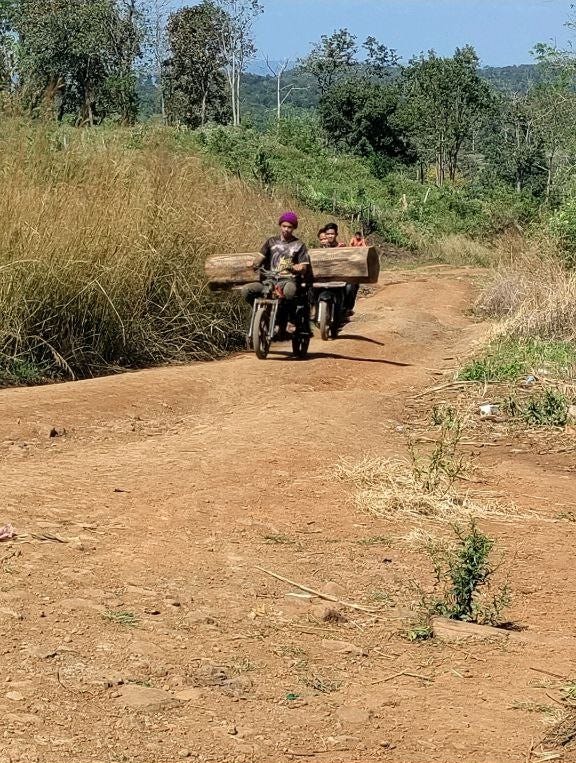
One At A Time Please (Photo by Author)

My wife and I have always loved nature, but we never imagined that we would end up living in the jungle. We were both working in stressful jobs in the city, feeling disconnected from ourselves and each other. We decided to take a break and travel to Cambodia, a country that we had heard was rich in culture and natural beauty.

We arrived in Phnom Penh, the capital, and spent a few days exploring the sights and sounds of the bustling city. We visited the Royal Palace, the National Museum, and the Tuol Sleng Genocide Museum. We learned a lot about the history and culture of Cambodia, but we also felt overwhelmed by the noise, traffic, and pollution.

We wanted to see a different side of Cambodia, so we took our motorbike and headed to Mondulkiri Province, the largest and most sparsely populated province in the country. We had read that it was home to thickly forested mountains, powerful waterfalls, and diverse wildlife. We were excited to see what adventures awaited us there.

We arrived in Sen Monorom, the capital of Mondulkiri Province, after a long and scenic ride. We checked into a guesthouse and explored the surroundings. We were amazed by the scenery: rolling hills covered with green grass, pine trees, and wildflowers. We felt like we had entered a different world.

We visited some of the attractions in the area, such as Bou Sra Waterfall, the largest and most impressive waterfall in Mondulkiri; Phnom Dos Kramom, a sacred mountain with a pagoda on top; and Mondulkiri Project, an elephant sanctuary where we got to feed, bathe, and walk with rescued elephants.

We enjoyed our time in Sen Monorom, but we wanted to experience something more authentic and off-the-grid. We heard about a community of indigenous people called the Bunong, who live in harmony with nature in remote villages in the jungle. We contacted a local guide who offered to take us to one of these villages and introduce us to a Bunong family who agreed to let us stay with them for a few days.

We packed our backpacks and followed our guide on our motorbike. We left the paved road and entered a dirt track that wound through the forest. We crossed rivers, climbed hills, and dodged potholes. After about two hours, we reached our destination: a small village of wooden houses on stilts surrounded by banana trees and bamboo.

We were greeted by our host family, who welcomed us with smiles and curiosity. They showed us our room, which was actually a hut that we had built ourselves with their help. It had a bamboo floor, a mattress, a mosquito net, and a solar panel for electricity. There was no running water or internet connection. We felt like we had gone back in time.

We spent the next few days living like the Bunong people. We ate what they ate: rice, vegetables, fruits, and some various wild meat. We drank what they drank: water from the well and tea from wild plants. We also learned from the Bunong people how they respect and protect the environment. They taught us how to make baskets, mats, and hats from natural materials. They showed us how to identify edible and medicinal plants in the forest. They explained how they worship their ancestors and spirits in sacred places. They invited us to join their ceremonies, dances, and songs.

We felt a deep connection with the Bunong people and their way of life. We realized how much we had been missing in our modern and hectic lives. We discovered a new sense of joy, peace, and gratitude. We found a new purpose in life by living in harmony with nature.

The experience was so impactful that we decided to purchase properties in Mondulkiri Province and call this place our jungle home. We are now living our dream of exploring the unknown and discovering new reasons for living in life. We are happy and fulfilled. We are thankful to Cambodia and its jungle for teaching us to appreciate life more.

Key Message: Appreciating life through a simple and sustainable lifestyle like the indigenous Bunong people.

Please clap, comment, subscribe and help donate to our cause of supporting the Bunong Tribal People of Cambodia.

Nature
Life
Lifestyle
Happiness
Travel
Recommended from ReadMedium