
Living in Cairo, Egypt — Part One
I can’t think of anything more exciting than international travel. “Part One” has been added to the title Living in Cairo, Egypt because I could not imagine sharing my three-year journey through Egypt in just one piece. My interest in international travel began many years ago as a junior at Michigan State University. I student taught at the International School of Brussels in Brussels, Belgium. Many years later, I had the privilege of teaching at a private day school in Charlotte, NC, and earning their Global Educator’s Certification. By doing so, I traveled to several countries and learned about the customs and cultures firsthand. In two countries, we lived with families to be immersed in the culture. Those experiences gave me the desire to live and work abroad. So, as I was nearing retirement age, I did not want to retire before having an International Teaching experience. After applying for a leave of absence, and with help from my head of school, I landed a teaching position in Cairo, Egypt. I taught at the school for three years, between August 2014 and June 2018.
It was as exciting as it was scary to pick up and move to a country across the ocean and so far from home. My husband joined me on this journey, making it easier to be away from our daughters and grandchildren. Although the trip was long, it was smooth and uneventful. There are many options for traveling to Egypt, as we’ve learned. To make a long journey more exciting and fun-filled, plan a twelve-hour layover in a country you have never visited. Not only does it beat two additional layovers where you sit in the airport, but it’s a bonus trip on your journey. New Year’s Eve 2016, we returned to Egypt from the Christmas holiday in the States with a planned twelve-hour layover in Rome, Italy. So, we spent New Year’s Eve in Rome! Our driver took us to the Roman Coliseum, where we walked around for a bit, and then drove us to other points of interest. In the summer of 2020, we drove to Washington, DC, and took our first direct flight to Egypt in less than twelve hours total. Our shortest journey ever to Egypt! As you plan your trip to Egypt or another country, know your tolerance for air travel time and airport layovers. Let that drive your travel planning and itinerary.
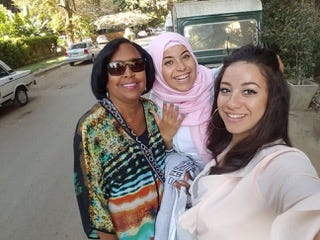
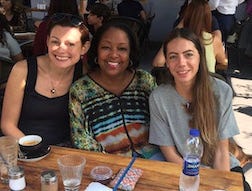
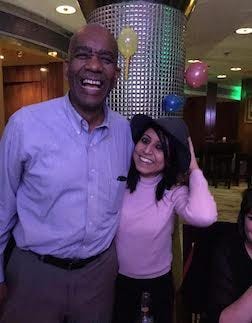
The life of an ex-pat (a person who lives outside their native country) can be fascinating if you have done the proper research. In most cases, like mine, you automatically have a co-worker community in place when you arrive. These people quickly become your family away from home. In my case, I became friends instantly with many co-workers at the school because we rode the “teacher bus” to and from school together each day. In addition, you end up working alongside these people and living nearby. The bonding was quick and natural. I now have many international friends, several “surrogate” daughters, and I consider Egypt my second home.
Should you decide individually or with a spouse or partner to live abroad, many resources (Internet, books, and magazines) are available to guide you to ex-pat communities in countries of interest. One resource that I highly recommend is the magazine — International Living.
http://internationalliving.com/
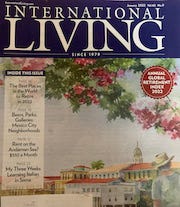
Each month, the magazine highlights safe, affordable, and exciting countries to move to as a foreigner. In addition, they report information on the cost of living, how taxes are handled, healthcare benefits, and other articles of interest for living abroad. They also sponsor trips to visit certain countries to learn about the environment firsthand. So, spending a few months, a year or two, or retiring abroad can be easier with these resources.
Upon arriving in Egypt, we were met by school officials and received an excellent week-long introduction to Cairo, and Maadi, a suburb of Cairo where we lived for three years. The first task was seeing the apartment we had preselected via the Internet before arriving. Next was shopping for groceries and everyday household supplies. We dined at different restaurants and did other activities that gave us a feel of the culture and city. Learning keywords needed for daily life is helpful, as we soon learned. We eventually found a great tutor and felt comfortable using many common Arabic words and phrases. It was surprising how appreciative the people in our neighborhood were of our attempt to communicate in Arabic. It was a pleasant surprise to see the number of people who spoke at least broken English. They were just as excited to communicate with us in our language.
There are so many wonderful things to say about Cairo, Egypt (Maadi in particular, where we lived) that getting started was hard! My very first impression was how kind and welcoming the people were. Maadi is a popular suburb to live in and a gathering spot for ex-pats. I never feared walking through the neighborhood or taking daily walks to Road 9 (approximately one mile away from my home), an area filled with restaurants, shops, and services. Everything you need is there, from optometrists to ice cream shops. It is an amazing area that comes alive each evening. I quickly learned that Egyptians are night owls. It is relatively quiet during the day, and the hustle and bustle begins after dark.
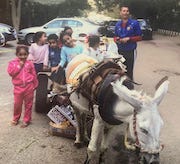
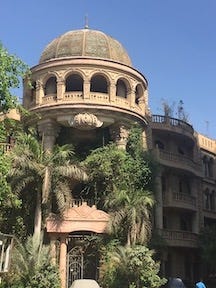
I also love the mixture of older Egyptian architecture with modern buildings and the mix of commercial and residential. All the modern conveniences are available and not far away. ATMs were centrally located and usually available in the local grocery stores. There were several ways to buy groceries which also added to the excitement. Monthly, we would take a car to a large food chain, “Carrefour,” which was the equivalent of Super Walmart and usually connected to a mall. We would stock up on staples, meats, cheeses, toiletries, etc. We would walk to our neighborhood grocery store every week, just a block or two away. They were small to medium-sized and filled with everything you needed. In addition, there were local “open-air” stands that sold candy, juices, and fresh fruit daily. However, my favorite was the man with the cart, common in most neighborhoods. As we walked home from the bus every day, he would have his mule-drawn cart filled with fresh fruits and vegetables, and usually his daughters and other children. I loved picking the fresh fruits and interacting with him as a vendor. He lived what seemed like a simple, happy life, and it will always be one of my fondest memories.
Rental housing for an ex-pat was inexpensive. The last apartment we rented was 11,000 LE per month (LE represents Egyptian Pounds). That is the equivalent of $611.00 US dollars.
The exchange rate at the time was strong in our favor, 18LE to one US dollar. So, our money went a long way there.
Our last apartment was the largest of the three apartments we rented (at almost 3,000 square feet), with two levels. This was not the typical size of apartments. However, nice, large apartments, fully furnished, were not hard to find for reasonable prices. You usually had a choice of modern buildings or the more traditional architecture. We always chose traditional housing options. We also selected to stay in Maddi versus the newer high-rise neighborhoods in New Cairo, where I taught school. The variety of housing options was excellent. It was unnecessary to spend a thousand dollars a month to live in a lovely apartment in a nice neighborhood. Our second apartment was in an area with several diplomatic embassies. We lived across the street from an ambassador’s home that looked like a smaller version of the White House in Washington, DC. The icing on the cake (all three years) was having a weekly housekeeper — something I never could afford in the States. Like most housekeepers, she cleaned from three to four hours each week, and the apartment was spotless. She would also wash and iron if needed. The unfortunate part was her pay. We were not allowed to pay her more than what other maids (that’s what they were called) were paid — the equivalent of $25.00 US. Of course, we gave lots of gifts and bonuses for each holiday.
Although somewhat homesick because of the sheer distance from family and the seven-hour time difference, I quickly settled into the good, simple lifestyle. Thank goodness for FaceTime! It made a big difference being able to see my daughters and grandchildren live. We could share our days, and I knew the younger ones would not forget us. One thing I never adjusted to was the five-day workweek, Sunday — Thursday. At first, I thought we worked the first few Sundays because of Workshops, training, etc. I didn’t realize until I arrived that Sunday was an official workday. I can honestly say I complained for three years about that. Lol! Working on Sunday didn’t feel right to me.
The workweek aside, I can’t explain how exciting it is to immerse yourself in another culture. And Egypt was the perfect culture to do that. When I arrived, I knew very little about Egypt or the culture. I now have such an appreciation for learning about developing countries firsthand. I also quickly realized that the media/press could generalize and paint an ugly picture of a nation and its people based on a few events or the acts of a few people. This keeps Americans wanting to stay “safe” in their homeland and not see the world. Honestly, there was so much racial violence going on in the States that I was thrilled to be in Egypt at that time. Of course, we would get an occasional phone call from family or friends who heard something on the news about a violent protest of some kind. We usually had no idea what was going on and were safe and enjoying ourselves in another part of the city.
Note: When living in another country, you should connect with the American Embassy when you arrive. You will then receive news updates on emergencies, a need to avoid a particular area, or an advisory not to travel outside of the country.
Most of the Egyptian population is Muslim, with a small minority of people of the Jewish and Christian faith. We had many Egyptian friends that were Muslim and some who were Christians. I attended the Maddi Community Church and enjoyed fellowship with other ex-pats representing over forty faith denominations. Like most churches, it had outreach programs and all the different programs and groups you would come to expect from an American church. There was a traditional indoor church service at the time. The website now only shows the Friday evening outdoor service under a large tent. I continue to receive weekly emails and enjoy keeping up with community events.
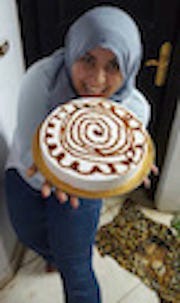
Becoming friends with people of the Islamic faith is exciting when you are invited to learn about and take part in their religious celebrations. Before arriving in Egypt, I had no idea how Ramadan was celebrated or what an “Iftar” or “Eid” was. I now have a better understanding of the cultural celebration.
Ramadan is Islam’s holiest month. In 2022, it began at sundown Saturday, April 2nd, and ends with Eid on Monday, May 2nd. It is observed by fasting, reflection, and prayer. Fasting takes place between dawn and sunset. Fasting is a way of showing God gratitude for his blessings. There is a pre-dawn meal before fasting begins. After an evening prayer at dusk, Muslims celebrate with a dinner called “Iftar.” We had the pleasure of attending Iftar meals. The word Iftar means “breaking the fast.” It is a beautiful celebration shared with family and friends. Eid marks the end of Ramadan and the month of fasting. I felt honored to learn firsthand by participating in these celebrations with our Muslim friends.
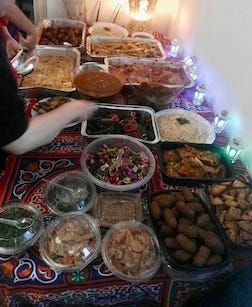
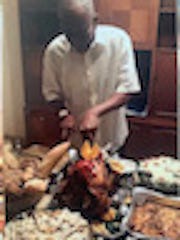
We traveled home to the States each year for Christmas. However, we started our own Thanksgiving tradition in Egypt.
We had friends from six or more countries join us for dinner in our first year. Several had never attended a real Thanksgiving feast. It was so much fun sharing one of our cultural celebrations that others had only read about. We continued the tradition for the three years we were there.
Oh, the malls! The biggest surprise was the large, very modern malls! Once inside, you felt like you were in any sizeable American mall. There was always a Starbucks and a food court that usually had McDonald’s, KFC, Baskin Robbins, and other familiar eateries. These eateries were side by side with traditional Egyptian foods. The same was true for western stores like Nike. They were also side-by-side with traditional Egyptian stores. The women were very stylish, and there was no shortage of places to shop, from casual to high-end clothing, handbags, and shoe stores. A favorite, however, was The Grand Mall. An old, larger building in Maadi with seven or more floors of shopping. Most of the stores sold more traditional Egyptian clothing. However, there were several stores with modern western apparel too. There is an escalator in the center of the mall. I loved riding to the top and visiting each floor. It reminded me of department stores from my childhood. I also loved being surrounded by the Egyptian community there. In the basement, there were several sporting goods stores and tailors. You could have detailed alterations done for less than ten dollars in a day or two. This mall also had many bakeries and restaurants that served traditional Egyptian food. No Starbucks or other western food chains. A must-see if you visit Maddi!
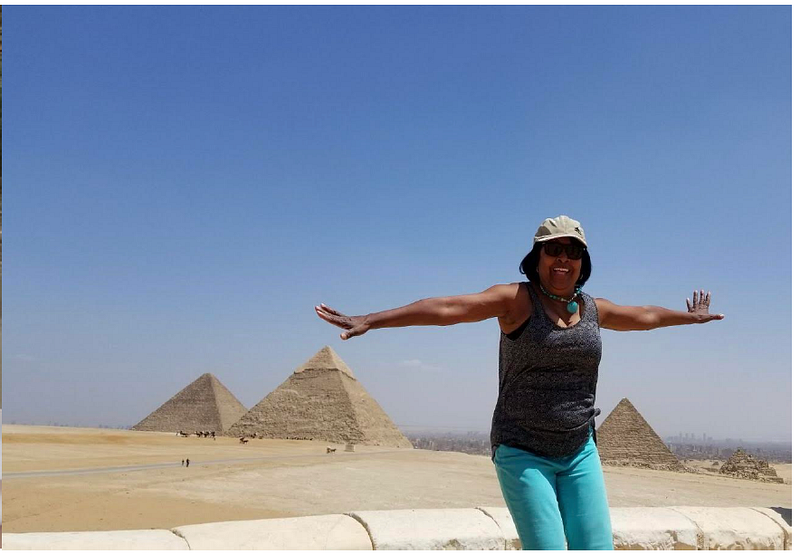
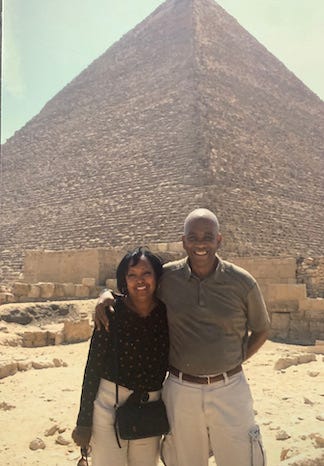
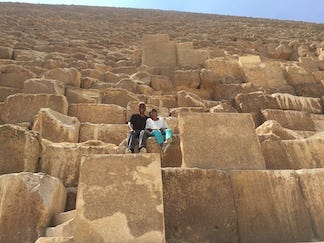
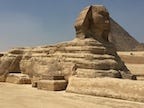
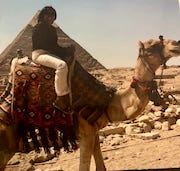
Lastly, Majestic! That is the only way to describe the Pyramids, which I have now had the pleasure to visit many times. I can say firsthand that pictures will never do justice to the Pyramids, one of the Seven Wonders of the World.
When you stand before the Pyramids and look up, your first thought is, how is this possible? They did not have cranes, heavy machinery, or today’s technology. The stones are massive; many are larger and taller than the average person. You feel like you are witnessing a miracle and history right before your eyes. On one occasion only, I entered the Pyramid that visitors are allowed in. It is a very narrow (claustrophobic) crawl space that a taller or larger person would have difficulty entering. You crawl a few yards and step up into a burial chamber. It was exciting to see such a historic site. However, I am cautious in recommending this experience. I only did this once in all my visits to the Pyramids.
There is so much more to share about my experience of living in Cairo for three years. As stated earlier, I will publish this article in two parts; Part two will highlight my favorite things to do in and around Cairo and our travels throughout Egypt.
“Traveling — it leaves you speechless, then turns you into a storyteller.” — Ibn Battuta


