
Little Lights
Scattered by Long-Ago Darkness
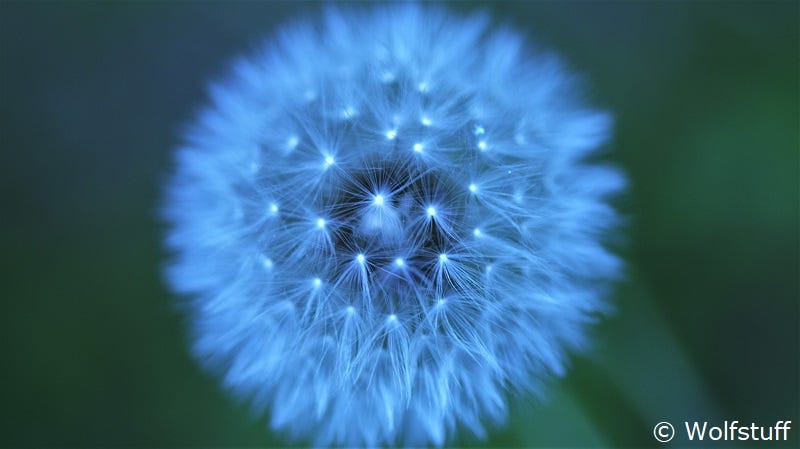
Scattered long ago by Darkness Many little lights yearn for itself
What is a sentient being? Specifically? Exactly?
The Buddhist and other eastern traditions bandy this word about a lot, but definitions vary.
Yes, humans. A given. Yes, animals. A given as well. Yes, devas and gods. Of course. But how about trees? Mushrooms? Cells?
Once upon a time there was the no-time before time, and in this no-time (and no-space) there was just One. Un-fragmented, un-scattered perhaps light, perhaps darkness, perhaps red or golden — but un-fragmented and un-scattered whatever color or non-color.
Then, I guess around the time, or non-time, of the Big Bang (straddling the very borderline between non-time and time, thus launching time as it were), this One fragmented into… and that’s just the point, into how many?
Into how many sentient beings? For surely each and every fragment (Atman) of the One (the Omnipotent, Omniscient, Wondrously Aware, Everything and Everywhere Brahman) was sentient, too. How could they possibly help but be?
Fast forward to the present and the definitions of “Sentient Being” range across the full spectrum of life, and in some cases beyond.
One secular definition (I guess it’s a legal definition as well) is “a creature who can suffer and feel pain; mostly animals and humans. A sentient being is one with the faculty of sensation — whence the word — and the power to perceive, reason and think.”
As for Buddhism, according to Wikipedia, sentient beings are beings who possess consciousness, sentience, or in some settings life itself. According to the Pali Canon, sentient beings are composed of the five aggregates, or skandhas: form/matter, feeling/sensation, perception/discernment, mental formations, and consciousness.
In the Samyutta Nikaya, the Buddha is recorded as saying that “just as the word ‘chariot’ exists on the basis of the aggregation of parts, even so the concept of ‘being’ exists when the five aggregates are available.”
While distinctions in usage and potential subdivisions or classes of sentient beings vary from one school, teacher, or thinker to another, it principally refers to beings in contrast to Buddhas. That is, sentient beings are characteristically not enlightened, and are thus confined to the death, rebirth, and dukkha (suffering) characteristic of samsara.
However, Mahayana Buddhism teaches that all sentient beings also possess Buddha-nature — the intrinsic potential to transcend the conditions of samsara and attain enlightenment, and so reach Buddhahood.
As Dogen puts it, “Those who greatly enlighten illusion are Buddhas; those who are greatly deluded about enlightenment are sentient beings.”
In Mahayana Buddhism, it is to sentient beings that the Bodhisattva vow of compassion is pledged — the pledge not to leave samsara for Nirvana while there still remains even one sentient being stuck in samsara — which always brings me the image of millions, billions, trillions of Bodhisattvas each insisting that the others enter Nirvana before him or her: “After you.” “No, after you.”
Furthermore, and particularly in Tibetan and Japanese Buddhism, all beings (including plant life and even inanimate objects or entities considered “spiritual” or “metaphysical” by conventional Western thought, say ghosts or devas) are or may be considered sentient beings.
So, what about trees? They can perceive threats (various invasive and parasitic insects, for instance) and not only mobilize chemical responses but can also communicate (chemically) with neighboring tress about the threat that they may begin to mobilize in preparation for the oncoming assault.
That, in my dictionary, at least on some level, takes the capability to perceive, reason, and think. Sentience, in other words.
And what about the T cells?
Again, turning to Wikipedia: A T cell is a type of lymphocyte (a white blood cell), which develops in the (T)hymus gland (hence the name) that plays a central role in the body’s immune response.
T cells are distinguished from other lymphocytes by the presence of T-cell receptors, a protein complex that recognizes foreign non-cell material, in other words the body’s “enemies”.
These immune cells originate as precursor cells, derived from bone marrow, and develop into several distinct types of T cells once they have migrated to the thymus gland.
These different types of T cells have important roles in controlling and shaping an effective immune response to, say, a viral infection, by executing their specialized immune-related functions.
One of these functions is immune-mediated cell death, which is carried out by T cells in one of several ways: This type of T cells, also known as “killer cells”, are cytotoxic (toxic to living cells) — this means that they are able to directly kill virus-infected cells as well as cancer cells; they are also able to utilize small signaling proteins, known as cytokines, to recruit other cells when mounting an immune response (recruiting an army).
A different type of T cells, function as “helper cells”. Unlike killer T cells, these helper T cells function by indirectly killing cells identified as foreign by assessing and determining if and how other parts of the immune system should respond to a specific, perceived threat (cellular leadership).
Helper T cells also use cytokine signaling to influence regulatory B cells (a lymphocyte not processed by the thymus gland, and responsible for producing antibodies) directly, and other cell populations indirectly.
Another distinct type of T cell are the Regulatory T cells that provide the critical mechanism of tolerance — the ability of immune cells to distinguish invading cells from the body’s normal “self” cells — thus preventing immune cells from inappropriately mounting a response against oneself.
As an aside, these same self-tolerant cells are sometimes co-opted by cancer cells to prevent the recognition of, and an immune response against, tumor cells — invader wolves donning self-cell clothing.
And I say: Wow…
As if this doesn’t require perception, thought and reason?
That, in my book, makes the human cell a sentient being.
Now, listen: there are approximately 37.2 trillion cells in a human body. And I assume that the number of cells in animal and plant bodies would be some astronomical number like this as well — in ratio to size, that is.
And when we take a look at our planet, and the number of species and cell-based life we have here (there are 350,000 species of beetles alone); and when we look at our galaxy, and the number of stars in the Milky Way (200 billion, or so); and when we’ll look at the number of galaxies (400 billion or so) in the universe; and when we assume (rightly, I am sure) that there’s some form of life spinning around each and every star in the universe; and when we assume that their cell-size and count is similar to ours: that makes for a whole bunch of sentient beings in the universe.
I have not made a Bodhisattva vow, for I honestly think it is meaningless. Looks great on paper, completely unreal in reality, whether conventional or ultimate.
Then, to make matters a little more overwhelming, if that’s possible, one has to wonder about molecules and atoms as well. Lots of motion there, and molecular intelligence that knows when and how to combine atoms with one another and in what way. Perception? Thought? Reason? You tell me.
I honestly don’t know where to draw the line: above this line equals sentient, below this line equals non-sentient. I honestly don’t know if such a line even exists. But I wonder, does it really matter?
Scattered long ago by Darkness, many little lights now yearn for itself.
If it can yearn, it is sentient. Flowers yearn for sunlight. Viruses yearn to kill you. Wolves yearn for reindeer mean and a mate. Human yearn for, oh, god, they yearn for everything, don’t they, at any cost, rest of life on this planet be damned.
And here’s my real question: in order for this Universe to dissolve and return to Truth (Emptiness), does every single individual, ignorant sentient being have to reach full awakening? If so, that’s a project and a half.
Or, does it only take one immensely enlightened being to realize Truth, and Poof, the Universe is gone, for everyone?
Samsara shot right through the heart.
Just wondering.
© Wolfstuff


