
Literature is my Utopia.
Helen Keller on reading. (The Commonplace Book Project)
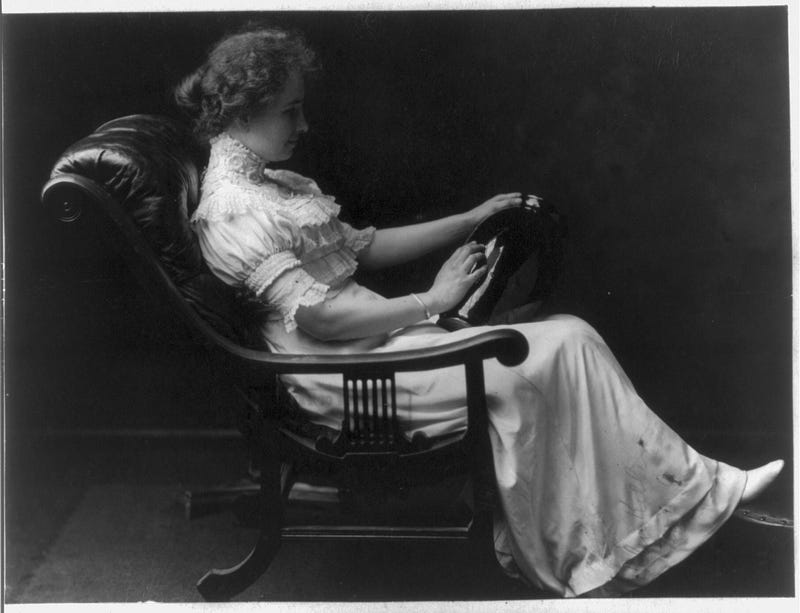
The Commonplace Book Project is a daily post based on Ray Bradbury’s advice to aspiring writers: read a poem, a short story, and an essay every day for 1000 days. These posts start with a quote and go wherever the rabbit hole leads. Follow The 1000 Day MFA publication so you don’t miss a thing.
“Literature is my Utopia. Here I am not disenfranchised. No barrier of the senses shuts me out from the sweet, gracious discourse of my book friends. They talk to me without embarrassment or awkwardness.” — Helen Keller, The Story of My Life
Literature is my Utopia is quite a statement from a woman who was both deaf and blind since she was a toddler. She learned to read braille, but before that she had to learn — without sight or sound — what words were.
I have a strong memory of being six or seven years old, standing in my grandmother’s backyard, and having the most wonderful epiphany: I could read anything. I might not know what they all meant, but I could sound out any word anyone put in front of me.
I don’t have any real memory of learning to read. My mother taught me with a set of yellow paper books — simple stories about a lion named Sam. I am Sam, Sam I am. See Sam run. Run, Sam run!
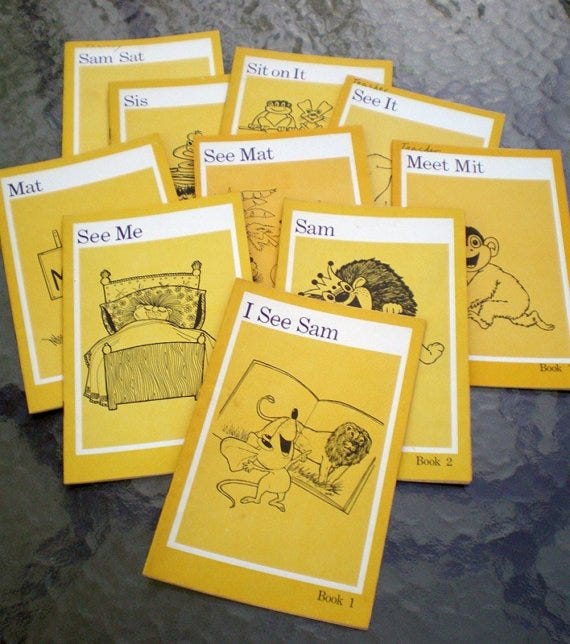
But that day, in my grandma’s backyard, I realized that I could read anything I wanted to. Anything. Every single story. It really was an incredible moment.
A couple of years later I read Helen Keller’s memoir, The Story of My Life, and it was her description of making the connection with words that stayed with me.
“I stood still, my whole attention fixed upon the motions of her fingers. Suddenly I felt a misty consciousness as of something forgotten — a thrill of returning thought; and somehow the mystery of language was revealed to me. I knew then that w-a-t-e-r meant the wonderful cool something that was flowing over my hand. The living word awakened my soul, gave it light, hope, set it free!”
Of course, it was a teacher that made the difference for Helen Keller. (A teacher, and parents with the means to hire one, but still. A patient teacher.) Helen Keller and Anne Sullivan worked together for nearly fifty years.
Keller called the day that Sullivan came into her life her soul’s birthday.
It makes perfect sense to me that Helen Keller would fall in love with literature.
I found this article about how radical Helen Keller’s politics were interesting.
The FBI kept Keller under surveillance for most of her adult life for her radical views. But Keller, who died in 1968, never saw a contradiction between her crusade to address the causes of blindness and her efforts to promote economic and social justice.
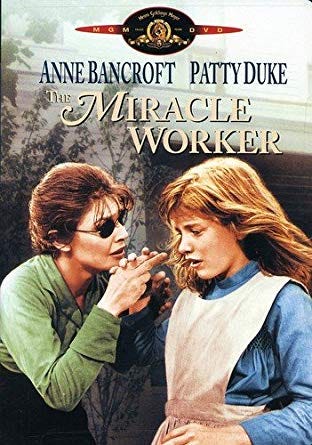
As I worked on this post, I watched the 1962 film, The Miracle Worker. It stars Anne Bancroft as Anne Sullivan and Patty Duke as Helen Keller and is incredible.
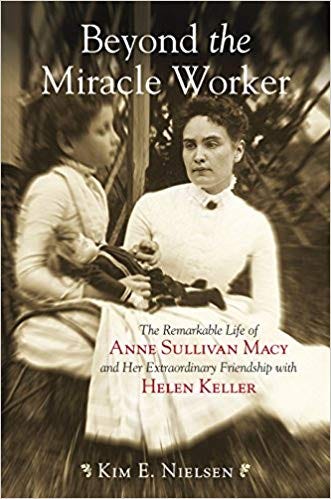
I’ve added Kim E. Nielson’s biography of Anne Sullivan, Beyond the Miracle Worker, to my reading list.
Keller had a friendship with Mark Twain, who was her champion. She was often accused of somehow being untruthful in her writing — of only mimicking back what Anne Sullivan told her of the world or out right plagiarism. Twain stood up for her.
Here’s one more excellent article. This one about how Helen Keller learned to write.
Yet the story of her life is not the good she did, the panegyrics she inspired, or the disputes (genuine or counterfeit? victim or victimizer?) that stormed around her. The most persuasive story of Helen Keller’s life is what she said it was: “I observe, I feel, I think, I imagine.” She was an artist. She imagined.
Today’s Poem:
Helen Keller by Langston Hughes
She, In the dark, Found light Brighter than many ever see. She, Within herself, Found loveliness, Through the soul’s own mastery. And now the world receives From her dower: The message of the strength Of inner power.
Shaunta Grimes is a writer and teacher. She is an out-of-place Nevadan living in Northwestern PA with her husband, three superstar kids, two dementia patients, a good friend, Alfred the cat, and a yellow rescue dog named Maybelline Scout. She’s on Twitter @shauntagrimes and is the author of Viral Nation and Rebel Nation and the upcoming novel The Astonishing Maybe. She is the original Ninja Writer.


