
“L’Infinito” by Giacomo Leopardi
Deep analysis of a classic Italian poetry masterpiece
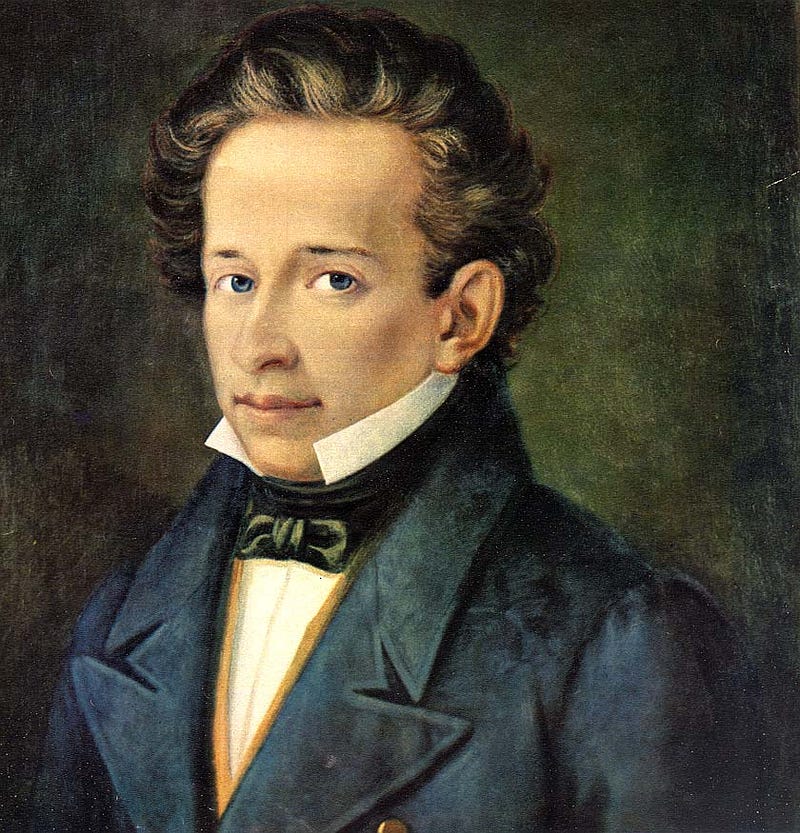
L’infinito (the infinite) is often considered one of the most (if not THE most) beautiful Italian poems ever written. This fame is due not only to its intrinsic artistic value, but to the extraordinary balance that is formed between language use, images, sensations and deep meanings of universal value.
Leopardi composed L’infinito between 1818 and 1819 in young years, in his hometown Recanati, in the Marche region. It is included in the Canti, his most famous poetic works and a cornerstone of Italian and worldwide literature.
But before the Canti, it was part of an early poems collection, called Idilli.
The greek term εἰδύλλιον (eidýllion), meaning idyll, usually referred to poetic compositions focused on the description of rural scenes, agreste landscapes.
With Leopardi, it undergoes a redefinition; in his idylls, the bucolic themes proper to the compositions written by the Greek and Latin poets (and later imitated in the humanistic and Renaissance age) are absent or transfigured.
The Leopardian idyll is a composition characterized by a strong lyrical intimism. In it, the element of natural landscape (often devoid of the characteristics of the ancient ideal landscape, like Arcadian archetypes) is closely linked to the expression of innerhuman moods felt for existence.
This expression of one’s own self doesn’t want to be a futile escape into the irrational or dream realm (as normally happens in romantic lyrics), but only a new opportunity for a broad reflection on time, history and the fate of men.
This is a new philosophical goal entrusted in the poetic composition.
The Leopardian idylls also present stylistic differences compared to other compositions — in particular the clever and wise mix of linguistic registers that ranges from the complex literary to the simple, flat and colloquial.
L’infinito is divided into two distinct parts:
1. In the first, the poet expresses concepts that are usual to himself.
2. In the second, he uses the imagination and gets lost into infinity.
Here comes the analysis of the text.
Original poem in Italian
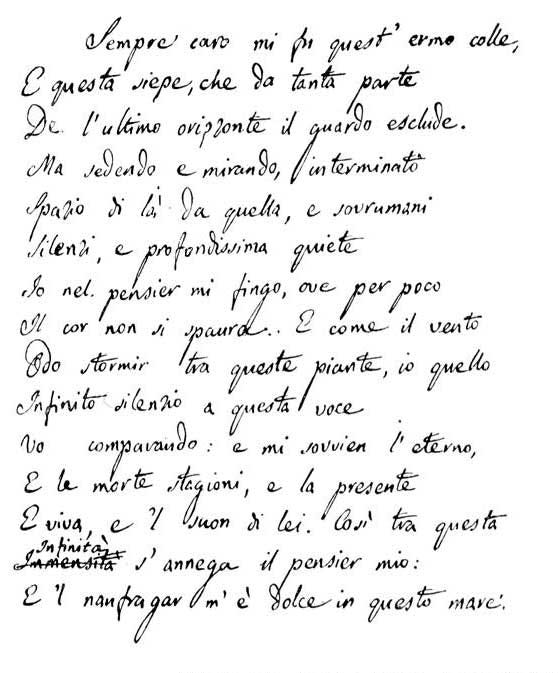
Sempre caro mi fu quest’ermo colle, E questa siepe, che da tanta parte Dell’ultimo orizzonte il guardo esclude. Ma sedendo e mirando, interminati Spazi di là da quella, e sovrumani Silenzi, e profondissima quiete Io nel pensier mi fingo; ove per poco Il cor non si spaura. E come il vento Odo stormir tra queste piante, io quello Infinito silenzio a questa voce Vo comparando: e mi sovvien l’eterno, E le morte stagioni, e la presente E viva, e il suon di lei. Così tra questa Immensità s’annega il pensier mio: E il naufragar m’è dolce in questo mare.
LISTEN (interpreted by Vittorio Gassman):
Literal translation
Always dear was to me this solitary hill And this hedge, which from so much part Of the last horizon the look excludes. But sitting and staring, endless Spaces beyond that, and superhuman Silences, and deepest quietness I pretend in thinking; where for a while The heart is not afraid. And like the wind I hear rustling among these plants, that Infinite silence to this voice I go comparing: and the eternal occurs to me, And the dead seasons, and the present And alive, and the sound of her. So between this Immensity drowns my thought: And shipwreck is sweet to me in this sea.
Parallel paraphrase
Meaning between the lines
1
— Sempre caro mi fu quest’ermo colle, — Always dear was to me this solitary hill — This lonely hill has always been dear to me
2
— E questa siepe, che da tanta parte — And this hedge, which from so much part — and also this hedge, which prevents my sight
3
— Dell’ultimo orizzonte il guardo esclude. — Of the last horizon the look excludes. — a good part of the distant horizon.
4
— Ma sedendo e mirando, interminati — But sitting and staring, endless — But sitting and staring,
5
— Spazi di là da quella, e sovrumani — Spaces beyond that, and superhuman — I imagine in my mind endless spaces beyond the hedge,
6
— Silenzi, e profondissima quiete — Silences, and deepest quietness — and inconceivable silences for man
7
— Io nel pensier mi fingo; ove per poco — I pretend in thinking; where for a while — and very deep quietness, so much that for a while
8
— Il cor non si spaura. E come il vento — The heart is not afraid. And like the wind — my soul is not afraid. And as soon as I hear
9
— Odo stormir tra queste piante, io quello — I hear rustling among these plants, that — the wind that makes the foliage of the plants rustle, I compare
10
— Infinito silenzio a questa voce — Infinite silence to this voice — that infinite silence at this rustling:
11
— Vo comparando: e mi sovvien l’eterno, — I go comparing: and the eternal occurs to me, — and the idea of eternity comes to mind, and
12
— E le morte stagioni, e la presente — And the dead seasons, and the present — the ages already passed and forgotten, and the current one
13
— E viva, e il suon di lei. Così tra questa — And alive, and the sound of her. So between this — still alive, with its noises. So, my thoughts
14
— Immensità s’annega il pensier mio: — Immensity drowns my thought: — sink into this immensity of space and time:
15
— E il naufragar m’è dolce in questo mare. — And shipwreck is sweet to me in this sea. — and getting lost in this infinite sea is sweet for me.
The poet is at Monte Tabor, his ideal refuge, in Recanati, Marche.
His hometown is the place that sublimates his mind, heart and soul.
The hedge prevents the view of the horizon, as the perceptual obstacle that allows the mind to escape from the immediate experience of the senses.
The poem is ultimately configured as a visual-perspective study of the elements of the landscape and a personal philosophical reflection. Beyond the hedge, therefore, open spaces without limits, deep silences, absolute peace.
Peace is bearer of dismay, and an indication of that eternity to which the sudden rustling of the wind in the foliage leads the poet “I” to shipwreck, annihilates it, merging with the universe.
So, between the threat of silence and the sonorous presence of nature, thought grasps the elusive universality of infinity, overcoming contingency.
With “infinite” and “spaces beyond the quiet” the poet refers to the future, which will always appear to us as a sweet illusion that will never go away.
The hedge, on the other hand, is the wall that divides the present from the future, the poet from the infinite and only lets us imagine what our fate consists of. This is the peak of Cosmic Pessimism in poetry.
Every man can try to grasp the infinite that provides a deep well-being…
…but also a sense of fearful dismay.


_-_ritr._A_Ferrazzi,_Recanati,_casa_Leopardi.jpg)
