Limiting Beliefs: Ditch the 4 Dream Killers Holding You Back
How to help, not hinder, yourself in achieving your goals
You’re probably not going to fulfill all your goals this year. And if you don’t, it likely won’t be because you’re incapable; it will be because you got in your own way.
A slew of limiting beliefs will distract you from your goals and New Year’s resolutions. Below are four ways you’re likely to shoot yourself in the foot with self-limiting beliefs, plus how to get rid of them.
1. Ego Depletion
After a long day at work, do you tell yourself that you feel exhausted and can’t possibly go to the gym or social event like you planned?
Then you’re subscribing to a limiting belief with little scientific basis.
You’re not alone in that. It wasn’t long ago that I routinely lounged on the couch eating ice cream and watching Netflix for hours after work because I was “spent.”
One of the most pervasive bits of folk psychology is the belief that self-control is limited — that we only have so much willpower available to us and are liable to run out if we overexert ourselves.
Psychologists have a name for this myth: ego depletion, the idea that we have a limited amount of willpower each day.
Research shows that willpower is not a depletable resource. Perpetuating the idea of ego depletion does you actual harm.
In one study, Stanford psychologist Carol Dweck concluded that signs of ego depletion were observed only in participants who believed willpower was a limited resource.
Suppose ego depletion is caused by self-defeating thought and not by biological limitations. In that case, the idea makes it less likely to accomplish our goals by providing a rationale to quit when we could persist.
Michael Inzlicht, a professor of psychology at the University of Toronto and the principal investigator at the Toronto Laboratory for Social Neuroscience, offers a healthier view of willpower: It’s not a finite resource but instead acts like an emotion, ebbing and flowing in response to what’s happening to us and how we feel.
That view helps us see a lack of motivation as a temporary reaction to a difficult task rather than as a total depletion of our daily dose of willpower.
2. Imposter Syndrome
Imposter syndrome is not a syndrome. Originally called the “imposter phenomenon,” it’s simply a cognitive bias — a “systematic error in the way individuals reason about the world due to subjective perception of reality,” according to Britannica. So when you tell yourself you’re not good enough for or at something, you likely have no real reason to believe that.
Imposter syndrome doesn’t go away. Paradoxically, the more “successful” you become, the more you feel like an imposter.
The key to beating imposter syndrome is understanding that it’s a cognitive bias and short circuiting it:
- Compare your life now to last year or five years ago. Note your achievements and how you’ve grown as a person.
- Celebrate your successes.
- Share failures with your closest friends and listen to them open up about their struggles.
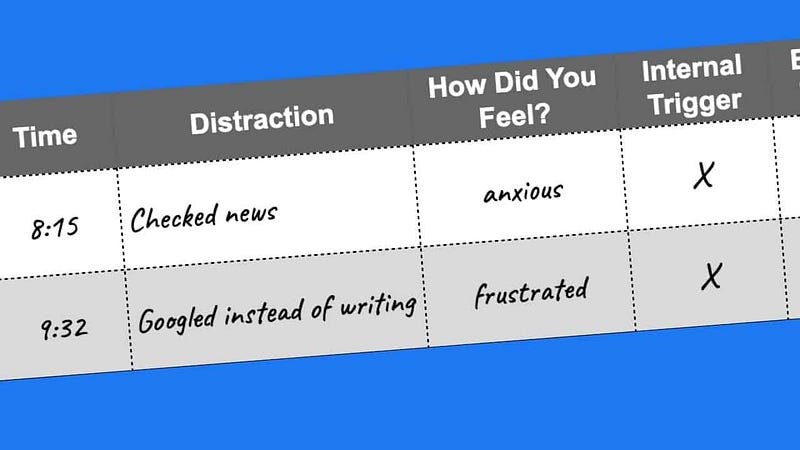
Free Distraction Tracker Distraction doesn’t have to be debilitating.
If you’re serious about taking control of your attention once and for all, download my distraction tracker and get started now.
Your email address is safe. I don’t do the spam thing. Unsubscribe anytime. Privacy Policy.
3. Your Inner Critic
Raise your hand if you’ve ever called yourself “an idiot” or “stupid.”
We all have an inner critic that disparages our abilities, worth, and choices. This internal dialogue, known as negative self-talk, chips away at our self-esteem and confidence, dampens our motivation, fuels anxiety, and reduces productivity.
To silence this inner critic and cultivate a more positive internal dialogue, try talking to yourself as you would to a friend. You may also repeat self-affirmations, which boost self-esteem and reshape your mindset. Pick one of these 32 science-backed morning affirmations.
4. Distraction
Day to day, distraction is the biggest obstacle to achieving your goals. And identifying distraction is trickier than it seems.
Distraction is anything that pulls you away from what you want to do.
Cleaning or doing the laundry might seem productive, but they’re distractions if you’re doing those tasks instead of reviewing your finances as you said you would. Scrolling on social media is not a distraction in and of itself unless you do it when you say you’d enjoy dinner with family.
Often, people think they are helpless against distraction, a belief perpetuated by the media’s claim that we are powerless against the “addictive” nature of social media. But we’re not powerless. Thinking you are, much like believing in ego depletion, is a self-limiting belief that will make it true.
That’s why I say the most valuable skill of the future is becoming Indistractable. In my book, I elaborate on the four-step model I developed to become Indistractable, but here’s an overview:
1. Master internal triggers
Distraction is an unhealthy escape from negative feelings or internal triggers. If we’re doing something that bores us or makes us feel incompetent, we seek relief with distractions. Identifying, exploring, and managing internal triggers will make you less likely to run toward distraction to escape discomfort.
2. Make time for traction
Schedule time for traction, or the actions that help you meet your goals and values, in a timeboxed calendar. By knowing what you want to do at any given moment, you can recognize and fight distractions.
3. Hack back external triggers
External triggers are anything in our physical environment that pulls our attention. They can be interruptions from family or coworkers, but most often, they are notifications from the digital realm: email, group chat, your phone, online feeds, and more. Limiting external triggers turns off their influence.
4. Prevent distraction with pacts
By making pacts, or precommitments, we reinforce our defenses against distraction.
Next time your dreams seem unachievable, ask yourself whether you’re getting in your own way and take steps to overcome those limiting beliefs holding you back.
Nir Eyal is a former Lecturer at Stanford and is the bestselling author of Hooked: How to Build Habit-Forming Products and Indistractable: How to Control Your Attention and Choose Your Life.
Indistractable won numerous honors and was named one of the Best Books of the Year by Amazon.
BONUS: Nir offers a complimentary Indistractable workbook on his blog, NirAndFar.com.