
Hidden game in the article
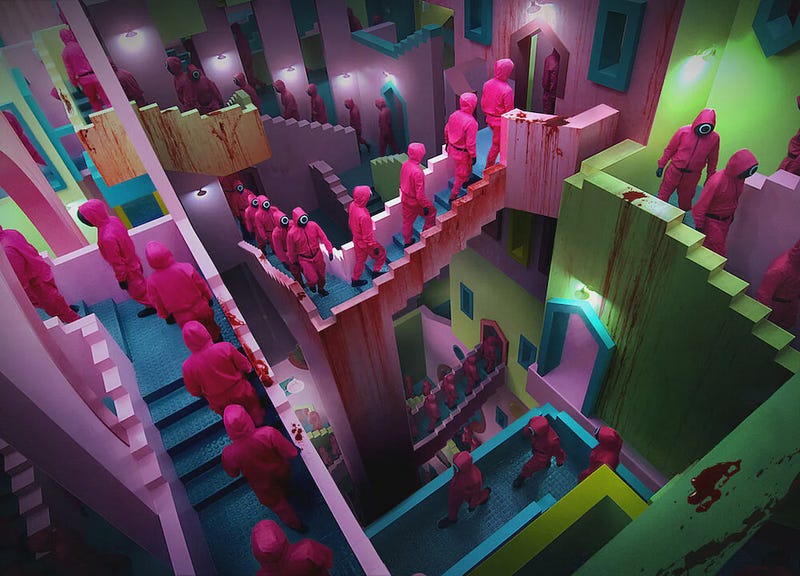
Like Squid games but without the pay
or the blood and gore
Let’s say you are in the market for a yellow car, you start to notice yellow cars everywhere you go. When we started implementing gamification inside our product, I started to notice these elements in unexpected places. Let’s start with Medium itself.
Is Medium a game?
It certainly feels so. There is a lot of game elements inside the entire process. If you notice any of the gaming community, the hardcore followers are heavily in tune with the game’s philosophy and beauty. But, they are also able to quote numbers and statistics. Posts about views, fans, claps, their ratios, trends and patterns in evolution, reward amounts are widely popular. Metric frenzy is a good indicator that you are experiencing gamification in action.
Let’s look at Medium through the Mechanics, Dynamics, and Aesthetics (MDA, for short — despite its limitations) lens. But, we will start with Dynamics.
Dynamics contain the constraints of the game. It is the rules by which the players play. Although, the rules are just one aspect of it. Some of them are straightforward and visible — you cannot clap for your own article, you can only clap 50 times, so and so forth. But, there are flexibilities — you can write how much ever you want. There is also the progression of elements such as the number of followers, view count increase over a month that gives a sense of progress.
Mechanics & Randomness
Do you remember the feeling you felt when you saw someone gets a jackpot at a casino? It’s not a quiet scene. There is a cacophony of coins clanging and lights flashing to attract attention. That is not just for the winner but people around demonstrating one key idea — Possibility. If you play long enough, you could be a winner too. You never know.
Compare that to experiences posted by a fellow writer. How they got to that one viral article that may or may not have changed their fortunes. Either way, it makes for a great read. Your mind is hooked on the possibility.
The mechanics part of the game describes how you interact with other players. Mechanics dictate what kind of experiences you are going to have. It is where the famous ‘algorithm’ would reside. Showing you content, managing your views, stirring the pot with controversial items (but not so much that it generates hatred and vile). The mechanics are managed in a way for you to feel certain ones as you come into the game and leave it (to come back later).
Randomness is key in generating viral moments. It has to be random to a certain extent to prevent ‘gaming’ the system itself. If there was a particular style of writing (or certain follower count) for your views to go viral, that system is broken because it will have run-away effects.
In his famous book ‘Linked’, Barabási describes what happens when you apply Quantum statistics (specifically, Bose-Einstein condensate formation) to networks. It leads to the formation of a ‘Monopoly’. What does that have to do with Medium? Imagine if the game is set up such that if you had 100K followers, you are guaranteed 10K views or so then that sets up a monopoly over eye-balls.
On the other hand, if you inject too much randomness, people will give up. For a game to be successful, it needs to look like the players have some control over their destiny. If it was all a roll of dice, players would lose interest quickly. They would play but they would not be addicted to playing. It is important to generate both — Possibility and differentiation for skill.
A few manifestations of these mechanics are worth pondering. One clear one is Publications. Publications give you an edge, they give you a sense of community.
Lastly, Aesthetics. These are all the fun elements that are spread through the entire process. I love the game dynamics of Medium. As someone who’s in between simple blogging and complex academic blogging, I find it pretty easy to make sense of what happens in terms of numbers. The design choice is very elegant, you can see all your posts, both published and unpublished (draft), with their respective stats like views, fans, claps, and comments.
Gamification aims to provide motivation towards a common goal. Look at the mission statement of Medium —
Medium’s mission is to deepen readers’ understanding of the world and to empower writers to share their best work and biggest ideas.
Medium understands the connection between readers and writers. Writers are readers first. Forming a strong community of writers that read each other’s work, improving the skill level of writers are behaviors that they want to keep motivating. Gamifying these behaviors is what we witness unfolding in front of our eyes every day.
What do Robinhood and US elections have in common?
Like I said earlier, once you want a yellow car, you see yellow cars everywhere. Let’s take a brief look at two other cases. One is the election in the United States.
One of the key constructs or features of something that’s a game is that players voluntarily accept the rules of the game. They love the game so much that they have a strong notion of what constitutes fair play. Sounds familiar? The constitution is the rule book that we all agreed to play by. That is why it is so important to accept that you lost the election — voluntarily. The game breaks down if the players start to feel that — there is inherent bias or unfairness.
It is also fun to see how there is a red team and a blue team. We do get really obsessed with the numbers and polls during an election cycle. The founding fathers had such keen acumen of including such strong game elements into the whole process.
Another interesting aspect that I came across is Robinhood. Robinhood includes game-like elements to boost the appeal for investing. In fact, they did get into hot water for doing exactly that.
In line with the spirit of gameplay — let’s play a game, one of the paragraphs in this article was written by an AI bot (Jarvis.ai). As a challenge, highlight it — if you can figure it out, I will buy you a cup of coffee (just for like 5–6 folks :)).
A field that can use some more elements of gamification in academia. You can read a perspective of academia stifling creativity in this piece by Myriam M
There are quite a few articles on gamifying in academia — in case, you are interested in looking at that more.


