
Flint & Steel Prompt
Lighthouses On Postage Stamps
January is National Hobby Month — Philately
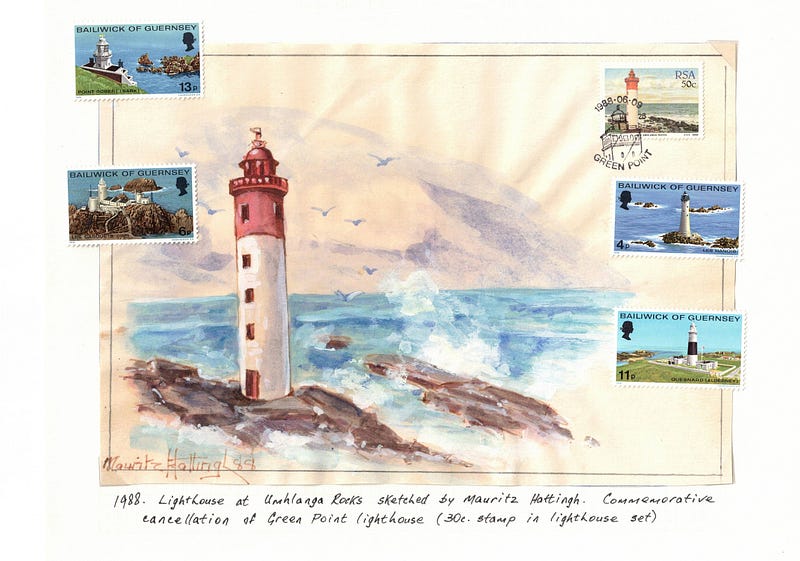
In response to Ellie Jacobson’s Flint & Steel prompt — Sparks #22: What Are Your Distractions, I Mean, Hobbies? — where she asks a poignant question whether or not hobbies are a distraction or a waste of time.
I seem to have too many hobbies and too little time to enjoy them — perhaps I need to read more Medium stories about ‘Time Management?’ But a couple of hobbies I’m currently reviving are my interest in Lighthouses and collecting postage stamps which carry them.
I’ve always been interested in lighthouses and stamps. It stems from school, and living close both to the North Sea and a major river, the Humber, in the UK.
During English Literature, we studied poetry. One particular poem, ‘Flannan Isle’ by Wilfrid Wilson Gibson, about three lighthouse keepers who mysteriously vanish, aroused my interest, especially the part where the search party finally arrive on the isle and enter the lighthouse to find:
Yet, as we crowded through the door, We only saw a table, spread For dinner, meat and cheese and bread; But, all untouched; and no one there
Whilst at school, I joined the Stamp Club, encouraged by my parents to find a hobby to keep me occupied on winter evenings in the days when we had no television, only a valve radio for company.
I learned that the Penny Black was the world’s first adhesive postage stamp and was issued in the United Kingdom in 1840 featuring a profile of Queen Victoria. Because Britain was the first country to issue stamps, the Monarch’s head has graced our stamps ever since. It means we are the only country never to display its name on postage stamps.
I learned also, there are millions of stamps worldwide, a hobby known as philately, and a philatelist being someone who collects or studies stamps.
But deciding which ones out of all these millions of stamps to collect was the problem I faced. Most of my school friends collected GB & British Commonwealth stamps, so that’s what I did.
Three years on, in 1962, my parents relented and bought a TV set. Having then seen The Beatles perform ‘Love Me Do’ on the telly, stamp collecting took a back seat, and the electric guitar became my main interest.
Years later, whilst on honeymoon in Jersey and Guernsey in the Channel Islands, my interest in both lighthouses and stamp collecting were resurrected.
Travelling around both islands was easy using public transport. Each day, my wife and I would hop on and off buses, visiting as many coves and sandy beaches as we could, seeing many lighthouses on our travels.
Both Channel Islands’ postal agencies issued colourful sets of stamps depicting views of bays, castles, and fortifications, and ports we had visited, and I came away from both Jersey and Guernsey’s main post offices with many stamps.
It wasn’t until I joined the Guernsey Philatelic Bureau, receiving every issue they subsequently produced, that my obsession with lighthouses took off. That year, the Bureau issued what I consider to be a beautiful set of four stamps depicting lighthouses, three of which we had visited on our honeymoon.
I became what is known as a ‘thematic collector’ — my specialist subject was collecting lighthouses of the world. The idea was to study the history of lighthouses in various countries, with the intention of visiting as many as I possibly could.
Thematic Philately is defined as: collecting postage stamps, postal stationery, postmarks, and other related philatelic material to illustrate a theme — cats, dogs, reptiles, ships, trains — the list is endless.
At present, I have stamps from 90 countries around the globe, but so far I have only visited 20 of these to see some of their lighthouses.
In 2000 I stayed in a lighthouse near Stranraer, Wigtownshire — Corsewall Lighthouse Hotel.
It was built in 1815 by renowned Scottish civil engineer Robert Stevenson, grandfather of ‘Treasure Island’ author Robert Louis Stevenson. The light is now an automated station and is maintained by the Northern Lighthouse Board.
Set in 20 acres of spectacular coastal scenery, with its own ruined Iron Age fort, Dunskirkloch, on-site, it is perched on the northern coast of the Rhinns of Galloway. Our room overlooked the sea, and we could watch grey seals and cormorants resting on the rocks below when the tide was out, the latter outstretching their wings to dry their feathers.
The place abounded with birds — oystercatchers, curlew, storm petrels, shearwaters, razorbills, and skuas — another of my hobbies. I’m what’s known as a birder or twitcher, a common birdwatcher.
So are hobbies beneficial or a waste of time?
Hobbies can lower stress levels, be beneficial for our mental health, and allow more social interaction with other people. They give us an opportunity to explore, travel and learn, and in the process increase both our awareness and happiness.
I would like to thank Ellie Jacobson for providing an opportunity for hobbies to be discussed in Flint & Steel, and you’ll find the link to her prompt below:
Another hobby of mine is completing jigsaw puzzles, and if you are interested you will find the link to that story below:


