Lifting UX Design from the doldrums: four key craft improvements for your teams
Rather than placing the blame on Figma, or other disciplines, how might we look at current conditions and adapt?
Do you and your design team feel like your product org doesn’t appreciate your potential impact on your shared work? Don’t give up hope, but don’t kick off your next “value of design” roadshow just yet. I’m here to tell you that while things feel dire, it’s not actually about telling folks the value of design — it’s about showing the value of design via self-directed changes in our work. It’s about leading with curiosity about our product and engineering partners and adapting our techniques to address the day to day issues they’re facing alongside the customer problems we’re already so good at addressing.
It’s tough out there in the UX community right now. I should know. I was recently laid off from my role as Director of User Experience for the Player Platform and head of the UX Craft at Riot Games. I, like many other designers out there, was heartbroken and blindsided to learn that the work I’d been hired to do over two years ago growing a design team to excellence and lifting up the craft across the company was no longer a priority investment due to financial conditions. (And I’ve been assured by senior leadership that my layoff was “purely business” and not performance, so that’s the only conclusion I can draw under these circumstances.)
But in the wins along the way, and what I’m hearing in questions from community members engaging with my book Design Beyond Devices, there is most definitely a path forward for us. Some companies are making short-sighted decisions motivated by current fiscal conditions, but as a craft we can’t lose sight of why we chose this path: we are user experience designers because we are passionate about reducing the pain of engaging with technology. The need for that expertise is universal and continuous.
As I look at some of the struggles facing designers at all levels, and the places where I was most successful at improving outcomes at Riot Games, these are some of the biggest opportunities facing us as a craft:
- Our design storytelling for partners is insufficient.
- Partners don’t know what design can do in ideation.
- Lack of shared understanding with our partners.
- Our cohesion within our craft is wobbly.
Notably, three of these deal with partners — the people we work with across disciplines; collaborators and stakeholders. When our craft quality is high and our impact is low, it is almost always a problem in our ability to connect to the organization around us — hard work that doesn’t come naturally to most people!
In this article, we’ll go deep on each of these four opportunities. Based on the deluge of messages of support I received post-departure, I consider my time at Riot a resounding success and myself possibly a victim of that success — I successfully raised the UX community up to new levels, and my employer chose to leave the casino table instead of reinvesting their wins. It happens; folks passionate about community and lifting people up don’t always get the support and recognition they deserve. The silver lining here is I have time to talk about where we got those wins and bring them back to the community at large. Let’s look at where the future might take your team.
Insufficient design storytelling
It’s easy to blame Figma, the web-based collaborative UX design tool, for a perceived commoditization of design. In reality, Figma’s not the problem; the problem is our overreliance on Figma at the expense of providing deeper context for our stakeholders and partners. This cheapens and commoditizes the work at a time when many partners are hungry for context. We can do better.
When we used tools like Photoshop and Illustrator in the Before Times, they didn’t demo well. The apps were large and crashed frequently, and could be hard to navigate. Figma changed all that, and provides an easy way to present work by allowing us to invite people as viewers into the file as they follow us directly. When given a powerful tool like this, the tendency is to stay in the tool. Who wants to keep creating other artifacts like PowerPoint decks and design specs where we used to place our exported designs with context? This streamlining of our work into visually dominant Figma deliveries is a manifestation of our human instinct to take shortcuts and not a response to the actual needs of our teams.
This streamlining of our work into visually dominant Figma deliveries is a manifestation of our human instinct to take shortcuts and not a response to the actual needs of our teams.
And yet I was struck by how strong the desire was from our partners on the Player Platform team in Riot Games to get the context of our designs — why are we showing this exploration? How did we come to these decisions? What scenarios and use cases are supported by this flow? This is a good problem to have! I coached my teams at Riot to add this context back to their design process and stakeholder share-outs, leading to observably better results. It’s not complicated to do this, it just takes intention. We’ll go deeper in a future post.
Another major element of our storytelling that often falls by the wayside is time. Figma isn’t great at flows — the depiction of a customer’s journey with an app over time. As a result, I’ve seen a decrease in integration of flows in our practice, to the detriment of our work. Every time I’ve made flows an integral part of deliveries, my engineering partners celebrated. On the Xbox Game Pass project at Riot Games, we adapted our Figma files so that the frames were connected as a flow, providing critical context and drastically improving comprehension.
As you look at the sum total of your deliverables to your partners, keep in mind that context matters. It is in our power to bring the context of our work to life as we deliver, and that very practice will help reinforce the value of design and how to engage with us earlier in the process. Whether you add additional artifacts like flows and journey maps, or whether you choose to enhance your existing deliverables with additional content and context, you are bringing your partners along, helping them make more informed decisions, and strengthening the end product.
Partners don’t ideate with design
It’s a tale as old as (digital) time: design isn’t involved early enough, we get pulled in at the end of the process, we’re not valued. While I know many designers get weary of explaining our craft to others, the fact remains that every organization — and even teams within organizations — will have a unique path along the Design Maturity curve as described by the Nielsen Norman Group. Accepting this and meeting partners where they are is key to success.

When I took on my role as UX Director on the Player Platform at Riot Games I saw teams engaging in product requirements definition, which was called Discovery. (At other companies I’d worked with, Discovery referred to an different phase in the process.) Not all of my designers were involved in this phase, but it was often because folks didn’t have a mental model for what Design would do during the phase. I took special care not to rock the boat on terminology — even though I’d seen “discovery” used differently to refer to a pre-requirements stage of the process elsewhere, it was important to meet the team where they were in order to make progress.
My response was to start documenting our UX design process for the org in a way that could help us speak the same language across the craft, but could also help our partners start to understand what techniques we could provide at earlier stages of the process.
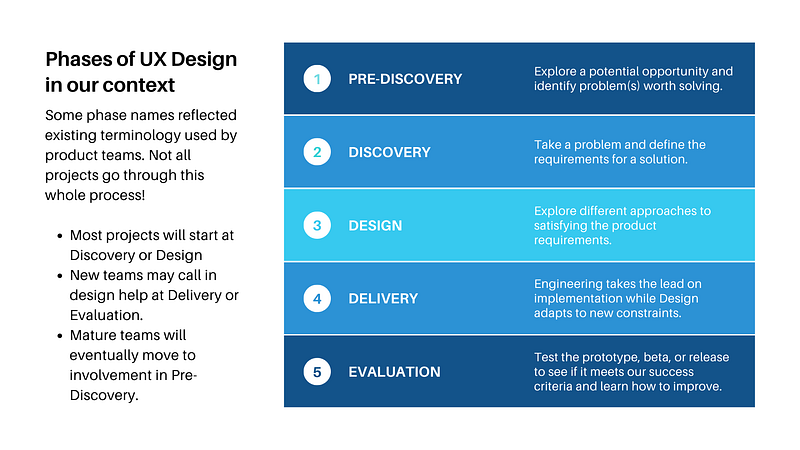
The simple fact that “discovery” was also part of the UX design process as became an important conversation starter. How can design help? What tools and techniques do we use in a stage when we’re NOT going straight to Figma? Don’t assume that your partners understand this.
For example, very early in my time at Riot I was meeting with the head of one of our Commerce sub-initiatives, who was in the Discovery process for an affiliate program beta but was finding other teams less than receptive to the vision. I offered to collaborate using specific skills — by providing storyboards and crafting clear problem statements and player personas to incorporate into the storytelling of the pitch deck. To his credit, my partner welcomed the collaboration. As a result of that joint effort, we found our cross-initiative partners more receptive to the project pitch, and the pitch became better aligned with player needs. From then on, there was a stronger mental model around the types of insight Design could provide outside of traditional user interface work.
To improve design maturity in your organization and open the door to design involvement ideation, give your partners a framework for engagement with you. Ideally, put this framework in the context of real projects that can benefit from your involvement. Don’t assume that your partners know what you can contribute. Go in, lead with curiosity, understand their needs, and offer specific help.
Lack of shared understanding
How often do we work on projects only to find that a key stakeholder had a closely-held belief only revealed in the 11th hour? What about projects where people seem to be talking past each other but turn out to be fairly aligned? The skills we’ve developed in service of customers can also be deployed in service of our coworkers — to drive to clarity and shared understanding early in the process on a new project or endeavor.
As I advanced into the senior leadership phase of my career, my ability to design and run shared understanding workshops became a critical differentiator for me. But I often reflect on the why — why is it that UX is well positioned to do this? Many of us are trained in cognitive psychology and the art of observing and interpreting human behavior and feedback. This gives us the ability to ask the right questions that make the journey towards alignment just as valuable as the alignment itself.
For example, early in my time at Riot Games I was asked to help one of our “initiative” teams in charge of our internal development tools with a re-chartering exercise. I often start planning these workshops with a kickoff meeting to understand what stakeholders are looking for (and to observe team dynamics). When I posed the question “do you feel confident you understand your customers” to the group, the response I received was “Yes, we do” —followed by a list of five specific names: the names of individual producers/product managers on each of the games. I dug in to try and get information about actual developers, but it was clear there was a misalignment and an opportunity for broader customer centricity.
That night, I tore apart my original plans for the chartering workshop. Before we could get to wordsmithing and principles, the team needed to gain a more nuanced understanding of the full spectrum of their customers. I noted that conversation was dominated by one of the leaders, and created an anonymous survey with which I gathered the first round of seed feedback for the workshop to ensure all voices were heard. That allowed me to ask tough questions like “what isn’t working” without fear of reprisal. I also added in a new series of exercises designed to get the team thinking about their customers in a new way, starting with the statement starters “As a ___ , I need ___, in order to ___.” Affinity diagramming of the responses in this exercise yielded really important insights for us about nuanced customer groups and opportunities. I saw a change in how that org approached future product opportunities by differentiating their customers and their needs by product phase and type — production, pre-production, platform etc.
Every group is different. Every group dynamic is different. And every individual in every group has a different lived experience, and a different perspective on what you’re about to build. A good shared understanding exercise helps you draw all of that out early in a project, so that you as a designer are playing with all the cards on the table, instead of a game of Texas Hold ’Em with everyone holding close to the chest. Use your design superpowers to build empathy and understanding with your partners just as much as you do your customers, and your process will become stronger for it.
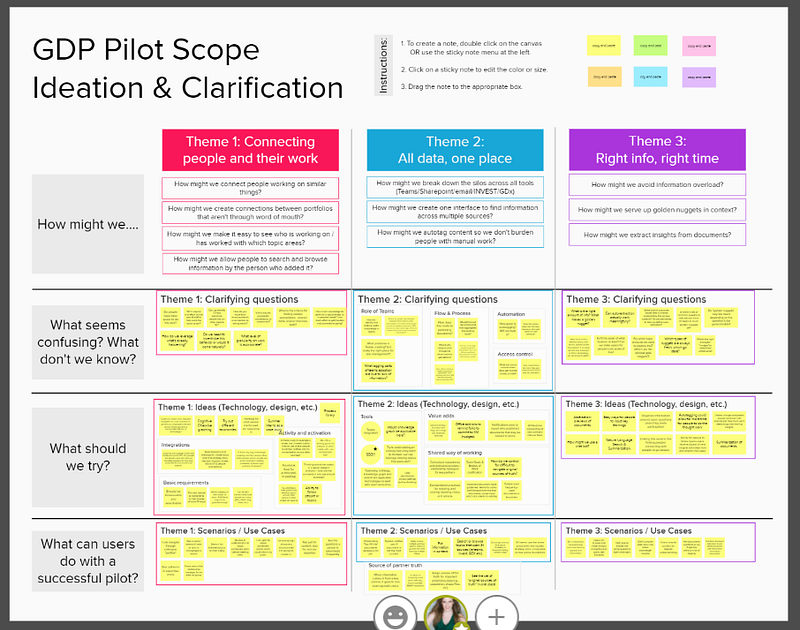
Use your design superpowers to build empathy and understanding with your partners just as much as you do your customers, and your process will become stronger for it.
Wobbly cohesion of craft
As design teams scale from a team of 1 to a team of some, each team has to find a way to iterate on their own processes.
- How do we come together and leverage our mutual expertise to make our work stronger from the start?
- How do we connect as a community of practice across business unit to reduce the risk of duplicated work or repeated mistakes?
There is often an expectation that “the designers” will review their work with each other, for better or for worse. And most designers are trained in an environment that involves some form of peer critique or review, such that a majority of designers I’ve worked with feel starved for support when working solo in an organization. But it is up to us to build the threads that bind us.
In particular, the practice of sharing and critique that’s built into the design craft gives UX designers and researchers a strong motivation to engage in cross-organizational networking in a unique way. I’ve found that a strong cross-company community of practice in design can yield huge benefits in identifying potential synergies, heading off potential repeat problems, and jumpstarting career growth for designers at all stages.
At Riot Games, I conducted a cross-craft survey early in my time at the company and the feedback clearly indicated that designers were hungry to see what other teams were working on. Now, this is a tricky one. It’s fine for me to say “I want to see what other teams are working on”, but this assumes the other teams are motivated to present, which is rarely the case at first.
The cross-team series was a slow start at first, without a lot of self-selection from designers to share. By 2023, we had a robust calendar of really impactful share-outs that led to visible cross-team collaboration after the shares, and even needed to book out several months in advance due to quantity of content. I hope the community continues this tradition in my absence; it is a low cost way to provide a unique value as designers back to the organizations we serve while growing craft skills in the process.
A recipe for better partnership and engagement
You can see the tangible results of these techniques in my public case studies published for Riot about the Xbox Game Pass project, where I and my team engaged with all four of these opportunity areas to significant success. Check out Part 1 and Part 2 on Medium if you’d like to go deeper. That engagement became a blueprint for effective cross-Riot and cross-disciplinary engagement that is being actively applied to several major initiatives you’ll see launching in 2024 and beyond.

The road can seem long and requires thoughtful engagement. During my time at Riot, the UX craft doubled in size from 35 full timers to over 70 full time designers. My own design team grew from 4 full time designers to 15 full time designers. The work described here was paired with deep engagement on recruiting, mentoring, manager support, and public outreach. And while I am a very prominent victim of the Riot layoffs, I have only heard of 2 UX designers (myself included) affected by this restructuring. (Based on comments from colleagues, I believe I was a victim of my commitment to continue the craft engagement alongside my other work, amongst other things — the visibility of the work made it easy to overlook the scope of impact and the fact that I was doing it on top of my regular full time job successfully managing a team of 16 and leading several projects. I’m sure a few of you can relate!)
Proportionally, that result still signals a growing appreciation for UX — just not a desire to continue investment in the craft as a whole. But it’s also a sign that my team of designers grew so successfully that they can soldier on without me. As a result of our partnership and collective hard work, 7 of my 15 designers were promoted during my tenure; all 4 of my original team members and 3 new hires who were promoted at their first opportunity. And I know for a fact that the craft as a whole has grown in impact and maturity — not just because of me, but also because of the collective engagement of the community along the way. We moved the needle on UX impact at Riot these past few years together.
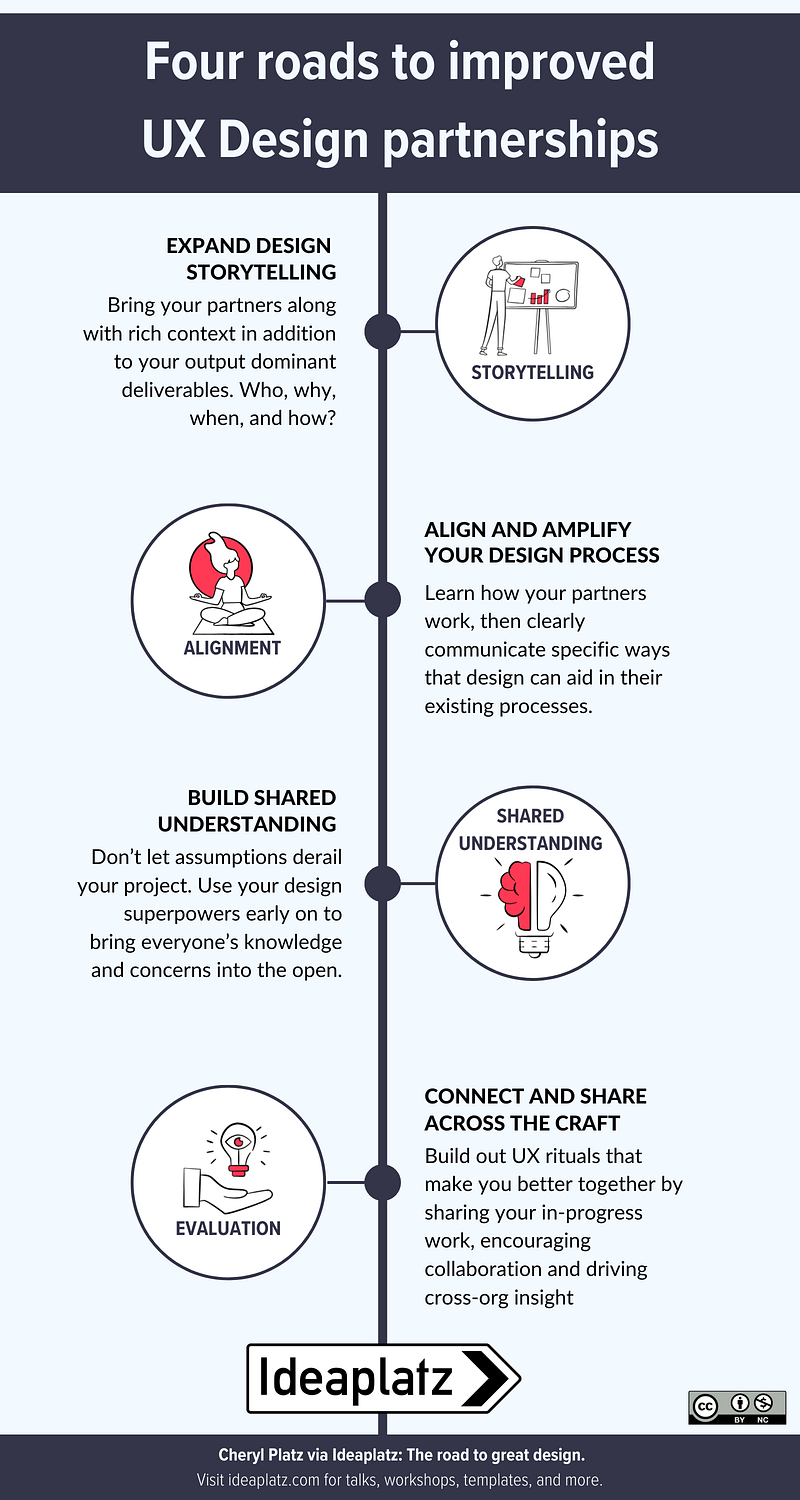
You can move the needle as well, whether you’re working from a central team or as a grassroots effort. To address the four areas we’ve discussed, keep these four recommendations in mind:
- Expand your design storytelling. Bring your partners along with rich context in addition to your output dominant deliverables. Who, why, when, and how?
- Align and amplify your design process. Lead with curiosity to learn how your partners work, then clearly communicate specific ways that design can aid in their existing processes.
- Build shared understanding across disciplines and teams. Don’t let assumptions derail your project. Use your design superpowers early on to bring everyone’s knowledge and concerns into the open.
- Connect and share across the UX craft. Build out UX rituals that make you better together by sharing your in-progress work, encouraging collaboration and driving cross-org insight
Don’t waste time telling people how valuable you are. Start with your partner relationships and chart a new path forward for your design practice. Lead with curiosity about your partners, apply your design superpowers to help you solve their problems alongside your customer problems, and with those strengthened relationships bring your organization further down the path of design maturity. You’re going to crush it.
If you’d like to hear more about any of these techniques in a future article, let me know in the comments!
Cheryl Platz is a world renowned user experience designer, product strategist, game developer, author, teacher, public speaker, and actor. She was Director of User Experience for the Player Platform and head of the UX craft for Riot Games from 2021–2024. She is currently an Adjunct Instructor of the video game craft for Carnegie Mellon University’s Masters of Entertainment Industry Management program, and owner of design education and consultancy firm Ideaplatz, LLC. Her bestselling book Design Beyond Devices is available at Rosenfeld Media, Amazon, or your favorite online bookseller.