avatarLinda Caroll

Free AI web copilot to create summaries, insights and extended knowledge, download it at here

6154

Abstract

hing.” ― Socrates</p><p id="a08e">Socrates believed philosophy should be used to achieve results for the greater well being of all society. He was trying to establish an ethical system of rule based on human logic instead of strict religious doctrine.</p><p id="ad46">Sadly, his ideas were not popular politically, and he was sentenced to death by hemlock. His work was destroyed, preserved only in the notes taken by Plato, his top student. Through Plato, his words would live on.</p><p id="6ab8" type="7">“The unexamined life is not worth living.” ― Socrates</p><h1 id="d692">4. Plato — the man who taught Aristotle</h1><p id="4115"><i>(c. 428–348 BC)</i></p><figure id="4f79"><img src="https://cdn-images-1.readmedium.com/v2/resize:fit:800/1*Ie5GaJEJjnH2qcecPxJgsQ.jpeg"><figcaption>photo of Plato created by <a href="https://twitter.com/ATomasi__">ATomasi</a> [<a href="https://www.instagram.com/alessandrotomasi__/">Instagram</a>]</figcaption></figure><p id="7326">Plato’s father descended from the Kings of Athens. As an aristocrat, he had access to the best education in Greece and he said the highlight of his life was meeting and studying under Socrates.</p><p id="4ed7"><b>He was devastated when his teacher was sentenced to death.</b> The death of Socrates affected him deeply. He preserved the teachings of Socrates, and began to philosophize about culture and the structure of society.</p><p id="5d9c" type="7">“The price good men pay for indifference to public affairs is to be ruled by evil men.” ― Plato</p><p id="36e8">Plato believe a “good life” required not just knowledge and intellect, but also healthy emotional responses. He founded his own school, “<a href="https://en.wikipedia.org/wiki/Platonic_Academy">The Academy</a>,” where he would teach Aristotle.</p><p id="bf84" type="7">“Be kind, for everyone you meet is fighting a hard battle.” ― Plato</p><h1 id="029b">5. Aristotle —polymath and first scientist</h1><p id="9b4b"><i>(c. 384–322 BC)</i></p><figure id="a33b"><img src="https://cdn-images-1.readmedium.com/v2/resize:fit:800/1*uwtd_lnh0NoJOgBpOXGPMQ.jpeg"><figcaption>photo of Aristotle created by <a href="https://twitter.com/ATomasi__">ATomasi</a> [<a href="https://www.instagram.com/alessandrotomasi__/">Instagram</a>]</figcaption></figure><p id="e176">Aristotle spent 20 years at Plato’s Academy, first as a student and later as a teacher. He was one of the greatest philosophers who ever lived, the first recorded scientist in history and Plato’s prized student.</p><p id="a5c0"><b>Aristotle was the first to dissect animals</b> to understand how their bodies worked and the first to attempt to classify animals and plants into groups.</p><p id="e0bc" type="7">“No great mind has ever existed without a touch of madness.” ― Aristotle</p><p id="8aed">After the death of Plato, Aristotle started his own school and became tutor to Alexander the Great, who sent Aristotle plants and animals from his empire when he became an adult.</p><p id="a825">Aristotle made pioneering contributions to the fields of philosophy and science and wrote many books about politics, culture, metaphysics and the anatomy of animals.</p><p id="09ff">When Alexander the Great died, Aristotle was also sentenced to death for his radical beliefs. Remembering what happened to Socrates, he fled the country and died a year later of natural causes.</p><p id="ccb1" type="7">“It is the mark of an educated mind to be able to entertain a thought without accepting it.” ― Aristotle, Metaphysics</p><h1 id="62cf">6. Epicurus — the man who inspired Jefferson</h1><p id="6dae"><i>(c. 341–270 BC)</i></p><figure id="e951"><img src="https://cdn-images-1.readmedium.com/v2/resize:fit:800/1*tHwwZVa8kqD20eebVDXzKw.jpeg"><figcaption>photo of Epicurus created by <a href="https://twitter.com/ATomasi__">ATomasi</a> [<a href="https://www.instagram.com/alessandrotomasi__/">Instagram</a>]</figcaption></figure><p id="8a8b">Epicurus had some of the most radical beliefs of all, and centuries later, Thomas Jefferson modified his motto for the Declaration of Independence.</p><p id="c5a0"><b>He welcomed women and slaves in his school, </b>and was one of the first Greeks to break from the god-fearing, god-worshipping tradition of the time.</p><p id="4561">He believed “the Gods” existed, but thought we should do “good” to one another for the sake of humanity and decency, not because we fear repercussion from the Gods. He believed decency made us happier.</p><p id="c6e5" type="7">“Is God willing to prevent evil, but not able? Then he is not omnipotent. Is he able, but not willing? Then he is malevolent. Is he both able and willing? Then whence cometh evil? Is he neither able nor willing? Then why call him God?” ― Epicurus</p><p id="9700">He believed every human has a natural born right to “<i>life, liberty, and safety</i>” and that “belief triad” was carried into the American freedom movement by Thomas Jefferson, as “<i>life, liberty, and the pursuit of happiness.</i></p><p id="65d6" type="7">“Not what we have but what we enjoy, constitutes our abundance.” ― Epicurus</p><h1 id="6da1">7. Zeno of Citium — the founder of Stoicism</h1><p id="df62"><i>( c. 336–265 BC)</i></p><figure id="71c8"><img src="https://cdn-images-1.readmedium.com/v2/resize:fit:800/1*0sVdG40DmazuPq6IkIy5Rw.jpeg"><figcaption>photo of Zeno of Citium created by <a href="https://twitter.com/ATomasi__">ATomasi</a> [<a href="https://www.instagram.com/alessandrotomasi__/">Instagram</a>]</figcaption></figure><p id="c37a">Zeno of Citium (pronounced <i>ZEE-no of SISH-um</i>) was a merchant until age 42, when he founded the Stoic school of philosophy.</p><p id="38c5"><b>Stoicism was named after the porch in front of Zeno’s house.</b> Not even kidding. “<i>Stoa</i>” is Greek for “porch.” That’s where he taught his philosophies to anyone who cared to listen.</p><p id="4dff">Zeno was described as haggard and sunburned. He lived a spare life with few possessions and mocked the wealthy of Athens. He was known to spend his time with serfs and beggars and often resorted to begging to exist.</p><p id="2ff9" type="7">“Steel your sensibilities, so that life shall hurt you as

Options

little as possible.” ― Zeno of Citium</p><p id="5552">Founder of the Stoic school of philosophy, he believed men are rational and do not need rules, money, court or laws and will manage themselves just fine without them. (haha) None of Zeno’s writing or work was known to survive.</p><p id="9c83" type="7">“Man conquers the world by conquering himself” ― Zeno of Citium</p><h1 id="b9e5">8. Plutarch — philosopher, writer & influencer</h1><p id="9a4b"><i>(45–120 AD)</i></p><figure id="5f35"><img src="https://cdn-images-1.readmedium.com/v2/resize:fit:800/1*W_vysYbuhVzMaB6JX15o5w.jpeg"><figcaption>photo of Plutarch created by <a href="https://twitter.com/ATomasi__">ATomasi</a> [<a href="https://www.instagram.com/alessandrotomasi__/">Instagram</a>]</figcaption></figure><p id="7821">If you switched careers partway through life, Plutarch would understand. He did, too. He was educated in philosophy in Athens and spent several years in Rome, lecturing on philosophy.</p><p id="2100"><b>Then writing called his name. </b>Once he began to write, no historian or philosopher was as widely read. He’s known primarily for <a href="https://en.wikipedia.org/wiki/Parallel_Lives"><i>Parallel Lives</i></a>, a series of biographies that paired up illustrious Greeks and Romans.</p><p id="ef3c" type="7">“The mind is not a vessel to be filled but a fire to be kindled.” — Plutarch</p><p id="694c">He was fascinated by character and human behavior and explored those in stories that were fact and fiction woven together so tightly that historians are still trying to untangle one from the other.</p><p id="ad45">Shakespeare drew many of his plays from the work of Plutarch. When you read the wise words of the Bard, many of the poignant thoughts first bled from the pen of Plutarch. So now you know!</p><p id="bd79" type="7">“Character is simply habit long continued.” — Plutarch</p><h1 id="38bd">9. Marcus Aurelius — last of the good emperors</h1><p id="bbf3"><i>(121–180 AD)</i></p><figure id="1383"><img src="https://cdn-images-1.readmedium.com/v2/resize:fit:800/1*ZDgSkR4urrqZ7MzTApfHDw.jpeg"><figcaption>photo of Marcus Aurelius created by <a href="https://twitter.com/ATomasi__">ATomasi</a> [<a href="https://www.instagram.com/alessandrotomasi__/">Instagram</a>]</figcaption></figure><p id="a2c3">Marcus Aurelius was an ancient social justice warrior who believed in peace and fairness. When he inherited the throne at age 17, he agreed to ascend on the condition that his brother share the throne and rule with him.</p><p id="ad52">Together, the brothers passed laws to stop the gladiatorial games and to help slaves and the middle class live better lives in a country where the middle class had been disappearing because of upper class corruption.</p><p id="3389" type="7">“When you arise in the morning think of what a privilege it is to be alive, to think, to enjoy, to love.” — Marcus Aurelius</p><p id="2f4d">A student of Stoicism, Aurelius is considered to be one of the most important Stoic philosophers. His book, <a href="https://www.goodreads.com/book/show/30659.Meditations">Meditations</a>, was one of the world’s most admired books on practical wisdom for many generations.</p><p id="1297">He wrote it, he said, as a guide for how he wanted to live his own life.</p><p id="2d27" type="7">“You have power over your mind, not outside events. Realize this, and you will find strength.” — Marcus Aurelius</p><h1 id="daf0">History isn’t boring, but the telling often is…</h1><p id="6e5f">They say those who ignore history are doomed to repeat it, but oh, do they have to make it so droll? History is not all dry and filled with wars and dates.</p><p id="9d2b">They were people back then — not unlike you and me.</p><p id="4763">They lived and laughed, and suffered the “slings and arrows,” as Shakespeare once said. I try to make their stories interesting.</p><p id="a287">If you enjoy, why not <a href="https://medium.com/@lindacaroll">follow me</a>?</p><h2 id="a4fc">You might also enjoy…</h2><div id="9656" class="link-block"> <a href="https://historyofyesterday.com/an-artist-created-lifelike-photos-of-the-wives-of-king-henry-viii-bdb99cd35155"> <div> <div> <h2>An Artist Created Lifelike Photos of the Wives of King Henry VIII</h2> <div><h3>Artist Becca Saladin’s art amplifies the pain and tragedy of five beautiful young women who died too young.</h3></div> <div><p>historyofyesterday.com</p></div> </div> <div> <div style="background-image: url(https://miro.readmedium.com/v2/resize:fit:320/1*GwJe6k5aEq6RRk1EgRpnOQ.jpeg)"></div> </div> </div> </a> </div><div id="cd04" class="link-block"> <a href="https://historyofyesterday.com/cleopatra-caesar-and-antony-and-what-theyd-look-like-today-c97abefd4681"> <div> <div> <h2>Cleopatra, Caesar and Antony and What They’d Look Like Today</h2> <div><h3>Did Hollywood whitewash Cleopatra? A Pulitzer Winning historian says no.</h3></div> <div><p>historyofyesterday.com</p></div> </div> <div> <div style="background-image: url(https://miro.readmedium.com/v2/resize:fit:320/1*g4zbhFaZAMD9Cf6bKD3K2w.jpeg)"></div> </div> </div> </a> </div><div id="7809" class="link-block"> <a href="https://readmedium.com/an-1889-magazine-asked-single-women-why-they-arent-married-and-ouch-the-replies-eab5853e1f45"> <div> <div> <h2>An 1889 Magazine Asked Single Women Why They Aren’t Married and Ouch, The Replies</h2> <div><h3>Men didn’t help with the housework back then, either</h3></div> <div><p>medium.com</p></div> </div> <div> <div style="background-image: url(https://miro.readmedium.com/v2/resize:fit:320/1*FiS3yuAobXlR0a2O9RAacQ.jpeg)"></div> </div> </div> </a> </div></article></body>

Lifelike Photos of The Ancient Philosophers and Stoics

An artist shows us the faces of the men we still quote for inspiration. (Some look younger than I expected!)
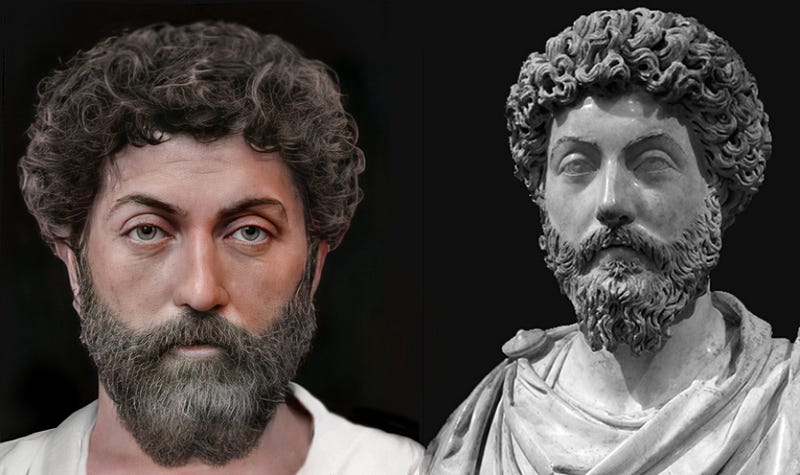
photo of Marcus Aurelius created by ATomasi [Instagram]

Alessandro Tomasi is an Italian-Lebanese artist and student from Florence, Italy. Last year, he started reconstructing the faces of historical figures from stone statues. Turning stone into flesh and blood, basically.

He started the project as a reaction to inaccurate portraits he was seeing.

“I decided to start doing these reconstructions after coming across other reconstructions on the internet, which have obviously been done by people with absolutely no knowledge about genetics or history.”

Tomasi says he researches the not only the person, but also the genealogy of the historical figure he is reconstructing.

Lifelike Photos of Ancient Philosophers…

Almost every day, I see quotes by Aristotle, Socrates and other philosophers. Thanks to Tomasi’s work, now we can put faces to the names and words.

1. Homer — the blind balladeer

(c. 800–701 BC)
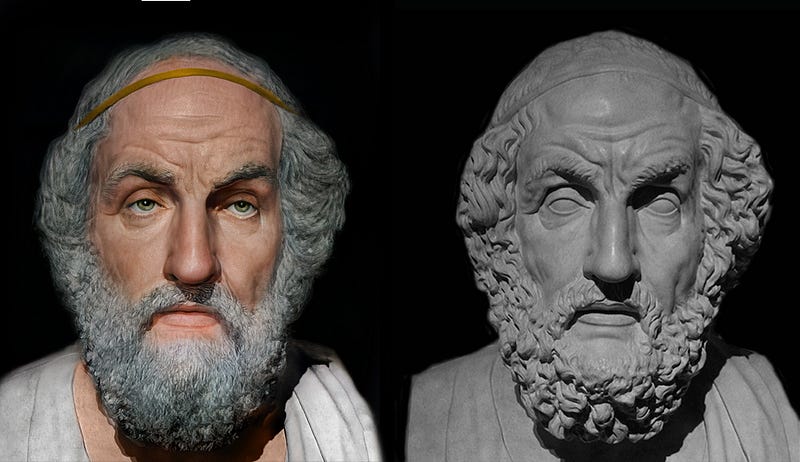
photo of Homer created by ATomasi [Instagram]

Homer lived before calendars existed. Since there was no way to track time, historians don’t really know when he was born. Some say about 800 B.C. Others think it’s more like 1200 B.C., but they don’t really know.

He was an epic poet and balladeer. Think spoken word poetry, and you’re close. Like Amanda Gordon at President Biden’s inauguration. Also? An “epic” poet doesn’t mean woohoo, amazing. lol. It means long. A book length story. In poetry. (That doesn’t rhyme)

“For a friend with an understanding heart is worth no less than a brother” ― Homer, The Odyssey

Homer wasn’t even a philosopher, really, but The Odyssey and The Iliad were the first written works to discus moral values of society, which led to the study of philosophy. So in a way, he was the beginning of philosophy.

No one is really sure if he wrote the stories, or whether he wrote down stories that were orally history back then, but — centuries later — Plato said Homer was “the educator of all Greece.”

Blinded in battle as a youth, they called Homer “the blind bard.” He was often depicted with sightless eyes, with a human or animal leading him.

“Any moment might be our last. Everything is more beautiful because we’re doomed. You will never be lovelier than you are now.” ― Homer, The Iliad

2. Pythagoras — the mind/body connection

(c. 570 BC – 495 BC)
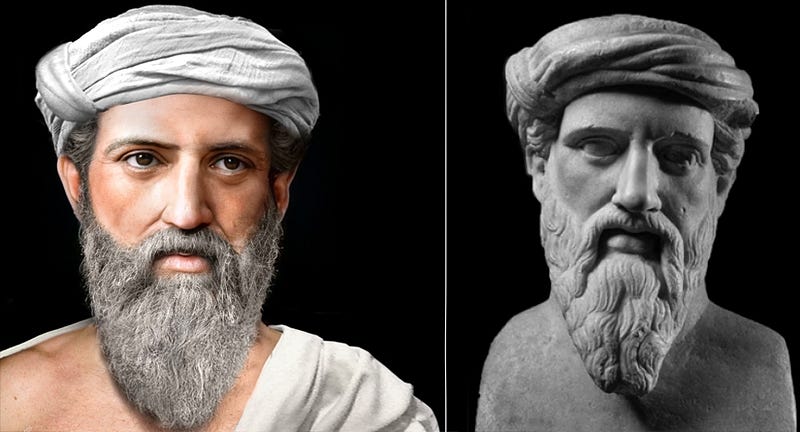
photo of Pythagoras created by ATomasi [Instagram]

Pythagoras was a Greek philosopher who believed in honesty; living a simple and unselfish life and generally showing kindness to people and animals.

“As long as Man continues to be the ruthless destroyer of lower living beings, he will never know health or peace.” ― Pythagoras

Can you believe we’ve been talking about humans destroying everything around us since 500 years before the birth of Christ?

Pythagoreans believed some simple tenets… That the body and soul function together, not separately. — That the soul is distinct and separate from the intellect. — That emotion comes from the soul, not the intellect. — That to have a healthy body requires a healthy psyche.

Those seem like pretty simple concepts today, but 500 years before the birth of Christ, they were a new and radical way to think. Back then, no one really thought too much about the mind/body connection.

Author of The Golden Verses of Pythagoras, his teachings influenced the thinking of Plato, Aristotle, and eventually — Western philosophy.

“No man is free who cannot command himself.” ― Pythagoras

3. Socrates — father of Western Philosophy

(c. 470–399 BC)
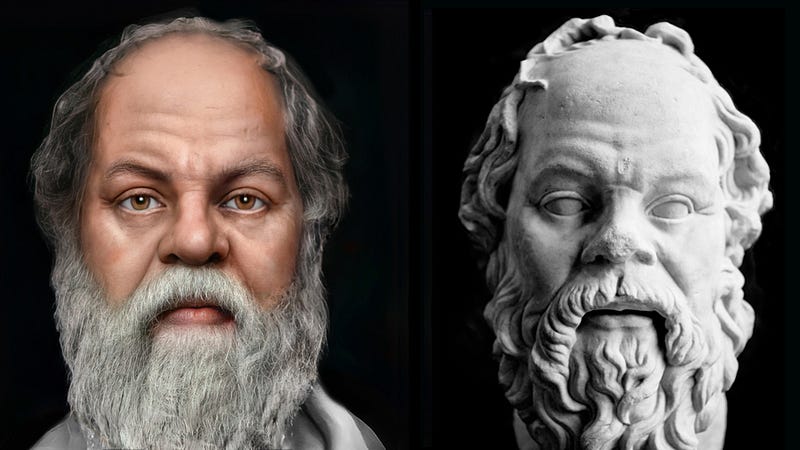
photo of Socrates created by ATomasi [Instagram]

Socrates was a scholar, teacher and philosopher who would die for his beliefs and become known as the “Father of Western Philosophy.

He was not the ideal of Greek masculinity. When you think of a Greek god, he wasn’t that. He was short and stocky, with bulging eyes that always appeared to be staring. His students thought he was brilliant and would listen to him for hours.

“The only true wisdom is in knowing you know nothing.” ― Socrates

Socrates believed philosophy should be used to achieve results for the greater well being of all society. He was trying to establish an ethical system of rule based on human logic instead of strict religious doctrine.

Sadly, his ideas were not popular politically, and he was sentenced to death by hemlock. His work was destroyed, preserved only in the notes taken by Plato, his top student. Through Plato, his words would live on.

“The unexamined life is not worth living.” ― Socrates

4. Plato — the man who taught Aristotle

(c. 428–348 BC)
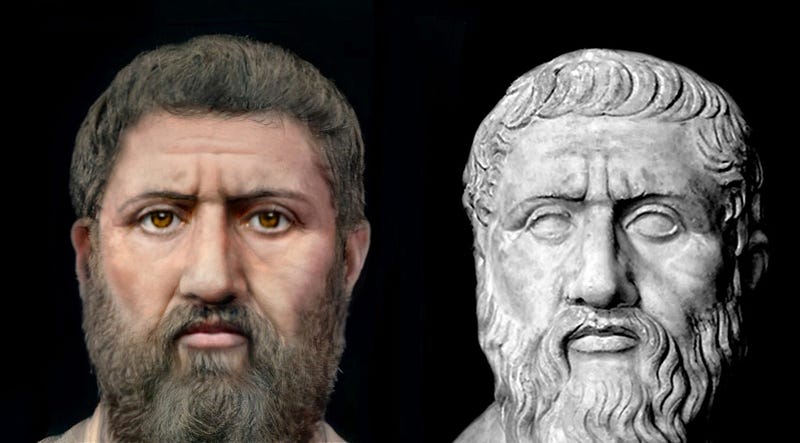
photo of Plato created by ATomasi [Instagram]

Plato’s father descended from the Kings of Athens. As an aristocrat, he had access to the best education in Greece and he said the highlight of his life was meeting and studying under Socrates.

He was devastated when his teacher was sentenced to death. The death of Socrates affected him deeply. He preserved the teachings of Socrates, and began to philosophize about culture and the structure of society.

“The price good men pay for indifference to public affairs is to be ruled by evil men.” ― Plato

Plato believe a “good life” required not just knowledge and intellect, but also healthy emotional responses. He founded his own school, “The Academy,” where he would teach Aristotle.

“Be kind, for everyone you meet is fighting a hard battle.” ― Plato

5. Aristotle —polymath and first scientist

(c. 384–322 BC)
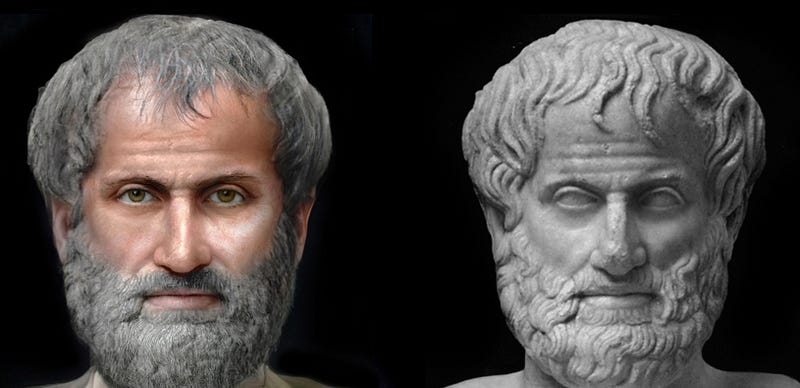
photo of Aristotle created by ATomasi [Instagram]

Aristotle spent 20 years at Plato’s Academy, first as a student and later as a teacher. He was one of the greatest philosophers who ever lived, the first recorded scientist in history and Plato’s prized student.

Aristotle was the first to dissect animals to understand how their bodies worked and the first to attempt to classify animals and plants into groups.

“No great mind has ever existed without a touch of madness.” ― Aristotle

After the death of Plato, Aristotle started his own school and became tutor to Alexander the Great, who sent Aristotle plants and animals from his empire when he became an adult.

Aristotle made pioneering contributions to the fields of philosophy and science and wrote many books about politics, culture, metaphysics and the anatomy of animals.

When Alexander the Great died, Aristotle was also sentenced to death for his radical beliefs. Remembering what happened to Socrates, he fled the country and died a year later of natural causes.

“It is the mark of an educated mind to be able to entertain a thought without accepting it.” ― Aristotle, Metaphysics

6. Epicurus — the man who inspired Jefferson

(c. 341–270 BC)
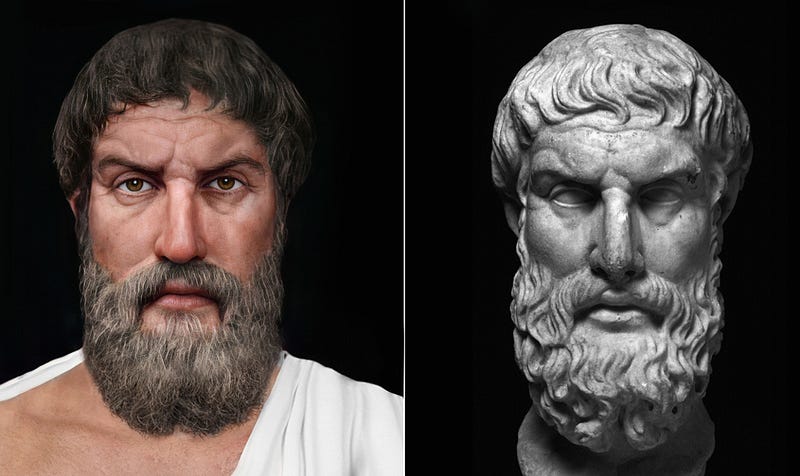
photo of Epicurus created by ATomasi [Instagram]

Epicurus had some of the most radical beliefs of all, and centuries later, Thomas Jefferson modified his motto for the Declaration of Independence.

He welcomed women and slaves in his school, and was one of the first Greeks to break from the god-fearing, god-worshipping tradition of the time.

He believed “the Gods” existed, but thought we should do “good” to one another for the sake of humanity and decency, not because we fear repercussion from the Gods. He believed decency made us happier.

“Is God willing to prevent evil, but not able? Then he is not omnipotent. Is he able, but not willing? Then he is malevolent. Is he both able and willing? Then whence cometh evil? Is he neither able nor willing? Then why call him God?” ― Epicurus

He believed every human has a natural born right to “life, liberty, and safety” and that “belief triad” was carried into the American freedom movement by Thomas Jefferson, as “life, liberty, and the pursuit of happiness.

“Not what we have but what we enjoy, constitutes our abundance.” ― Epicurus

7. Zeno of Citium — the founder of Stoicism

( c. 336–265 BC)
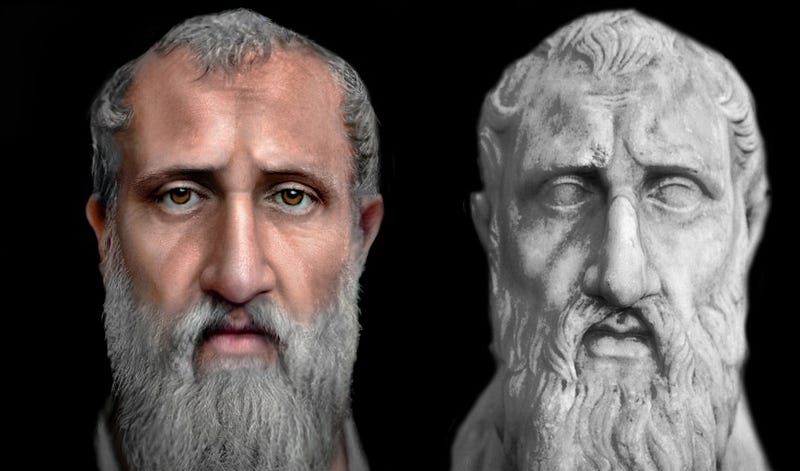
photo of Zeno of Citium created by ATomasi [Instagram]

Zeno of Citium (pronounced ZEE-no of SISH-um) was a merchant until age 42, when he founded the Stoic school of philosophy.

Stoicism was named after the porch in front of Zeno’s house. Not even kidding. “Stoa” is Greek for “porch.” That’s where he taught his philosophies to anyone who cared to listen.

Zeno was described as haggard and sunburned. He lived a spare life with few possessions and mocked the wealthy of Athens. He was known to spend his time with serfs and beggars and often resorted to begging to exist.

“Steel your sensibilities, so that life shall hurt you as little as possible.” ― Zeno of Citium

Founder of the Stoic school of philosophy, he believed men are rational and do not need rules, money, court or laws and will manage themselves just fine without them. (haha) None of Zeno’s writing or work was known to survive.

“Man conquers the world by conquering himself” ― Zeno of Citium

8. Plutarch — philosopher, writer & influencer

(45–120 AD)
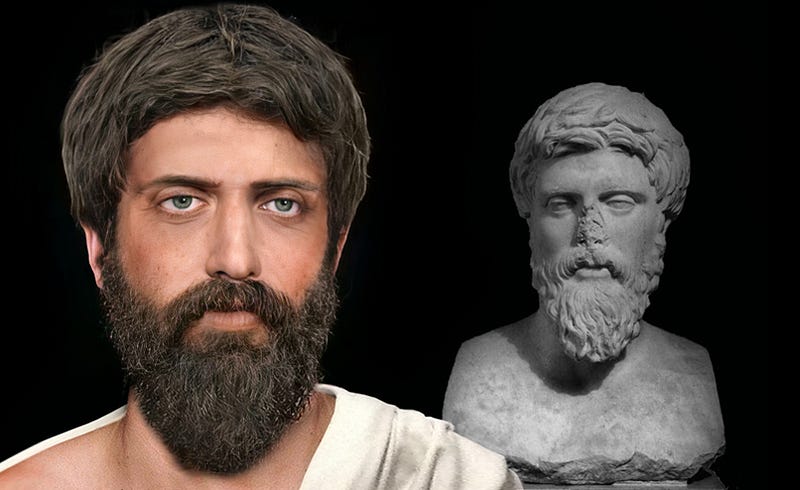
photo of Plutarch created by ATomasi [Instagram]

If you switched careers partway through life, Plutarch would understand. He did, too. He was educated in philosophy in Athens and spent several years in Rome, lecturing on philosophy.

Then writing called his name. Once he began to write, no historian or philosopher was as widely read. He’s known primarily for Parallel Lives, a series of biographies that paired up illustrious Greeks and Romans.

“The mind is not a vessel to be filled but a fire to be kindled.” — Plutarch

He was fascinated by character and human behavior and explored those in stories that were fact and fiction woven together so tightly that historians are still trying to untangle one from the other.

Shakespeare drew many of his plays from the work of Plutarch. When you read the wise words of the Bard, many of the poignant thoughts first bled from the pen of Plutarch. So now you know!

“Character is simply habit long continued.” — Plutarch

9. Marcus Aurelius — last of the good emperors

(121–180 AD)
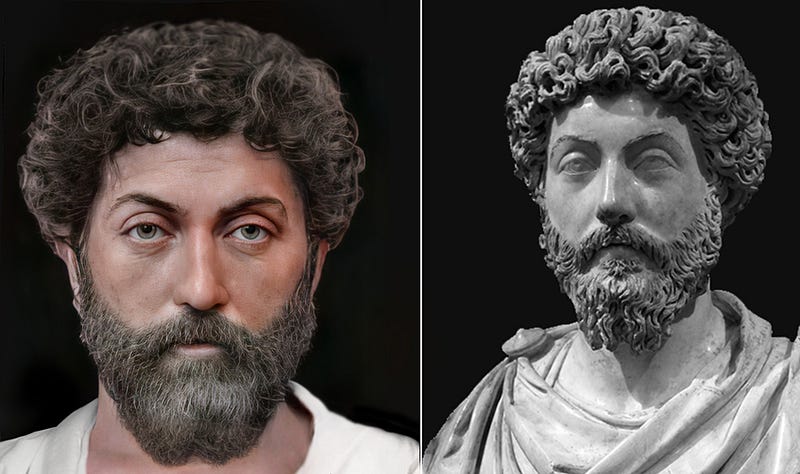
photo of Marcus Aurelius created by ATomasi [Instagram]

Marcus Aurelius was an ancient social justice warrior who believed in peace and fairness. When he inherited the throne at age 17, he agreed to ascend on the condition that his brother share the throne and rule with him.

Together, the brothers passed laws to stop the gladiatorial games and to help slaves and the middle class live better lives in a country where the middle class had been disappearing because of upper class corruption.

“When you arise in the morning think of what a privilege it is to be alive, to think, to enjoy, to love.” — Marcus Aurelius

A student of Stoicism, Aurelius is considered to be one of the most important Stoic philosophers. His book, Meditations, was one of the world’s most admired books on practical wisdom for many generations.

He wrote it, he said, as a guide for how he wanted to live his own life.

“You have power over your mind, not outside events. Realize this, and you will find strength.” — Marcus Aurelius

History isn’t boring, but the telling often is…

They say those who ignore history are doomed to repeat it, but oh, do they have to make it so droll? History is not all dry and filled with wars and dates.

They were people back then — not unlike you and me.

They lived and laughed, and suffered the “slings and arrows,” as Shakespeare once said. I try to make their stories interesting.

If you enjoy, why not follow me?

You might also enjoy…

Philosophy
History
Quotes
Stoicism
Artist
Recommended from ReadMedium