
Life Without Petroleum
What is like hydrocarbon?
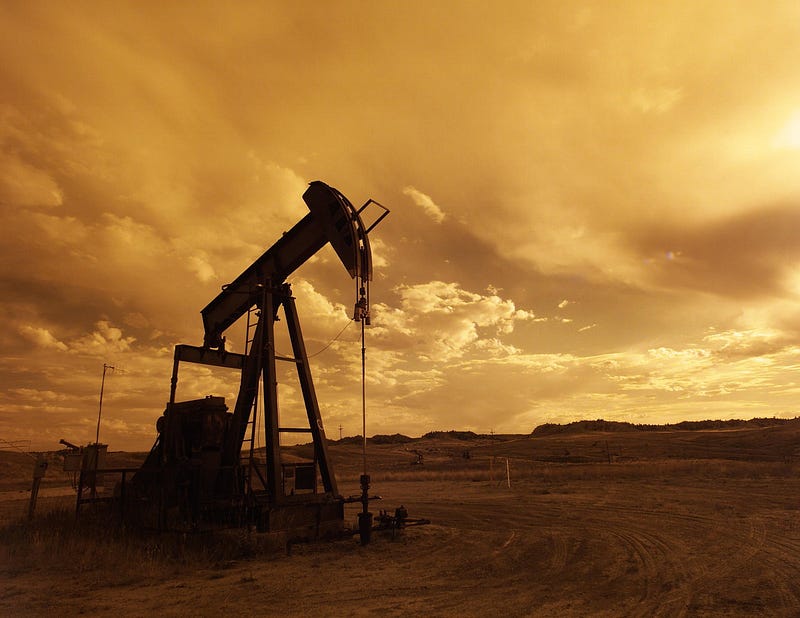
Well, there’s no nice way to put this: We are petroleum’s bitches. Yup, we gave ourselves fully to petroleum and forgot how to live without it. Our clothes, our streets, our food, our furniture and nearly everything else is made from fossils. Those commodities, however, were not invented after the first discovery of oil. For millennia, we produced those needed items using natural fibers, stones, wood and metal.
Since there are still people who deny climate change and would be completely distracted by the rest of this little essay, let’s remove that distraction. Let’s pretend that petroleum combustion is beneficial — that it clears the lungs, strengthens the muscles, and cures cancer. Let’s imagine that we have access to two hundred years of easily retrieved crude oil. Does that mean we’re just good to go? No.
I will refer my reader to Stein’s Law: “If something cannot go on forever, it will stop.” At some point, we will have to wean ourselves off of it and so, we should have a plan to do exactly that. That reminds me of an aphorism that I first heard at a class for entrepreneurs: One who mounts a tiger must have a plan to dismount. That’s where we are (or will be) with petroleum. For that reason, anyone who tells you that we can’t function without oil is actually saying we can’t function. If we’re OK with that, lets dig our graves right now and start trying on our dirt shirts.
If we believe that we can survive, then we must understand how we might do that. The illusory abundance of petroleum has encouraged us to waste and over-tax other resources. This leaves us in an unsustainable state on multiple fronts including packaging, transportation, distribution and human population. Each of those growing problems will eventually march into a hard stop wherein no existing mechanisms will allow that way of doing things to continue. A disciplined approach to making these unsustainable systems sustainable will require serious effort. It will be difficult in the sense that doing things differently is always difficult. On the plus side, if you will eventually have to do something differently, you may as well accept that and adopt that new behavior now with raw abandon. Let’s consider what we might do to address the end of petroleum as it approaches.
Population
When John F. Kennedy was elected, we had about three billion people living on this Earth. When Thomas Jefferson was elected there were about one billion people. In the Middle Ages, we estimate about 350 million. Today we are approaching ten billion. Any engineer will tell you that every source of raw materials is a limited resource. It can be provided at a certain rate for a certain amount of time at which point, you had better be able to recycle and reuse it for the rest of time. All of the resources on the Earth are being used by an exponentially growing number of people and that means exponential depletion. The human population must be reduced to a reasonable number if we are all to survive. It is an existential imperative and so I would like to consider it first.
We could, of course, slaughter all of our inferiors as practiced by ruthless (and failed) dictators. We could order families to stop at one child, which never quite worked for Communist China. We could hoard all of the food and let famine and a paucity of fresh water kill everyone without dirtying our pristine (and very white) hands. We could also approach this as a cultural crisis.
As silly as it may sound, over-population could be reviewed in a cultural context. The study Understanding The Over-population Crisis discusses a number of causes and at least implies some possible solutions. Family planning education, for instance, has proved effective in reducing population growth in various studies in Africa and South America.
China’s one-child policy, imposing penalties for families with more than one child, began in 1979. It was an attempt to gain some control over China’s exploding population. It was very unpopular and was relaxed to something like one and a half children in the mid 1980s. Even that was eventually relaxed to the original two-child policy.
After that relaxed standard was made official, the Chinese government found that large numbers of families were still limiting themselves to one child. Despite the vocal repudiation of the one-child policy, and its technical failure, the culture had changed. No one wanted to be told to do this, but most citizens had settled on two parents and one child as the model family. They were largely doing what the government wanted but they all felt that this was by their own volition. One child was fine as long as it was voluntary.
I could imagine producing a more persuasive and less coercive campaign to be recommended to countries with particular population growth issues. We would need to use education and skilled marketing to associate the small family with prosperity and good fortune, in the minds of the citizenry. I may be wrong. There may be no way to bring about this cultural change, but without it, all other solutions are unlikely to succeed. If not by design, as the systems fail people will die through violence. So, we need to try to design and implement a non-violent solution. This can be done but will those in power act?
Rediscover Reuse Recycle
Many of the early ancient materials are recyclable. Metals and glass, if properly configured, may be recycled, without practical limit, into useful new commodities. Unlike plastics, which may be recycled once into a completely different thing which itself is not recyclable, glass and metal may be melted down, refined and formed into entirely new and recyclable products. In a post-petroleum world, we will avoid fusing glass or metal to other non-recyclable components within an assembly. In other words, if the mechanism is primarily made of steel, we will avoid sealing it into a plastic or ceramic cowling. We will make it all metal so that it can be melted down with minimal impurities and converted back into some other metal thing.
Beyond that, we would stop selling food, lubricants, paint and solvents in individual one-use containers. Instead, people would get used to doing what their great great grandparents did. They would bring their own reusable empty containers to the local market where they would fill them with the goods they require. From tomato sauce to olive oil to nail polish to rice, the dry goods would be dispensed in bulk to avoid the need for throw-away plastic containers. More goods would be locally sourced to reduce unnecessary transportation.
While glass and aluminum containers are recyclable, reusing them saves a huge amount of energy that could be used for more important processes. Certainly some items would be sold in individual containers, but they too would be made of glass or metal so that they could be recycled.
We are already to the point that gold may be more efficiently mined from certain cell-phone-rich landfills than from a gold mine, and those sites are rich in other valuable metals like cobalt and selenium. Rather than go through that complex process, we will find that simply reusing the materials is easier and cheaper.
Hydrocarbon Without the Baggage
Organic chemistry is fascinating. When working with carbon atoms, all sorts of things are possible. The carbon itself will form long chains to produce graphene which is a very useful component of high strength plastics. Those plastics are made primarily of carbon: carbon combined with hydrogen and nitrogen and the occasional phosphorous to make long chains of molecules that we call polymers. Those polymers are the building blocks of plastic. Plastic is very useful and will undoubtedly be required even after petroleum is unavailable. I say plastic is very useful, but if we cannot produce a plastic that can be recycled without practical limit, we will still want to limit its use to cases where no other material will suffice.
Crude oil is plant and animal material (organic material) that has been subjected to extreme pressure and temperature in the bowels of the Earth over millennia, transforming it into the black goo that oil wells extract. The useful material that we extract from crude oil is called hydrocarbon, which is composed almost entirely of carbon and hydrogen. The plant and animal material was largely made of carbohydrates (composed of carbon, hydrogen and oxygen), but deep in the Earth over those millennia of heat and pressure, the oxygen was stripped from them, leaving hydrocarbon.
Any decent organic chemist can make, for example, plastic from a hydrocarbon; but, using a similar method one can also make plastic from a carbohydrate. In other words, what we now make from oil can also be made from plant material. Our chemical factories will need to be transformed to use carbohydrates from plants rather than hydrocarbon from pressure-cooked plants, but plastics and rubber can still be made.
We have been using latex since the 17th century. That stretchy and very useful material was extracted from the Gutta tree as Gutta-percha. In its raw form, it has uses but is a bit fragile. Modern techniques could easily take natural latex and refine it into the more stable and chemical resistant material that we use today. Whether from hydrocarbon or the Gutta tree’s carbohydrates, latex is latex and really good latex may be produced from the natural material using modern chemistry.
Anyone who has owned an MGB automobile in the 1970s knows how supple and resilient natural rubber (from the rubber tree) is. Unfortunately, it doesn’t stand up well to hydraulic fluid or heat. Synthetic rubber is far superior but the underlying chemical is about the same. We can produce natural rubber and further refine it using modern techniques so as to make it as stable and as durable as rubber from hydrocarbon.
Carbohydrates are hydrocarbons without the baggage. The carbohydrate-based plastic would derive from plant material and as it deteriorates, it returns to the environment as carbon and hydrogen to be reused for the production of more plants. Our carbohydrate-based plastics would be compostable and would reenter the environment to produce more plants and more compostable plastic.
The Road System
It cannot be denied that our road system represents the arterial organ of our economy. Whatever you buy in a store was delivered by a truck. Many roads and highways are paved using asphalt. The engineering question arises, which is most effective: a carbohydrate-based asphalt or concrete? That is an active question which needs to be answered by folks with more data than I have. Asphalt can certainly be provided from plants but modern techniques for producing “green” concrete (a method that greatly reduces the release of carbon into the atmosphere during production) may prove to be the best approach.
Railroad tracks are already largely metal, and electric aircraft (becoming practical as solid state battery technology matures) introduce no serious environmental repercussions. For crossing the oceans, modern blimps may offer reasonable options.
We curmudgeons may scoff at virtual reality technology like Meta but we must take its useful aspects seriously. Such technology may be used to give a home buyer a virtual and very useful tour of a potential home. It could be used to take a group of engineers into the workings of an electric motor design. It could make a large amount of travel irrelevant. Of course, we will travel to broaden our minds and meet new cultures skin-to-skin, but a leisurely electric blimp ride to Japan would be fun and entirely hydrocarbon-free.
For emergencies, when the speed of a jet is required, an under-the-ocean electric bullet train may suffice or an aircraft using plant-derived isobutanol, an alcohol containing almost the same amount of energy per kilogram as gasoline.
All of the travel we are used to now will be possible post-petroleum but the environment will not be doomed.
Want Not
The illusion of limitless petroleum, propagated by the oil companies, gave everyone permission to waste. Limitless petroleum led to limitless plastic which led to massive landfills and microplastics polluting every living creature. Petroleum made us consumers. We must peel off that fetid skin of the consumer to reveal the real human underneath. That good human acquires, to cite Mortimer Adler, what is needed and nothing else. To have what is needed results in a pretty good life: food, shelter, companionship and the occasional wondrous debauch.
In a world where the limits are clear, everything becomes more precious. There is great remorse in discarding, there is a feeling of loss when the old smartphone, that served for twenty years, can no longer be repaired; but, the thrill at the new purchase is even more pleasant. A world without petroleum is a world of adults who accept their responsibility to husband the resources of the Earth, to treasure real value and to produce value in return. A reasonable profit becomes enough and enough is sufficient to the wise. When waste becomes impractical, everything becomes more valuable and life becomes more joyous.
Julian S. Taylor is the author of Famine in the Bullpen a book about bringing innovation back to software engineering. Available at or orderable from your local bookstore. Rediscover real browsing at your local bookstore. Also available in ebook and audio formats at Sockwood Press.