
Yes, Life Today Is Better Than It Was 100 Years Ago
But that’s a pathetically low bar for modern Americans
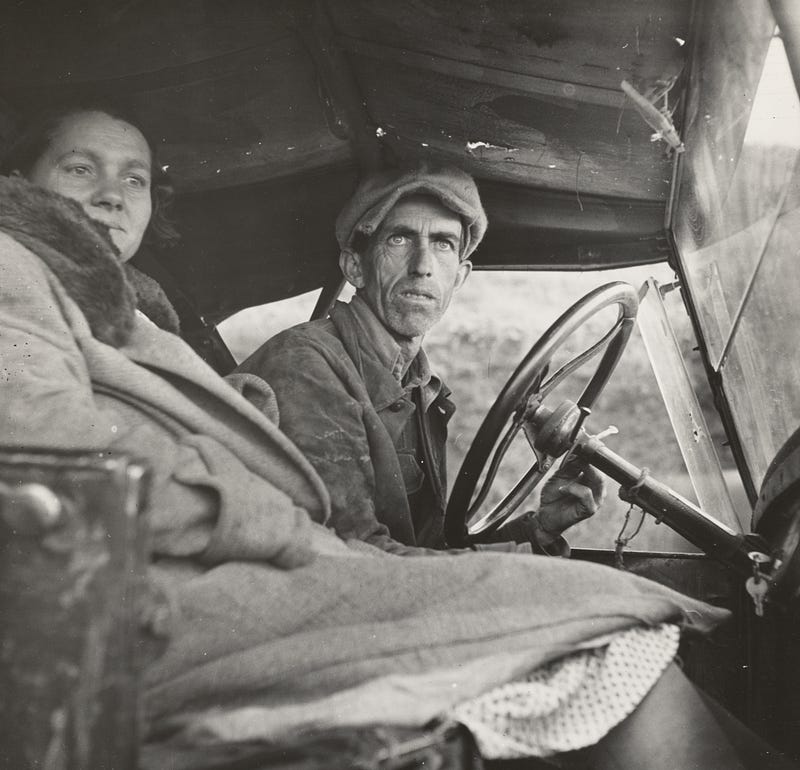
Over the past few months, I’ve noticed the rise of a strange new kind of article. Instead of focusing on the problems facing the U.S., these thought pieces compare life today with the horrors of the past. The point being, of course, that “when you look at the big picture, things aren’t really that bad.”
The topics vary, but once you notice it, you’ll see these kinds of articles everywhere:
- “Think Coronavirus Is Bad? The Spanish Flu Pandemic of 1918 Killed 50 Million People.”
- “Inflation Is Good for You: Don’t panic over milk prices. Inflation is bad for the 1 percent but helps out almost everyone else.”
- “No, The Coming Recession Won’t Be As Bad As The Depression.”
According to these articles, (usually written by people over 40) the problem isn’t the pandemic, runaway inflation, or impending economic collapse. No, the real problem today is that we lack perspective.
We don’t know how good we have it. Because if we just had a little more historical context we’d realize that life was awful 100 years ago.
To which I say…yeah? Of course, life was worse in 1922 than it is today. That’s not some kind of revelation.
I don’t need a detailed inflation-adjusted analysis to show me that we’re probably better off than people who lived through the actual Great Depression (the name kind of tipped me off).
And comparing where we’re at today with the darkest moments of the last century won’t make today’s problems go away.
The Line Is Supposed to Go Up
Things are supposed to be better than they were 100 years ago. That shouldn’t be cause for celebration. That’s what societies are supposed to do.
Children are supposed to have more opportunities than their parents. And their kids should have lives so much better than ours that they’re basically unrecognizable. At least, that used to be the goal.
Now, it seems like we’re ok splitting hairs to justify the price of milk instead of fighting for a better future for the next generation.
- Get back to normal! Covid “only” killed 1 million Americans (so far) and crippled tens of millions of others. You should go to Coachella!
- Take a road trip! You should be thrilled about paying $7 a gallon. We couldn’t even get gas in the 70s!
- Buy a house! Who cares that you’ll never be able to pay it off thanks to stagnant wages, soaring housing prices, and crushing student loan debt. My grandpa had polio! YOLO!
Call me ungrateful, but I think we should be setting the bar a little higher than comparing our quality of life to a time when millions of Americans didn’t have electricity.
I mean…that’s literally gaslighting us.
Progress Is the Bare Minimum
To be clear, I’m not debating that for most people, life in the U.S. today is better than it was 100 years ago. Again, that’s pretty obvious.
We have penicillin, the internet, washing machines, air conditioners, and clean drinking water (depending on where you live). The average house in 2022 would be a sci-fi wonderland to someone from the 1920s, not to mention all the other mind-blowing gizmos that we take for granted.
The amount of game-changing technology stuffed into a “crappy” $100 smartphone is an absolute marvel of engineering.
You can have Thai food delivered to your door instead of eating boiled cabbage for dinner again tonight. Thanks to investment and advancements in medicine (and a generation of people who trusted vaccines), polio isn’t going to cripple your children, and you probably won’t die of smallpox. Fingers crossed on that last one. 🤞
Today, women can vote, gay people can get married, and minorities in the U.S. can even take a road trip across the South without using a regularly updated guidebook that lists the safe places to eat and get gas so they don’t get murdered or imprisoned for running a stop sign.
Look at how far we’ve come!
Life in the U.S. is unarguably better in 2022 than it was in 1922 for millions of Americans. I admit it. You got me.
A high school kid working at McDonald's earning minimum wage is better off than a 12–year old who worked 70 hours a week in an unventilated factory for subsistence wages before federal child labor laws were passed in 1934.
…hooray?
Is…is that your whole argument? Things aren’t a complete nightmare anymore, so we should just be happy and go to work in a cubicle because we don’t have tuberculosis?
Has life in the U.S. gotten so bleak that we have to go back to a time when Confederate soldiers were still alive to feel like we’re doing ok?
Because that feels like we’re headed in the wrong direction.
Stagnation IS Decline
The dangerous thing about articles that say life is better than before is that they’re not wrong. Life is better than it was 100 years ago.
But we shouldn’t be psyched about that.
Intergenerational advancement isn’t a cause for celebration. It’s the norm. The control group. In fact, when the next generation doesn’t improve, everyone should get very nervous.
When you read things like “successive generations are not becoming wealthier than their parents for the first time since the Industrial Revolution,” or “life expectancy in the U.S. declined in back-to-back years,” people should be losing their minds.
Because outside of total societal collapse, that sort of thing has never happened before.
And the fact that we’re even debating if our quality of life is better than the horrors and inequities of life at the turn of the last century is a sign of how bad things have really gotten.
‘Life Should be a Dream…’
As a child of the 80s, I expected the future to be awesome. Blame Back to the Future 2. ¯\_(ツ)_/¯
I thought at least some of us would have jet packs, personal robots, and yes, hoverboards by now. Because that’s what I was told a functioning society does.
It makes life better for the next generation.
And while I can live without my hoverboard, I never expected things to go so far the other way. I shouldn’t be “happy” that my earning potential is better than a Dust Bowl farmer. I wasn’t “lucky” that the unemployment rate when I graduated college wasn’t quite as bad as when people were lining up for bread.
Those things shouldn’t have even been options.
Call me an optimist, but I thought we’d figured a few things out over the past century. At least enough to have moved past preventable tragedies like baby formula shortages, the next World War in Europe, and a global recession every decade.
Turns out the real future is a lot more like Biff’s version.
Better Than Worse Isn’t Good Enough
The funny thing is that I actually agree with people who scream that we should be grateful for all the things we have today. Because they’re right. Life today is great compared to life 100 years ago.
But it should be so much better, you guys.
We should be light years ahead of how people lived in 1922. We’ve split the atom, mapped the human genome, and created the 5nm microchip and GPS satellites. We have lasers and 3D printers. We sent a man to the moon (unless you’re one of the 2% of people who believe that’s impossible because the Earth is flat).
You’re reading on a device that you carry in your pocket that has 24/7 access to a global database with the sum total of human knowledge (and cat videos) that’s simultaneously available to billions of people.
The 1920s had this.
The sheer amount of social and technological inventions and innovations from the past 100 years should make people from 1922 look like peasants from the Dark Ages.
And yet here we are, comparing the price of groceries, rent, and a new car from 100 years ago.
And somehow losing.
It shouldn’t even be close.
Being “better off” than your great-gam-gam is like cheering for LeBron when he dunks on a toddler. Life from 100 years ago shouldn’t even be in the same league as life today, let alone a measure of “success.”
And yet, in a lot of ways, many Americans are exactly where we were 100 years ago. Struggling to make ends meet at dead-end jobs, victims of discrimination or exploitation, and powerless to make their lives better for themselves and their children.
Progress Isn’t Enough Anymore
Let’s say that most things really are way better than they were in the 1920s. Cool.
Is that enough for you?
Do make you feel like we’re headed in the right direction? Are (debatable) improvements from a century ago really something worth getting excited about?
And if you are thrilled with how we’re doing, how far back do we have to go before we realize that we shouldn’t be comparing our quality of life to people who lived in the actual Dark Ages:
- “The mortality rate of the Black Death was way higher than Covid. Who needs a mask?”
- “Vikings used to kill a lot of people. You should be grateful that you even have a job where you get to work 65 hours a week to pay off your student loan debt while living with three roommates.”
- “Why don’t you have kids, yet? Women today are less likely to die in childbirth than they were 400 years ago?”
The point isn’t that we should be grateful that things are better than they used to be. Life sucked when everything was sepia-toned.
The point is that our stagnation has gotten so bad that we are mining the (increasingly distant) past for complicated examples of how things could be worse instead of trying to make things better.
And that’s incredibly dangerous.
“Compared to life ‘back then’, the lines all go up! Everything is fine. There’s nothing to worry about. The emperor’s new clothes are way better than anything your great grandparents had!”
Because when we stoop to these pathetic comparisons, we accept that this is as good as it can get. And it’s not.
Is This the Best We Can Do?
“A society grows great when old men plant trees whose shade they know they shall never sit in.” — ancient Greek proverb
Our ancestors fled wars, famines, persecution, and fascism, to give their descendants a chance at a great life, not just “a little bit better when you factor in inflation.” It’s why they scrimped, saved, and busted their asses working in deadly mines and cramped textile factories.
They’d be horrified if they saw us comparing our lives to theirs.
I know I am.
Are we really arguing that we’re better prepared for this recession than the one that hit when farmers still used horse-drawn plows? Are we comparing the mortality rate of a pandemic where we created one of the most effective mRNA vaccines in a matter of months to the 1918 flu when flu vaccines didn’t even exist? (The first flu vaccine was created in 1940).
Maybe I’m naive. But I don’t think we should be comparing our lives to some of the worst times in history and saying “At least it’s not that bad!”
This is an incredible time to be a human being. I’m grateful to be alive today when I have the opportunities that I do. But I also think that we deserve so much more than being “grateful” we don’t have it as bad as people used to.
And I won’t stop feeling that way until we stop letting people convince us to settle for “not that bad” and start building something truly amazing.
Shawn Forno is a travel writer with 15 years of experience, (Lonely Planet, Tortuga Backpacks). He’s also created and managed content strategies for creators like Matt D’Avella (The Minimalists). Shoot him an email if you want to work together. He also runs a travel channel with his wife.


