
Life Near the Spectrum: How an Unexpected Diagnosis Rebooted My Brain and my Business
(FYI this is NOT a 16 minute read. 😑)
Sad bop soundtrack: For your listening pleasure, Hedda Prochaska and Daniel Ramirez scored this series with a “sad bop” playlist of happy sad songs.
On an otherwise forgettable day one March, my brain shorted out.
I sat on the floor of my old room in my parents’ house, locked behind four doors for maximum solitude. When the Zoom doctor gave his version of a mic drop, I heard it on the same frequency I deliberated if the bird chirping outside was lovely or annoying, and if I decided it was annoying, did that make me a bad person, and if it did, would I look as good as Betty Draper shooting sky rats in my front yard with a BB gun while sporting sunglasses and smoking a cigarette.
For 40 years, I’ve been burdened with a constant din of questions and answers, never the right combination of both. My brain, always “on” with the clatter of a spinning slot machine, suddenly hit a jackpot. But instead of sirens and a flood of coins, I heard…nothing. No birds. No Zoom video. My room had magically transformed into an anechoic chamber.
The man on Zoom? A psychologist who finally found the right Q&A pattern to unlock my brain, triggering it to automatically update and reboot.
My real prize? The invaluable gift of neurodivergence.
A diagnosis hiding in plain sight
For me, neurodivergence is a hearty mix of one percent IQ and severely impairing ADHD/ADD combined.
For the record, I am not crazy. I don’t have a personality disorder. I have the official paperwork to prove it. But it took a biblical pandemic, privilege and ruthless self advocacy to get it done.
My assessment ranks me in the neighborhood of Asperger’s Syndrome. I simplify it as “Asperger’s adjacent.” I process information and experience life akin to those on the high functioning end of the spectrum, at least enough that this new information explains my lifelong and near pathological sense of not belonging. And, well, everything else. And by “everything else” I mean the entire left circle and the overlap plus bits of the right circle. 🤦🏼♀️
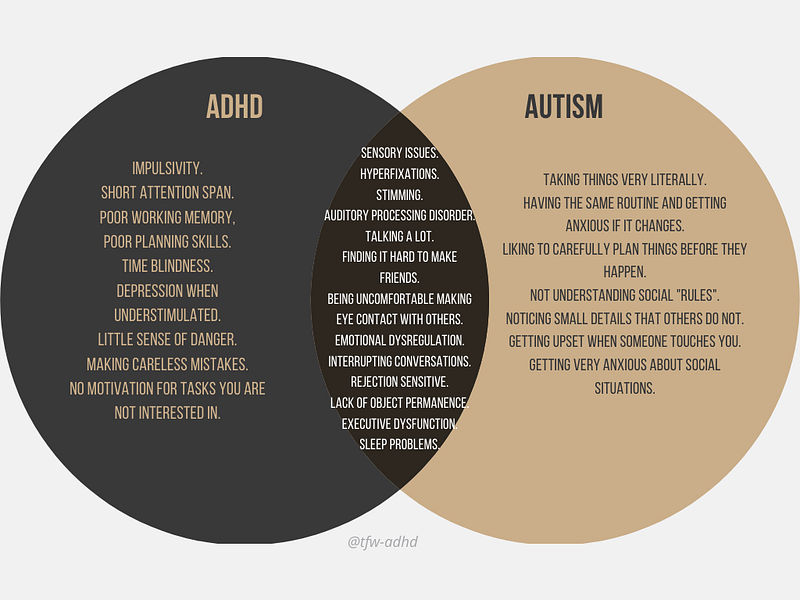
Turns out, I was right-ish all those times I inappropriately joked about being “autistic” when it comes to the social nuances of dating or networking. (I’m sorry I trapped you in the corner of the bar to extol the virtues of The West Wing. I realize now you said “excuse me,” not “tell me everything you know about Aaron Sorkin. 1–2–3 go.”)
Thanks to the environment in which I was raised, my gift for gab skillfully hid my neurodivergence from the world. And from me. Even when it made me obnoxious.
I like Jun Yu’s description of neurodiversity in Forbes: “ Neurodiversity is the concept of neurological differences observed in human variations. Historically, these differences have been labeled as Autistic Spectrum, Dyspraxia, Dyslexia, ADHD, etc. At times, we were quick to call neurodivergence a developmental disorder or a disease. But, we know much more now. Neurodiversity is a competitive advantage.”
I am most definitely not the first to tell this kind of story. And unfortunately, I won’t be the last. But I take comfort in the fact I’m not alone, as evidenced by recent narratives about “ The Lost Generation” of women just trying to survive the world and themselves.
To anyone who called me crazy or that other “c” word: I know who you are and I don’t blame you. It’s easier to call someone crazy than to endure the discomfort of not understanding them. Especially when someone is chronically difficult and not clinically disturbed.
I never lost my mind. I finally decoded it.
I firmly believe if you didn’t have a personal reckoning during quarantine, you didn’t do it right. Thanks to Mother Nature’s “time out,” I experienced the kind of mental and emotional exhaustion that could only result from my brain suddenly unplugging after working overtime, all the time, forever.
For most of my life, I knew something wasn’t right. I didn’t think it was *wrong,* per se, but I definitely knew it was different. And not in the fun-ta-da-jazz-hands!! way most people want to feel. My “knowing” came in the form of question marks without questions. On the odd chance one formed, I didn’t think I had any right to ask it because I had an independent and relatively happy life by anyone’s standards. (That’s not to say it’s been painless and abundant. I don’t live under a bridge but I have one picked out.)
On one particularly low day during lockdown, the question finally appeared: I can’t seem to get out of my own way. Is it possible I’ve been living with depression my entire life and didn’t know?
Given its pervasiveness in my gene pool, I wouldn’t be surprised. We don’t have heart disease or cancers and diabetes. We have depression and its related lifestyle and health impacts. I had a responsibility to explore it. I called my doctor, explained my concern, she took me seriously, and hastily prescribed medication. If that’s not privilege, I don’t know what is.
I am a young-ish, educated white woman and business owner who can afford health insurance. I benefit from a world of privilege with access to opportunities and resources I wasn’t expected to earn. (Yeah, I kinda want to slap myself, too.) The least I can do is admit it and use it as a springboard to advocate for others — like traumatized kids in foster care…or neurodivergent adults trapped in a neurotypical world, a traumatic existence in itself.
A quick disclaimer: Neurodivergence is subjective to each person. This is what it’s like for me and only me. I don’t speak for anyone else. (However, I’ve heard a lot of “me too’s!” this year.)
Better living through chemistry
A few months on the “starter pillz” — my antidepressants for beginners — afforded me noticeable improvements I didn’t know were possible until they changed. But with clarity came more questions. These unaffected “leftovers” pointed to ADHD.
I endured six hours of testing across nine different intellectual and psychological assessments, only to learn my executive functioning is basically shit thanks to my brain’s tragic inability to sufficiently produce and regulate dopamine. (It’s been suggested I’m “lucky” I never tried cocaine because it would take so much for me to “feel it” that I’d probably die.)
The data-informed punchline lands particularly hard. In the words of the psychologist re my ability to experience enduring success — in school, at work and in personal relationships — I never really “stood a chance” in the first place. He explained how I would’ve had a much different life had I been diagnosed and treated earlier. This initiated an acute grief cycle as I reconciled the loss versus my reality.
I self-navigated the healthcare system to my therapist who specializes in neurodivergent adults, and to my psychiatrist for a daily dose of Adderall strong enough to revive a dead horse. The Brain Team and I unspooled my entire life to learn most of my adverse experiences and behaviors were actually neurological, not character flaws. They helped me understand the difference between my personality and my brain chemistry in terms of neuroscience, psychology and pharmaceuticals.
As I’m sure you can imagine, having the “right” information has given me an immense amount of self compassion. I now understand that I’m not categorically an asshole, but my brain has its moments. (Except those times I actually was an asshole, in which event I am fully aware and am very sorry. New information does not absolve me of the pain and heartache I’ve caused others.)
The Before & The After
A quick disclaimer: Neurodivergence is subjective to each person. This is what it’s like for me and only me. I don’t speak for anyone else. (However, I’ve heard a lot of “me too’s!” this year.)
My experience with severe, untreated adult ADHD is the reality of constantly meeting barriers to success at work and in relationships (exhausting), always being “close but no cigar” (discouraging), and being the only thing standing in the way of reaching my true potential (infuriating).
Like any major medical diagnosis, mine halved my life into The Before and The After.
In The Before, I was chronically exhausted because my daily experience moving through life felt like pushing the ocean away to keep going forward. My poor brain wasted SO MUCH ENERGY to just exist.
The following functional impairments, as defined by the American Psychological Association et al, exemplify my life in The Before (via real-life external points of view) and in The After (my personal perspective):
Executive Function
The is the big-bad-voodo-daddy-dark-overlord of our ability to exist in the world. It is a broad term for an exhaustive set of skills required to form and achieve goals, such as working memory, emotional regulation, time management, and impulse control.
I self-navigated the healthcare system to my therapist who specializes in neurodivergent adults, and to my psychiatrist for a daily dose of Adderall strong enough to revive a dead horse. The Brain Team and I unspooled my entire life to learn most of my adverse experiences and behaviors were actually neurological, not character flaws. They helped me understand the difference between my personality and my brain chemistry in terms of neuroscience, psychology and pharmaceuticals.
As I’m sure you can imagine, having the “right” information has given me an immense amount of self compassion. I now understand that I’m not categorically an asshole, but my brain has its moments. (Except those times I actually was an asshole, in which event I am fully aware and am very sorry. New information does not absolve me of the pain and heartache I’ve caused others.)
The Before & The After
A quick disclaimer: Neurodivergence is subjective to each person. This is what it’s like for me and only me. I don’t speak for anyone else. (However, I’ve heard a lot of “me too’s!” this year.)
My experience with severe, untreated adult ADHD is the reality of constantly meeting barriers to success at work and in relationships (exhausting), always being “close but no cigar” (discouraging), and being the only thing standing in the way of reaching my true potential (infuriating).
Like any major medical diagnosis, mine halved my life into The Before and The After.
In The Before, I was chronically exhausted because my daily experience moving through life felt like pushing the ocean away to keep going forward. My poor brain wasted SO MUCH ENERGY to just exist.
The following functional impairments, as defined by the American Psychological Association et al, exemplify my life in The Before (via real-life external points of view) and in The After (my personal perspective):
Executive Function
The is the big-bad-voodo-daddy-dark-overlord of our ability to exist in the world. It is a broad term for an exhaustive set of skills required to form and achieve goals, such as working memory, emotional regulation, time management, and impulse control.
The Before
- What do you do again? Pick a job.
- Why don’t you understand chains of command?
- You can’t navigate internal politics.
- You don’t belong in a formal office environment.
- You procrastinate the easiest things.
The After
- Professional clarity — I bring out the best in the intelligentsia: Branding, strategic communications, and leadership development.
- Not only can I effectively navigate complex organizations and internal politics, I can thrive within them. (I think Aladdin sang about this on his magic carpet ride.)
- I work with organizations on emotional, social and intellectual problem solving among teams. This work is especially useful for knowledge workers.
- I work remotely so I can optimize my environment and my time based on how my brain works, not how someone else’s brain works.
The following neurological disorders live under the executive function umbrella.
Distractibility
Difficulty in maintaining attention or a tendency to be easily diverted from the matter at hand.
The Before
- You’re a klutz. How many new bruises today?
- You had another car accident?
- Why are you so out-of-sight-out-of-mind about, well, everyone and everything?
- Did you harvest your water cup farm?
The After
- I drive like a grandma.
- I proactively reach out to friends more.
- I only use one water cup — maybe two — when I visit.
- When eating outdoors, I don’t zone out from important conversation to contemplate drawing treasure maps for squirrels to find their stashes next season. (At least, not as often. Someone should really help them.)
Hyperfocus
A deep and intense mental concentration fixated on an activity, specific event or topic. The opposite of distractibility.
The Before
- Which rabbit hole did you fall down this time?
- Whose life have you hijacked lately?
- What business did you start?
- It was just a crush, why are you so devastated?
- What hobby are you obsessed with now?
The After
- I make time for rabbit holes and communicate my “absence” better.
- I’m not as needy with friends (you’re welcome, all of you).
- I enjoy healthier attachments instead of those driven by dopamine floods.
- I make a list of big ideas instead of starting businesses around them.
- FINE, I’ll borrow a horse instead of buying one when I return to horseback riding next week.
Impulsivity
Behavior characterized by little or no forethought, reflection, or consideration of the consequences of an action, particularly one that involves taking risks.Verbal. Physical. Emotional. Mental. Social. Financial. Impulsivity relates to an actual neural ability and speed of thought, not a moral compass.
The Before
- I can’t trust what you’ll say.
- You steamroll people in meetings.
- You have a filthy mouth; who raised you? (Surprisingly, West Texas WASPs, not sailors.)
- Stop finishing other people’s sentences.
- Don’t interrupt.
- No, credit card debt is not actually “normal.”
- Why are you always on the move?
- That idea is insane. Call Meghan. She’ll do it!
The After
- I’ve heard more than once that I seem different but they can’t pinpoint how. (Best compliment ever.)
- I no longer live with an overwhelming and false sense of urgency. “Patience” takes on new meaning in convos when I am able to endure someone else’s pace instead of finishing their sentences to keep it moving.
- I enjoy listening SO MUCH MORE now that my short term memory has improved. I don’t interrupt as much out of fear that I’ll forget what I want to say; or because of a neurological misfire.
- My Amazon delivery guy misses me. I think.
- Pause. I can do that now.
- I still stick my foot in my mouth or summon my inner Space Cadet. But hopefully not as much.
- I’m still fun and fearless. But much better moderated in my fun fearlessness.
Hyperactivity
A mind — not just a body — constantly in motion. Inability to prioritize importance of new information (which makes us EXCELLENT at trivia night). There are 10 answers to every one question. Every challenge is a Rubik’s cube. Poor retention of new information. Think at lightning speed.
The Before
- TMI.
- I don’t care if you are right. I can’t trust you if you can’t “show your work.”
- I asked for the salt, not your life story.
- You slept 13 hours, how can you still be tired?
- I’ve met you ten times, why can’t you remember my name?
The After
- I can make deeper connections and insights, and see around more corners, now that my brain can “take it all in” and sort it out later, instead of processing in the moment.
- “The knowing” phenomenon is real. My brain still absorbs the patterns and details it did before, but it manages the inputs better.
- I’m a more organized thinker.
- I can focus.
- I can “stay in my own lane” much better. Or at least acknowledge the lane exists. Baby steps, y’all.
- I have more energy because I’m not wasting so much to maintain my presence.
- I can answer yes or no instead of giving a speech. (You’re welcome. Again.)
- I am not nearly as exhausted throughout the day because my brain is working more efficiently. If I nap, it’s because I can not because I need to.
- I’ll pass the salt before you ask for it.
- I’m less likely to over consume alcohol to slow my brain down in social situations. My liver is grateful.
Rejection sensitive dysphoria (RSD)
An extreme emotional sensitivity and pain triggered by the perception that a person has been rejected or criticized by important people in their life. It may also be triggered by a sense of falling short — failing to meet their own high standards or others’ expectations.
The Before
- Why are you so hard on yourself?
- For having such a strong ego, yours sure is fragile.
- I walk on eggshells around you.
- Don’t take it so personally!
- We’re not shutting you down, we’re redirecting you.
- Lighten up — my dislike of your favorite food is not a character assassination.
The After
- I *finally* enjoy healthier emotional DEtachment…
- …and healthier social attachments.
- My natural resting state is no longer an 11 on an intensity scale, which means:
- I experience significantly less emotional impact of unemotional things.
- I experience life on an even keel.
- I can “feel” without feeling too much.
- I am much less likely to feel rejected or dismissed when I don’t feel heard.
Sensory Integration Dysfunction (SID)
Also known as Sensory Processing Disorder, a condition characterized by difficulties in organizing, processing, and analyzing sensory input (touch, movement, body awareness, sight, sound, smell, and taste). Life in hyper-alert mode causes discomfort from external stimuli, all the time, and is largely responsible for the need to pull the “escape hatch” frequently.
The Before
- You’re never at your desk and that’s a problem.
- You don’t wear sweater layers. How do you survive a Vermont winter?
- Why are you wearing sunglasses in a thunderstorm?
- You can hear. Why do you need closed captioning?
- We’re making eye contact, I didn’t mumble, and there’s no background noise — how did you not understand what I said?
- How can you be happy going days without seeing anyone or talking aloud?
The After
- I don’t live every day with the constant and almost unbearable urge to escape.
- My brain can better control the frequency at which it absorbs various stimuli. I can process the sound of birds chirping without the “priority status” of a primary conversation.
- Background noise is still annoying but less stressful.
- I still have a physical aversion to the feeling of being confined and trapped, especially to someone else’s desk. But I know how to advocate for myself now.
- If its remotely scratchy knit, I can’t tolerate it. And I can’t tolerate the feeling of being restricted and suffocated by layers of clothing. Staying comfortably warm in a New England winter is my own special talent.
- I still dislike loud noises and big crowds and bright days, but they’re less draining. My friend’s 8 year-old-son has Asperger’s and I end up wearing his noise cancelling headphones more than he does.
- I still like my alone time. But I don’t need it in long stretches anymore.
Time blindness (time agnosia)
Neurotypical adults develop an innate awareness of time and an ability to track its passing. People with ADHD often don’t. We struggle with poor time management, poor judgment on how long something will take, missing appointments, tardiness, “lost time” down a rabbit hole, etc.
The Before
- You were happy! Why didn’t you marry him?
- Why don’t you own a house?
- You could do so much more with all the time you (appear to) have.
- It’s not normal to have FIVE reminders on your calendar for every meeting.
- How do you not hear your clock ticking? It sounds like a metronome!
- That project will take three months longer than you think it should, FYI.
The After
- My entire life, I was incapable of making decisions about my future because I couldn’t conceive of one. I experienced this so acutely it made me wonder if my lack of personal foresight meant I was supposed to die young. Now I can (vaguely) see something worth anticipating.
- I actually have staying power. I don’t feel the need to keep moving on like in The Before.
- The timer on my phone is the best function ever invented. I can actually plan my trips down the rabbit hole! All I need is a block of undisturbed free time and a list of curiosities.
- I have no business being a creative department traffic manager. *Shrug*
- I still don’t hear “the clock” ticking, but I hope that’s because it hasn’t started and my whole “late bloomer” life experience also applies to my womb.
Stinker thinker
If I were a boy about 10 years younger, I *probably* wouldn’t be writing this today, for two reasons: 1)The diagnostic criteria for ADHD globally is STILL designed for a seven year-old boy, and 2) the data wasn’t quite there yet when I was a kid, even though I showed all the signs, and especially when I showed signs you couldn’t actually see.
How to be human
My whole life, I’ve watched everyone around me and wondered why things were so easy for them. I daydreamed about what it was like to move that comfortably through the world. I knew I was missing something, but I couldn’t tell you what it was, especially as it relates to social endurance and staying power.
Now I understand why I was compelled to write about how to be human in the years before my diagnosis. And why I so easily wrote about the intersection of emotional and artificial intelligence. To my detriment, and to the frustration of my parents, many friends, bosses, boyfriends, and strangers in the grocery checkout line, I had to learn the hard way what comes naturally to neurotypical folks.
I had to teach myself how to be human.
And I’m not one to learn the easy way. I spent a lifetime masking, instead. When I finally figured those things out, I wrote what I wished someone had told me, in an effort to make someone else’s life easier.
In 2006, the World Health Organization (WHO) determined US adults with ADHD are eighteen times more likely to be disciplined at work for perceived “behavior problems” and are 60% more likely to lose their jobs. If this doesn’t shock you, it should. When neurotypical management — the majority of decision makers — don’t know how to “deal with” the neurodivergent, we are cast out as “problematic people” and “office culture misfits,” taking with us valuable intellectual resources.
While neurodivergence is a common consideration in STEM-related industries, it is much less so in the corporate world at large. My primary professional adjustment in The After is to position my work to include the neurodiverse — and workplaces who want to embrace neuroinclusion but aren’t quite sure how. Now that I deeply understand the world from both sides, I can help close that gap:
For the neurodiverse, I understand what it takes to “learn” what neurotypicals are born knowing and never once had to think about. And for the neurotypicals, I help them understand how to communicate and work with the neurodiverse. Everyone else benefits from my neurodiversity and how my brain processes the intangible and emotional world around us.
One of the most powerful things my neuro-adventure taught me is that neurodivergence is a rare gift. The data validates I’m using my brain exactly how it was designed. It is why I’m good at what I do. By channeling my neurodivergence into my work, I solve complex social and intellectual puzzles to bring out the best in others — a brand, an organization, a team or an individual.
Frankly, I think humanity in general would benefit from learning how to be human on purpose instead of just coasting through it. Effort makes everyone better.
MEB
Meghan E. Butler is a business & leadership strategist and a professional writer. She is a founder of Curry+Butler: Writing to Influence, a strategic writing collaborative and speaker coaching service — the latter for which she was trained by TED; and a founder of Frame+Function, a strategic communications and branding consultancy. Meghan is on a mission to create a more emotionally intelligent world. Her “Emotional Intelligence @ Work” editorial platform and leadership development service are designed for leaders who want to maximize their teams by optimizing their humanity — together.Originally published at https://www.linkedin.com.


