avatartarun bhatt

Free AI web copilot to create summaries, insights and extended knowledge, download it at here

3661

Abstract

er to perform brain surgeries.</p><p id="042b">High IQ does not promise success. If we can’t make use of our knowledge to drive positive results, it’s of no use. It’s like boasting of crazy football skills but being scared to put them on display.</p><p id="ff06">This is where Emotional Intelligence comes in. Emotional Intelligence helps to operate at optimal IQ consistently.</p><h1 id="f7d0">But How?</h1><p id="ef74">Emotional Intelligence helps us to use our emotions to our advantage. It keeps us motivated in times of stress. Most importantly, it allows us to build meaningful and constructive relationships.</p><p id="2c41">But there is more to it.</p><figure id="fe3e"><img src="https://cdn-images-1.readmedium.com/v2/resize:fit:800/0*l014eJyeWU0lq4VA"><figcaption>Photo by <a href="https://unsplash.com/@averey?utm_source=medium&amp;utm_medium=referral">Robina Weermeijer</a> on <a href="https://unsplash.com?utm_source=medium&amp;utm_medium=referral">Unsplash</a></figcaption></figure><p id="387d">Our body generates electric signals for every sensation like sight, smell, sound, and taste. These signals are interpreted as emotions by the <a href="https://en.wikipedia.org/wiki/Limbic_system#:~:text=The%20limbic%20system%20largely%20consists%20of%20what%20was,lobe%20of%20the%20cerebrum%20primarily%20in%20the%20midbrain.">Limbic System</a>.</p><p id="6948">The <b>limbic system</b> is the portion of the brain that deals with three key functions: emotions, memories, and arousal (or stimulation)</p><p id="f671">These emotions are then transferred to the rational part of the brain (<a href="https://en.wikipedia.org/wiki/Prefrontal_cortex#:~:text=%20There%20are%20three%20possible%20ways%20to%20define,electrical%20stimulation%20does%20not%20evoke%20movements%20More%20">Pre Frontal Cortex</a>).</p><p id="1766">The <a href="https://en.wikipedia.org/wiki/Prefrontal_cortex#:~:text=%20There%20are%20three%20possible%20ways%20to%20define,electrical%20stimulation%20does%20not%20evoke%20movements%20More%20">Pre Frontal Cortex</a> is also the place where IQ resides. It's the executive centre of the brain.</p><p id="b77e">The <a href="https://en.wikipedia.org/wiki/Prefrontal_cortex#:~:text=%20There%20are%20three%20possible%20ways%20to%20define,electrical%20stimulation%20does%20not%20evoke%20movements%20More%20">Pre Frontal Cortex</a> has the ability to handle conflicting thoughts. It is also responsible to differentiate between good and bad, better and best, same and different.</p><p id="06a5">The Pre Frontal Cortex uses both intellect and emotions to achieve a certain goal. In short, it needs both IQ and EQ to perform a task.</p><p id="2bde">Therefore, to be able to consistently produce great results, we need to train our brains to handle conflicting thoughts and emotions.</p><p id="26a6" type="7">“people with the highest levels of intelligence (IQ) outperform those with average IQs just 20% of the time, while people with average IQs outperform those with high IQs 80% of the time.” ― Travis Bradberry, Emotional Intelligence 2.0</p><h2 id="0c54">I vs We</h2><p id="aba3">In today’s day and age, it's all about teamwork. We know, a successful marriage is a result of two committed and compatible partners. Two people, not one — a team.</p><p id="92d0">We know, the success of a movie is dependent on its actors, producer, director, and support staff. An actor alone, can’t smash box office results if the script is not compelling.</p><p id="ec01">Similarly, a successful business needs high performing teams. But, a team can’t consistently produce great results if they are not compatible emotionally and intellectually.</p><p id="

Options

aa78">Let’s try to understand this with an example. This example was illustrated by <a href="https://www.youtube.com/watch?v=-hoo_dIOP8k&amp;t=1450s">Daniel Goleman in his talk at google</a>.</p><p id="b27a">Imagine a company like Google where the average IQ is above a certain threshold. Now, let's graph a plot comparing IQ and EQ.</p><figure id="1004"><img src="https://cdn-images-1.readmedium.com/v2/resize:fit:800/1*r9ipwDkyjszFR8iABAp8EQ.png"><figcaption>Self made using powerpoint</figcaption></figure><p id="3d76">As you can see, the IQ of each team member is quite close to each other. That’s great. It’s a highly efficient team. But, hang on.</p><p id="75bf">Look at the EQ variance. It varies a lot as compared to IQ. This means the way each team member processes an emotion is very different.</p><p id="5726">In simpler words, the team lacks emotional compatibility. This incompatibility will disturb the momentum of the team. In times of stress, there will be disagreement, politics, and complaints. As a result of which, the team will not be able to achieve consistent results.</p><p id="6c02">And even when it does, there will likely be discontentment in the team.</p><p id="c2c8"><b>Conclusion</b></p><p id="6811">With most of us, IQ remains more or less the same as we grow older but EQ can be worked upon. We can ‘grow it’. We can train our brains to handle emotions in a better way. EQ will always be a work in progress. The good news is that little tweaks in lifestyle can bring great results.</p><p id="ef16">Hopefully, I have been able to explain the significance of EQ in our lives. I would be writing another article shortly on ways people can work on their IQ.</p><p id="357d">Regards Tarun</p><p id="b040" type="7">P.S — Medium is an excellent platform to read, write and learn from fellow authors. If you want to join me in this journey, Join medium today.</p><p id="089b"><b>References</b></p><ul><li><a href="https://en.wikipedia.org/wiki/Intelligence_quotient">Intelligent Quotient</a></li><li><a href="https://en.wikipedia.org/wiki/Emotional_intelligence">Emotional Quotient</a></li><li><a href="https://en.wikipedia.org/wiki/Daniel_Goleman">Daniel Goleman</a></li><li><a href="https://www.danielgoleman.info/topics/emotional-intelligence/">Daniel Goleman’s work on Emotional Intelligence</a></li><li><a href="https://en.wikipedia.org/wiki/Limbic_system#:~:text=The%20limbic%20system%20largely%20consists%20of%20what%20was,lobe%20of%20the%20cerebrum%20primarily%20in%20the%20midbrain.">Limbic System</a></li><li><a href="https://en.wikipedia.org/wiki/Prefrontal_cortex#:~:text=%20There%20are%20three%20possible%20ways%20to%20define,electrical%20stimulation%20does%20not%20evoke%20movements%20More%20">Pre Frontal Cortex</a></li><li><a href="https://www.youtube.com/watch?v=-hoo_dIOP8k&amp;t=1450s">Daniel Goleman talks at Google</a></li><li><a href="https://www.thescienceofpsychotherapy.com/prefrontal-cortex/#:~:text=Brief%20Definition%20The%20prefrontal%20cortex%20%28PFC%29%20is%20the,personality%20expression%2C%20decision%20making%2C%20and%20moderating%20social%20behaviour.">Clinical Reference of Pre Frontal Cortex</a></li><li><a href="https://www.youtube.com/watch?edufilter=NULL&amp;t=712s&amp;v=E6h1dl-BVpc">Emotional Intelligence 2.0 Audiobook</a></li><li><a href="https://www.beyondthemind.com/extras/meditation-the-brain/frontal-lobes-the-limbic-system-meditation-mental-silence/#:~:text=The%20frontal%20lobes%20and%20the%20limbic%20system%20work,limbic%20system%20which%20then%20produces%20the%20appropriate%20emotion.">Frontal Lobes, the Limbic System, Meditation & Mental Silence</a></li></ul></article></body>

Life measured by Quotients

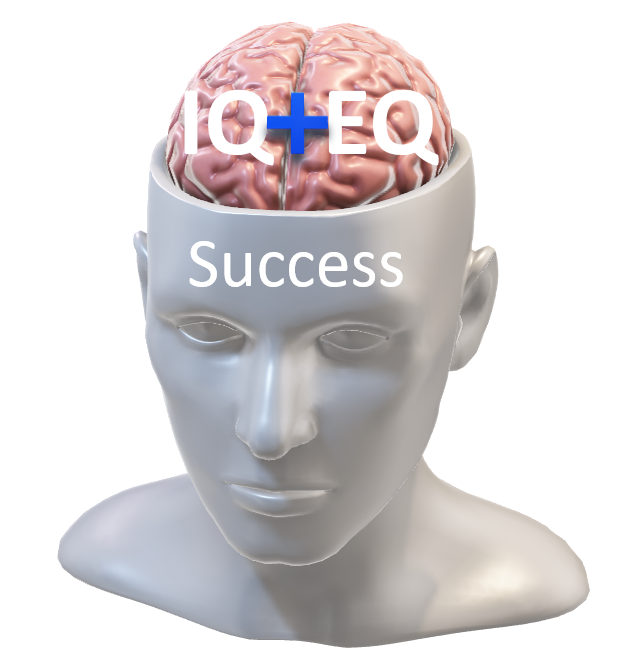
Let’s measure our life quotients. Shall we?
Self made using powerpoint

How is success measured? Is it measured with the brand of clothes we wear or the number of zeroes in our payslip? Is it gauged with the school or university we attend to, or the model of iPhone we own? (Sorry Apple, I am an Android fan and I don’t need to sell my kidneys to buy it.)

What is the problem in measuring success with what you own? I don’t have any. My problem is with the tool used to predict success. This is a common problem. It confuses our youth and sets, in my opinion, wrong standards.

I was born in India. It was an era where Doctors and Engineers were considered to be the only profession running the world. The sole objective of my middle-class parents was to make me an Engineer.

They were more concerned about my grades than their own Sex life. To be an Engineer, I was told to have a high IQ (Intelligence Quotient). The problem was — No one knew how to build up an IQ? The common perception was hard work. But, is it?

All my childhood, teachers constantly tormented me for top grades. Leadership roles were also given to students with top rankings. I worked hard but that didn’t turn me into an academic genius.

There was a downside though. I was tired and saturated. I started questioning the whole process. Why am I working so hard? What is the point of studying these many subjects? What am I going to do with this knowledge?

There were no answers.

Enter..! Emotional Intelligence

Confused between low self-esteem and high male ego, I started my professional career. I have to accept, it was chaotic during the first few years.

As I was taught in school, I thought hard work brings success. And again, this was not the case. Despite slogging for extra hours and weekends, I always had the feeling — I am not good enough.
Self made using powerpoint

Surprise, Surprise.

In comes a colleague well ahead of her times. Her name was Madhu. She changed my perception of success.

Madhu told me that IQ alone is not enough to be successful. I kept listening. It was Madhu who introduced me to the concept of EQ (Emotional Quotient).

So what is EQ?

Emotional Quotient is a measure of Emotional Intelligence. Madhu asked me to read about Daniel Goleman’s ground breaking work on Emotional Intelligence. I did so.

Emotional intelligence is your ability to recognize and understand emotions in yourself and others, and your ability to use this awareness to manage your behaviour and relationships.

Don’t get me wrong. The intellectual capability will always be the basic need for any profession. We cannot expect an “Emotionally Intelligent” civil engineer to perform brain surgeries.

High IQ does not promise success. If we can’t make use of our knowledge to drive positive results, it’s of no use. It’s like boasting of crazy football skills but being scared to put them on display.

This is where Emotional Intelligence comes in. Emotional Intelligence helps to operate at optimal IQ consistently.

But How?

Emotional Intelligence helps us to use our emotions to our advantage. It keeps us motivated in times of stress. Most importantly, it allows us to build meaningful and constructive relationships.

But there is more to it.
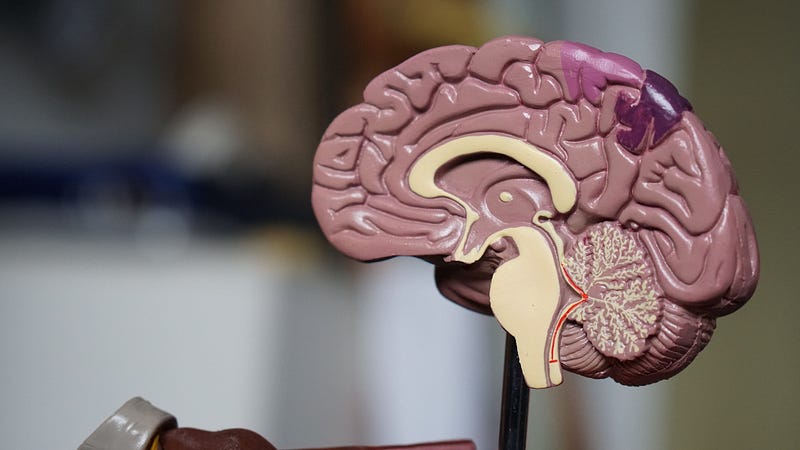
Photo by Robina Weermeijer on Unsplash

Our body generates electric signals for every sensation like sight, smell, sound, and taste. These signals are interpreted as emotions by the Limbic System.

The limbic system is the portion of the brain that deals with three key functions: emotions, memories, and arousal (or stimulation)

These emotions are then transferred to the rational part of the brain (Pre Frontal Cortex).

The Pre Frontal Cortex is also the place where IQ resides. It's the executive centre of the brain.

The Pre Frontal Cortex has the ability to handle conflicting thoughts. It is also responsible to differentiate between good and bad, better and best, same and different.

The Pre Frontal Cortex uses both intellect and emotions to achieve a certain goal. In short, it needs both IQ and EQ to perform a task.

Therefore, to be able to consistently produce great results, we need to train our brains to handle conflicting thoughts and emotions.

“people with the highest levels of intelligence (IQ) outperform those with average IQs just 20% of the time, while people with average IQs outperform those with high IQs 80% of the time.” ― Travis Bradberry, Emotional Intelligence 2.0

I vs We

In today’s day and age, it's all about teamwork. We know, a successful marriage is a result of two committed and compatible partners. Two people, not one — a team.

We know, the success of a movie is dependent on its actors, producer, director, and support staff. An actor alone, can’t smash box office results if the script is not compelling.

Similarly, a successful business needs high performing teams. But, a team can’t consistently produce great results if they are not compatible emotionally and intellectually.

Let’s try to understand this with an example. This example was illustrated by Daniel Goleman in his talk at google.

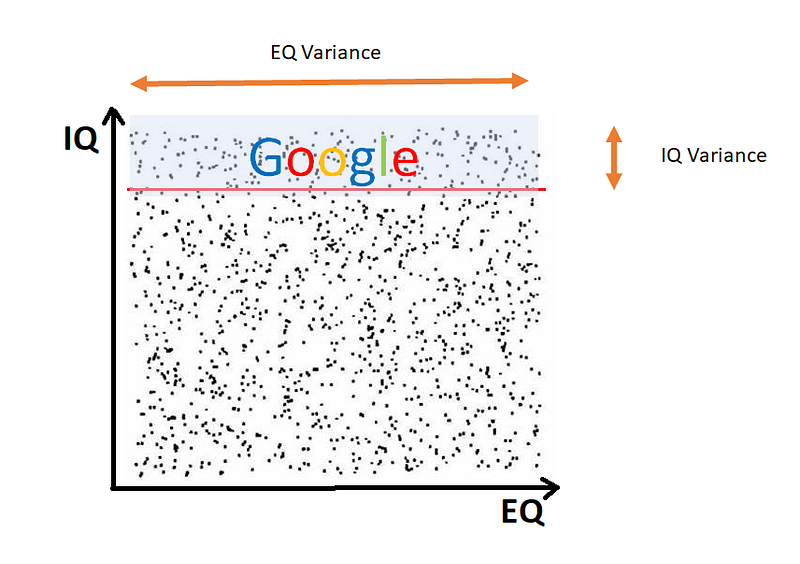
Imagine a company like Google where the average IQ is above a certain threshold. Now, let's graph a plot comparing IQ and EQ.
Self made using powerpoint

As you can see, the IQ of each team member is quite close to each other. That’s great. It’s a highly efficient team. But, hang on.

Look at the EQ variance. It varies a lot as compared to IQ. This means the way each team member processes an emotion is very different.

In simpler words, the team lacks emotional compatibility. This incompatibility will disturb the momentum of the team. In times of stress, there will be disagreement, politics, and complaints. As a result of which, the team will not be able to achieve consistent results.

And even when it does, there will likely be discontentment in the team.

Conclusion

With most of us, IQ remains more or less the same as we grow older but EQ can be worked upon. We can ‘grow it’. We can train our brains to handle emotions in a better way. EQ will always be a work in progress. The good news is that little tweaks in lifestyle can bring great results.

Hopefully, I have been able to explain the significance of EQ in our lives. I would be writing another article shortly on ways people can work on their IQ.

Regards Tarun

P.S — Medium is an excellent platform to read, write and learn from fellow authors. If you want to join me in this journey, Join medium today.

References

Emotional Intelligence
Intelligent Quotient
Emotional Quotient
Self Help
Motivation
Recommended from ReadMedium