
“Life Lessons from the Crow.” More Than Just a Yoga Pose
On Parenting, Writing & Perseverance
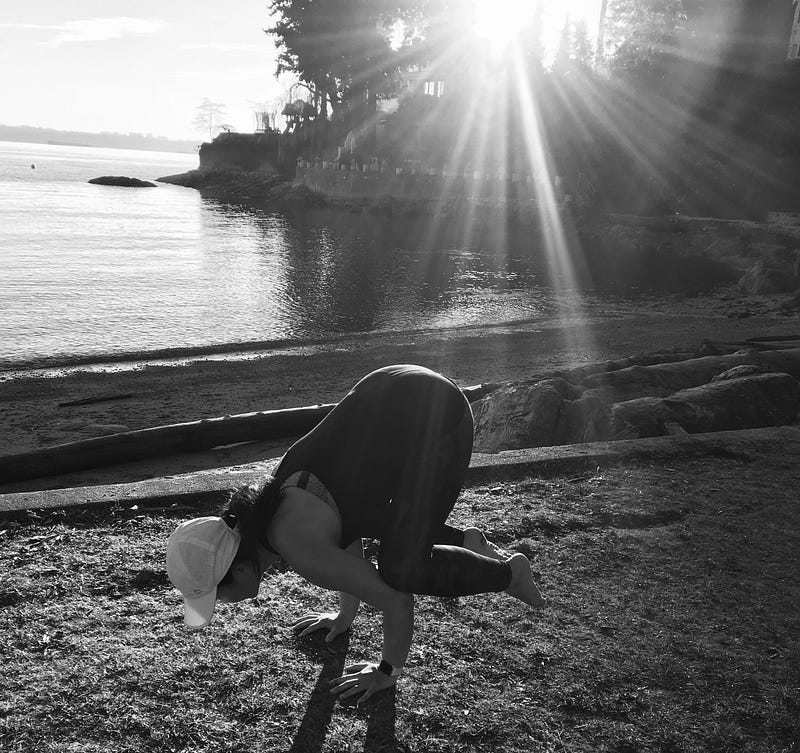
I was eager to tackle “the crow” after mastering my first headstand this summer.
I’ve been practicing headstands every day, along with doing 25 daily push-ups over the last few months to build up my arm and core strength. This practice plays a role in my fitness journey that I began last year to better my health, embrace age 50, and defy the road bumps of middle age. Although I’m a yoga newbie, I was confident I could easily master “the crow” because I can stand on my head without wobbling — for nearly 4 minutes, but I quickly discovered that crow is much harder than a headstand. Headstands make beautiful Instagram shots, but crow-pose demands more strength, agility, and perseverance.
The crow humbled me.
Learning to headstand self-empowered me to try new poses, but it was humbling and reminded me that learning a new pose needs to be done with care and daily practice. It’s not something I can master in a few days. I made multiple crow attempts, and each time (body trembling), I was afraid of crushing my skull onto the floor. A few times, I banged my forehead or smashed my cheek onto the mat, but I got back up and kept persevering. I reminded myself to “look forward — not down,” so I wouldn’t fall forward and to focus on aligning my body parts in the proper form. The yoga instructors on the video made it look effortless. The same anxiety, fear, and self-doubt raced through my mind as they did during those early days of learning how to headstand. “This is scary. I’ll never get there.” But I knew I needed to calm my thoughts, my breath, and slow down.
The crow and the frog.
I practice crow every evening on my yoga mat in the living room, sometimes while my 10-year-old son is sitting on the couch watching Netflix. One night, instead of trying to tip me over while I’m practicing this pose (and then laughing and running away), he asked if I could teach him “the crow.” Typically, he expresses little interest whenever I ask him to do yoga with me because it’s boring. Still, he likes to distract me by crawling under me while I’m in downward dog or shouting “I’m hungry!” every few seconds or cranking up the volume super loud on TV to overpower the volume of the yoga video playing on my laptop.
I was delighted when he asked me to teach him the crow. I’m not sure why this particular pose intrigued him because he wasn’t keen on learning to headstand, but maybe it’s because the crow pose looks “frog-like.” He’s been begging me every single day to get a frog so he can watch it jump and swim around the “boring fish” in our big fish tank. He promises that he’ll feed, care for it and catch it if it escapes from the tank but insists that it’s “highly unlikely” the frog will escape — “seriously, Mom.” (I’m terrified of amphibians.) Sorry, no frogs are allowed in this house. That’s a hard no, son.
Teaching my son the crow.
I made sure to place the safety pillow on the yoga mat for my son to prepare for any possible head crashes. A few minutes later, my husband came home from a sweaty cross-fit training workout. I looked up and said, “Hey, I’m teaching our son how to do crow pose!” I glanced at our son and said, “Crow is a tough pose to learn, isn’t it?” My son and I both made several wobbly millisecond attempts in between fits of laughter and forehead dunks before his father arrived. I re-demonstrated the pose. After I finished my demo, my husband walked over to the mat, tossed the pillow aside, assembled himself into a crow pose on his first attempt, held it for a steady five seconds, and said, “Like this?”
Ugh. That annoyed me. Here I am trying to set an example for my son to “keep practicing every day” and show him that nothing “comes easy.” But obviously, I was impressed because my husband never attempted the pose before then. Men typically have more upper body strength than women. My husband is also wiry, competitive, and stubborn; he ran a grueling uphill 90km mountain trail race while he had the flu because of his fierce determination, but he’s on a different personal life journey than I am, and I respect that. This pose may come easily for some people, but most crow newbies don’t get it “just right” on their first try.
Mastering the crow together.
What began as one insecure, body trembling millisecond first attempt at crow pose drew me down a path of daily multiple wobbly practices and led me toward a steady, confident, humble 19-second crow pose — over 60 days. I realized that learning crow naturally requires me to calm my thoughts, breath, and pace, and while I was practicing the same repetitive pose every day, I was also learning the gracefulness of “slowing down.”
My son and I have been challenging each other to “crow pose contests,” and his longest-held crow is 38 seconds. I try to teach him the benefits of pushing himself to improve his strength and endurance while incorporating the values of patience and perseverance. He was beaming with pride that day because he bettered his own personal time, but for the record, he was especially pleased that he “beat Mommy!”
Yogis recommend holding crow pose for 30–60 seconds. The world record is 4 minutes, 21 seconds set by Krishan Kumar according to recordsetter.com.
Like me, my son is eager to master new things “right away,” and I hope our experience will be a takeaway life lesson and reminder for both of us the next time my son or I take on a new challenge. It’s easy to forget the struggles, fears, and anxieties we dealt with during the early days of learning or trying something new after having mastered a particular yoga pose or personal challenge. It’s natural to embrace the confidence that comes with the glory of mastering headstand and crow when I practice them today. Still, it was the repetitiveness, guts, and “slowness” of the journey that got me there, to make these poses look “effortless.”
Benefits of crow pose.
The “crow” (bakasana) improves balance, deepens concentration, focus and increases confidence and self-awareness. It stretches the wrist flexors (the palm side of the wrist), which helps counteract the effects of daily typing. It builds and tones the core, strengthens the arms and upper back, and increases the spine’s elasticity and flexibility. It’s one of the basic arm balances to build up towards learning other arm balances such as flying crow and handstand.
This pose challenged me to focus on lifting versus falling. Because I need to support my weight on my hands, it forces me to tackle the fear of face-planting and aligns my mind-body relationship. During those seconds, while I’m practicing crow, I’m fully engaged and present in that empowering “body-in-the-air” moment.
It is the perfect balance of holding on and letting go. Crow Pose invites you to accept your fears and embrace the courage to fly. — Ling Beisecker, Yoga Teacher, DoYouYoga
Learning crow is like writing.
Each day is different. On some practice days, I nail the crow on my first attempt. On other days it takes dozens of attempts to get into the flow. Some days I envision crashing and need that “safety pillow” for my forehead to land on. Other days, I have inner strength and built up confidence from practicing, take a risk, remove the pillow, and “let go!” If I fall, I get back up and try again — every time.
With writing, sometimes I feel like I’m “failing” because I’m anxious, scared, and doubting my capabilities as a writer, but I try anyway. I write out a few words, then my next sentence comes, and I start rolling out paragraphs and begin to feel capable. Some days my writing is average or predictable. Other days I’m braver, and I write from that quiet, vulnerable place within me that’s aching to scream, which frees me to“let go” rather than letting my negative thoughts drag me down. I keep writing in between the ups and downs until my story becomes a polished piece.
From ugly to graceful.
My first few dozen attempts at crow were ugly and wobbly, but my form became graceful and steady with daily practice. I wanted to nail the form on the first day, even though I knew it wasn’t possible. I had to break it down, take a step back, be patient, and respect the yoga process.
Practice, practice, practice. Write, Write, Write. Re-align your body or edit your words in between. Patience. Slow down. Let go. Repeat.
Respecting the slow process of perseverance.
It’s the only way to get better at anything — by tackling the fear of falling one day at a time. Now, my son wants to learn how to do a headstand like his mom and run a mountain trail race with his dad. But we’ll start with some basic foundational training first — after we get that darn frog. Perseverance works in mysterious, unexpected ways. You win, son. And like he says, maybe I’ll get over my fear of amphibians, one day at a time.
About the Author: Mary Chang is an award-winning short story fiction writer, published memoir article writer, blogger, newbie Medium writer, and newbie yogi striving to become a better human, parent & writer. Her stories are inspired by exercise, humor & people. Fueled by cartwheels, headstands, and the crow pose! Learning the benefits of yoga, by one pose at a time. Read her blog at www.marychangstorywriter.com.
You can read her most popular Medium stories here.


