
Life Lessons and Laughing in an Elevator with Tony Gwynn
Sharing secrets and learning from a Hall of Famer
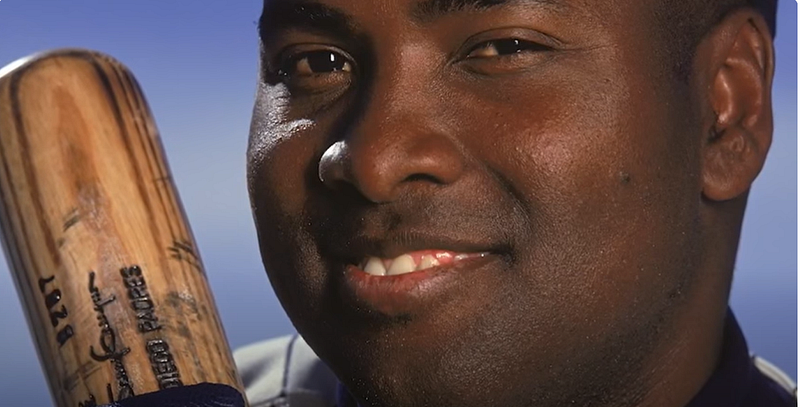
Frantically, I interviewed several Los Angeles Dodgers in the visiting clubhouse at Jack Murphy Stadium after the Dodgers’ 12-inning loss to the San Diego Padres on July 4, 1991.
With a Grim Reaper-like deadline approaching, I dashed like base-stealing king Rickey Henderson to the elevator to return to the press box and file my story.
Ding!
The elevator opened and there — all alone — singing was a 5-foot-11, 200-pound African American man in a white polo shirt, teal shorts, loafers, and a backward baseball hat, holding a Padres kite.
“She’s a bad mama jama Just as fine as she can be Hey, she’s a bad mama jama Just as fine as she can be”
It wasn’t hard to identify this person with the distinct high-pitched voice.
He was only one of the best hitters ever in Major League Baseball, and on this particular night he went 4-for-5 to became the all-time Padre leader in stolen bases with 243.
He was known throughout baseball as Mr. Padre.
It was four-time (and eventually eight-time) batting champion Tony Gwynn.
And it was just the two of us sharing an elevator.
Tony Fucking Gwynn. I’m actually in an elevator With Tony Fucking Gwynn.
“Hi, Tony Gwynn,” I said like an exuberant kindergartner.
“Well hello…,” Gwynn responded.
“Um, Mike, Mike Butler,” I stammered.
“Well, delighted to meet you Mike Mike Butler,” he chuckled in his famous laugh.
I had to do something, I thought, but what? Think!
I got it!
“Rapid fire!” I said loudly. “What is the funniest thing that has ever happened to you as a baseball player?”
I threw future Hall-of-Famer Tony Gwynn a nasty, unexpected curve — high and tight.
His eyes grew large, and then a giant friendly smile emerged. This larger-than-life baseball superstar known for rarely striking out wasn’t about to whiff against some rookie reporter.
“Major or Minor leagues?” he retorted.
“Majors,” I answered.
“We’re playing at Wrigley Field. I’m in right field and this fan is just hounding me saying I resembled a ninja turtle with my big ass. I’m hunched over, trying to hold in laughter.”
“I can see this guy in the corner of my eyes. When the inning ends, I dart over as fast as I can to the railing.”
“Security is getting nervous, but I just shake his hand and tell him, ‘That is one of the best ones I have ever heard’ and then run to the dugout. I wanted to look back to see his expression, but I knew it would ruin the whole thing if I did.”
Ding!
Damn! The elevator ride and conversation is over, I thought.
But, Tony turned the tables.
“What’s yours, Mike?” he asked as we exited the elevator.
Having a far less illustrious career than Tony Gwynn, I nervously told him when I was a college disc jockey, left the mic on, fell from my chair, and dropped an f-bomb for the whole town to hear.
I was rewarded with another one of Gwynn’s patented belly laughs.
“Damn, that is something I would do,” he joked.
The utmost praise.
Since Gwynn successfully slammed my first curveball question out of the park, I threw him a fastball.
“What do you attribute your success to?” I asked.
“First, getting to the ballpark really early and applying good old fashioned hard work. Second, meeting (Boston Red Sox Hall of Famer) Ted Williams. He loved talking about the craft of hitting. He changed a lot of the ways I viewed hitting.
“Lastly, the use of video equipment. I bought all this equipment to break down every pitch, every swing.”
“What’s the key to being a successful sports writer?” he asked me back.
“I would say reading great writers like Bill Murray, Mike Downey, and Bill Plaschke — and writing as much as possible,” I said.
“Billy (Plaschke) is the best,” Tony said. “ I really enjoyed when he covered the Padres. We were a shit show. Oh, the stuff Bill had to put up with — dealing with Jack Clark and Larry Bowa.”
“Last question: favorite childhood memory?” I asked.
“That’s easy. Playing sockball. We couldn’t use baseballs or we would bust windows, but me, my brothers and all the neighbors would have these epic sockball games. I was the home run king. Oh man, did we lose lots of socks.”
Tony chuckled loudly as he reminisced.
“What’s yours?” Tony asked.
I told him the time my dad was returning to a Division III basketball game/birthday party when I was 8. And my dad hearing the legendary line on the radio about my mom, “We can’t start the second half because there’s a crazy redhead chasing a bunch of kids all over the court.”
“That’s hilarious,” Tony chuckled.
Oh shit! My story!
“I-I-I have to run to write my story,” I told Tony.
“Don’t forget to to include my four hits,” he laughed and spit in a red Solo cup. “And, stay away from this tobacco stuff — it’s so addicting.”
He reached out his hand and said, “It’s been a pleasure meeting you and sharing memories, Mike Mike.”
And walked into the darkness.
Singing.
“Ooh, she’s bad Just as fine as she can be, hey She’s a bad mama Jama, ahh Just as fine as she can be”
I just stood there staring in awe of this future legend who had taken the time to answer my personal questions and cared enough to ask them back.
Wow. Just wow.
I became a huge Tony Gwynn fan that night.
The stories of Gwynn’s huge heart are endless — whether it was buying bat boys $150 Nike shoes, signing autographs for hours, or befriending rookie reporters entering the Padres’ intimidating clubhouse.
He was a friend to everyone.
Gwynn died of parotid cancer at age 54 in 2014 due to his tobacco use — never able to kick the habit.
Looking back at that memorable elevator ride, so many things he said profoundly impacted my life.
I continued to write and read, rigorously trying to implement the same work ethic Gwynn incorporated on the baseball diamond.
As my coaching career in baseball blossomed when our kids reached playing age, I spent countless hours studying the game and the art of hitting.
For eight straight springs and summers — from farm to PONY— I would take my son Brady to individual batting practice. I’d hurl bucket upon bucket of baseballs until my arm was about to fall off to prepare him for that night’s game.
“Don’t dip you shoulder.” “Spray the ball to all field.” “Load and explode.”
“Remember those tips Tony Gwynn talked about.”
I loved Gwynn’s dedication and desire to be the best in the game.
Brady had many successful all-star seasons in Little League. Always atop my batting order with the best batting average on the team — and one of the top in the league.
It was due to his hard work, dedication, and studying the game.
It was due to Tony Gwynn.
He even took Tony’s famous №19 jersey number.
Unfortunately, he also inherited Tony’s bad habit.
Nightly, I hear him coughing uncontrollably. I see cigarette lighters or flavored vapes lying around the house.
It breaks my heart.
It makes me think of Tony Gwynn.
His Hall of Fame career. Infectious laugh. Love of family. Friendly to everyone.
But also his tobacco addiction, forcing him to leave this world way too soon.
Tony Gwynn could hit the most deadly Nolan Ryan fastball.
But struck out to tobacco.
He called himself a “Tobacco Junkie” and spoke out against the use of smokeless tobacco in baseball after he retired.
I need to pass along one more Tony Gwynn life lesson to my son.
Before it is too late.
I know it would bring Tony Gwynn a giant smile from above if he could impact another life like he did so many while he was alive.
Thanks for reading my story.
You might also enjoy:


