
Life Lessons — A Financial Planner’s Perspective
Common threads beyond money

As I look back on my career as a financial planner, I think of the diverse range of human experiences I’ve had the pleasure to experience firsthand. From the excitement of entrepreneurial success to the contentment of a well-earned retirement, my clients’ stories have been varied and inspiring.
Here are a few of the deeper lessons I’ve learned working with people over the years.
Money and happiness
Over the years, I’ve met many clients who, despite amassing significant wealth, didn’t find contentment or joy. For some, their lives were consumed by a relentless pursuit of more and more, while for others, they were driven by the fear of losing what they had built.
One client I worked with, Jack, had built a massive real estate empire in Los Angeles over the decades. His net worth was well over $100 million. Despite being in his seventies, a time when most would have retired, he stayed intently focused on building up more wealth.
He lived in the same modest house in the Mid-Wilshire neighborhood of Los Angeles for decades. He also drove the same 1983 Mercedes-Benz 190E. Whenever I proposed our annual client meeting, he declined to drive to my office to conserve fuel. As for vacations? The concept was foreign to him. Even though Jack lived life by his own rules, it seemed his existence revolved solely around the pursuit of wealth, leaving little room for anything else.
Although Jack is an extreme case, what’s interesting is that studies have shown that people in developing countries often report higher levels of happiness compared to those in developed and wealthier nations. This could be due to several factors.
For instance, people in developing countries may derive happiness from improvements in their living conditions or increased earnings, even if they have to work longer hours. Focusing too much on material possessions can be detrimental, leading to anxiety, depression, and dissatisfaction.
It’s a reminder that while financial stability is important, it’s not the only path to a fulfilling life.
Giving back
Achieving financial security is often at the center of my work as a financial planner. But over the years, I’ve discovered that fulfillment can be found not only in accumulating wealth but also in giving it away.
Many of my clients have taught me the power of generosity. They regularly donate to causes they care deeply about, whether it’s supporting local charities or establishing their foundations. This act of giving not only benefits the recipients but also brings a sense of fulfillment and purpose to my clients. They often express a sense of satisfaction, knowing their wealth is making a positive difference. And I’ve seen this generosity enrich their lives with a sense of purpose and connection.
My own experience volunteering with the Rotary Club during the years I lived in Pasadena confirms this belief. The members of my local Rotary Club were made up of many successful people in the community. We would often organize volunteer projects and assist local groups in need.
One of our most memorable projects involved organizing a large group of volunteers to spend a day building new homes in small villages in Mexico for families in need. Although building those homes under the hot sun was hard work, seeing the joy and smiles on residents’ faces as they walked into their brand-new homes, built with love and care, is a memory I’ll always treasure.
Beyond personal fulfillment, research has also shown the positive impact of giving. A 2008 study published in Science revealed that giving money to others directly led to greater happiness compared to spending it on oneself. Another study in the Journal of Personality and Social Psychology showed that volunteering significantly reduced stress and anxiety.
What many successful people already understand is that giving back isn’t just about helping others—it's about enriching our own lives in ways we didn’t know we could.
Comfort vs growth
Another lesson I’ve learned is the relationship between risk and growth. This powerful correlation is especially true in the world of investments. Studies by firms like Morningstar show that higher-risk asset classes, such as stocks, have consistently outperformed so-called “safer” asset classes like cash and bonds over the long term.
This is highlighted by comparing the performance of the S&P 500, a representation of U.S. stocks, compared with cash over the past 20 years. The S&P 500 has delivered an average annualized return of around 9.66% over the last 20 years. On the other hand, cash returns have been below 2% in every calendar year since 2008, with an average annual return of just 0.6% from 2008–2020.
The relationship between risk and reward also applies to our personal lives. Data and research validate the power of calculated risk-taking. The Kauffman Foundation, for instance, reveals that over half of all new jobs are created by startups within five years of their founding.
I’ve embraced this philosophy of risk-taking in my personal life. Over a year ago, I decided to leave the security senior-level job at a big bank and pursue the dream of starting my own investment adviser and financial planning firm.
I quickly found out that launching my own business was much harder than I thought. I faced lots of setbacks and unexpected obstacles. And just like many entrepreneurs, I had to acquire new skills and adapt to changing circumstances to persevere.
Looking back, I’m glad I stepped out of my comfort zone and made the decision to take the risk of the unknown. This decision has opened up many new and unexpected opportunities, including working as a financial writer and consulting for fintech companies.
Time — the most precious asset
Perhaps the most important lesson I’ve learned is that time is the most precious asset. Time is not just a powerful factor in compounding wealth; it's also what shapes our lives.
Albert Einstein is often attributed with the quote: “Compound interest is the eighth wonder of the world. He who understands it, earns it … he who doesn’t … pays it.”
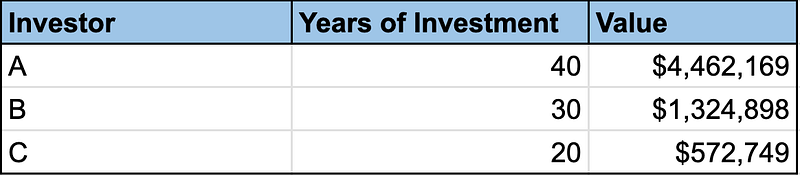
Time’s impact on wealth accumulation is remarkable. Consider three investors: Investor A, who starts saving $10,000 annually at age 25, achieving a steady 9% return annually; Investor B, who begins the same journey at age 35; and Investor C, who begins the same journey at age 45.
While they all invest the same amount each year and achieve the same return, the power of time and compounding gives Investor A a massive advantage. By the time Investor A reaches age 65, they’ve amassed $4,462,169, compared to Investor B, who has amassed $1,324,989, while Investor C has amassed $572,749.
But the value of time applies not only to the world of finance. I used to work with a client, Charles, who built a successful and growing accounting practice and, over the years, built it into a multi-million-dollar firm. He loved his work and always engaged with his clients. Even as he was in his late sixties, he was dedicated, showing up every day to the office and having a schedule of packed client meetings.
During a visit to his office one time, I noticed many framed photos of his family on the walls. His children and grandchildren lived all over the country. But because of the priorities of his business and the distance, he rarely had opportunities to see them. His wife led a busy social life, often traveling and spending time with friends, while he rarely took any time away from work.
When I asked him some more about his family, I could tell there was some sadness on his face. Charles confessed that he wished he could have spent more time with his children and grandchildren when they were young, which is something he missed out on.
Unlike money which can be earned, invested, and multiplied, time is irreplaceable.
Looking Back
Over the years, some clients have come to me seeking guidance, not just in managing their finances but also in making sense of life’s many and often complex decisions. Despite the differences among all the people I’ve worked with, I’ve observed a common thread—a desire to live a fulfilling and meaningful life.
My journey as a financial planner has given me insights that extend far beyond the world of finance. I’ve seen that chasing wealth and business success relentlessly usually comes at a cost to other areas of our lives, such as our relationships or our health.
I’ve also come to learn that the wealth we possess isn’t just measured in dollars and cents, but in our sense of purpose and fulfillment, and the impact we have on others’ lives.
You can also follow me on X.