
Life Is Short And Then You Die
Or is life long, but poorly spent?
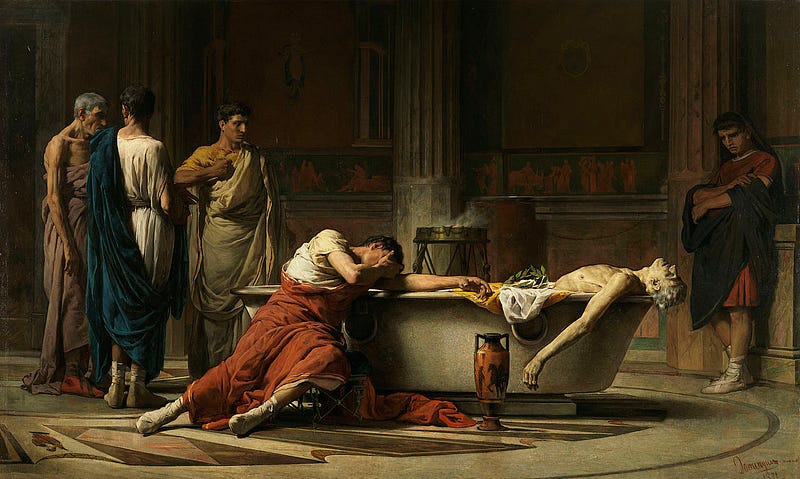
Think of life as a bank account. At the moment we are born, each of us receives a certain number of dollars, deposited in an armored steel vault. We do not know the amount of this initial infusion of seed money, but we do know that it is a wasting asset. Every hour, one dollar is withdrawn and spent to fund whatever we are doing at the moment. Nothing stops this outward flow of cash, and we have no way to add more money to our present holdings. When the balance reaches zero, when the balance is depleted, we die.
An hour passes, a dollar departs.
If you could watch the flow of dollars leaving your account, if every hour spent left a visceral reminder in your mind of your march toward death, would you spend your time-dollars in the way you do now?
The Roman philosopher Seneca employed a similar analogy in his treatise On the Shortness of Life. People complain, wrote Seneca, that nature grants us a limited lifespan. They bemoan the shortness of individual existence. If nature was just, we would live for thousands of years, more than enough time to indulge in the treasures and experiences of life. Then, sated with centuries, every desire met, we could slip into death, fulfilled and content.
This position, suggested Seneca, was nonsense, total poppycock. If humans waste the limited amount of time we are currently given, why would it be probable that we would manage a longer life any better? An incompetent manager will bungle a thousand years as easily as sixty. The gift of additional time will not improve the situation.
In fact, humans were granted more than enough years to forge rich and satisfying lives. The problem is that we make foolish choices with our time-dollars. We live as if the balance of our mortality savings account can be replenished with additional dollars whenever we choose. Failing to realize that our funds are actually limited by a future date with death, we waste our assets like a profligate billionaire.
We, suggested Seneca, are the problem, not nature:
It is not that we have a short time to live, but that we waste so much of it. Life is long enough, and we are given a sufficiently abundant amount to achieve great things, assuming it is well invested. But when life is allowed to flow away in senseless luxury and pointless activities, death’s approach forces us to realize that our days have departed before we realized they were passing.
It is not that we are given a short life: we make it short. (Sen. Brev. 1.3)
The financial analogy offers an excellent means of visualizing our situation. Unaware of our dwindling supply, we spend our hours as if we possessed an unlimited supply. We throw our cash around until we drain our account and confront the poverty of a wasted life.
As a moralizing Roman writer, Seneca felt compelled to list a variety of life-draining activities: political ambition, an unhealthy devotion to sex and alcohol, the avaricious compulsion to accumulate money and possessions, the insatiable hunger for fame, popularity, and celebrity. These common pursuits offer no meaningful return on our investment.
We may not agree with Seneca’s list of useless pursuits. The critical point is to know how much a goal or a diversion will cost, and make certain that it is worth the life dollars that will be spent to acquire it. Perhaps someone wants to work fifteen-hour days for years, to build a business, or to bring an innovative new product to market. There is nothing inherently wrong with that, assuming the person has made a proper cost benefit analysis for the project: how many dollars from the mortality bank will this cost? Will the payoff compensate for the hours of life it will cost?
Our problem is that we leap into these endeavors as if they came with no price, failing to realize that each hour spent on something, extracts another dollar from the bank. Those dollars cannot be recovered; life is shortened. Are we spending our money wisely?
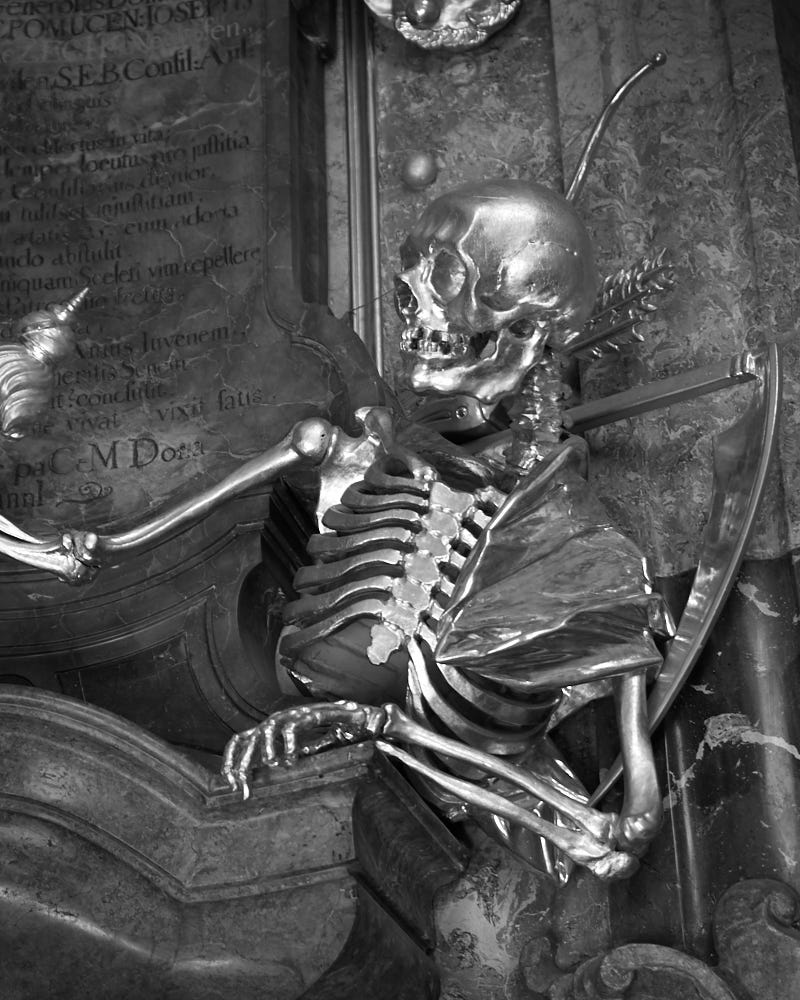
Roman Stoics employed a concept, memento mori — remember your death — to encourage contemplation of the diminishing number of hours remaining to each of us. The idea originated with the Stoics, and was appropriated by the earliest Christian authors. We find it etched into the gray stones of old cathedrals, or tucked into the corners of the paintings of the masters. Because of its ecclesiastical context, many believe that the words are an imperative to consider your current moral life, in order to avoid punishment in the next life. In fact, memento mori exhorts us to count the dollars. Remember that every hour spent will never return; our supply is limited: can we afford to waste them thoughtlessly?
Seneca reminds us that not only are we inclined to spend our lives recklessly, but others will also demand time from us as if the hours came with no price. Our boss asks us to work overtime on his pet project; we are hectored into attending fruitless and pointless meetings; our friends pressure us to join them in activities that hold no interest. We consent to these impositions reflexively, without thought. We fail to calculate the cost, in terms of the hours of our life, that each of these unwanted intrusions costs us.
If someone attempted to rob us, wrote Seneca, we would be outraged and leap to defend our possessions. “Farmers do not allow anyone to steal their land, and if someone tries, they rush to take up stones and weapons…No one willingly divides his money and shares it with others.” (Sen. Brev. 3.1) But how many people thoughtlessly surrender a piece of their life — time that because of its irreplaceable nature is of greater value to the individual than property or cash — to satisfy the whims and demands of others?
Time spent carelessly, time surrendered to satisfy another, time wasted on meaningless pursuits, erodes the supply of hours that nature has granted. It is not that we begin with too few hours; life is long once we learn the habit of properly valuing our time. Seneca shepherds his readers toward a mindful posture, a state of discernment that separates wheat and chaff.
Count the cost. See each hour as an irreplaceable dollar in a dwindling pile. Life will seem long, argues the master, if we shun activities that squander the only true asset we possess: time. While we might not choose to devote all of our waking hours to the study of philosophy — as he recommends — Seneca is undoubtedly correct that the despair commonly felt as we approach the end of our own life, could be reduced if we spent more of our life dollars on what we hold most important. Then, when our deposit reaches a balance of zero, we may depart this world with the satisfaction of having devoted much of our life to the essential and important.
Quotations from Seneca’s On the Brevity of Life were translated by the author from the Latin text of De brevitate vitae, found in Senecae Dialogi, Oxford University Press, 1977.