
“Life is either a daring adventure or nothing at all.”

I wish I could take credit for the title of this story, but those words were spoken many years ago by Helen Keller.
Take a minute and try to imagine you are blind and deaf. And that you were stricken with those disabilities when you were not yet two years old. It would be challenging enough to have just one of those disadvantages, let alone having both.
Helen Keller turned those “disadvantages” into advantages. Read a little bit about her and a few of her amazing accomplishments, which we’ll then apply to our lives.
Who was Helen Keller?
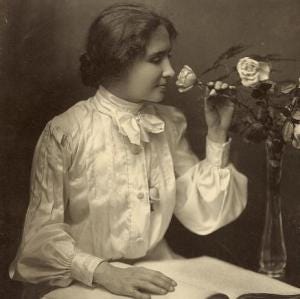
Image from https://www.womenshistory.org/education-resources/biographies/helen-keller
Helen Keller was born on June 27, 1880, in Tuscumbia, Alabama, and she became one of the most iconic figures in history for her tireless work as a disability rights advocate, author, and lecturer.
At just 19 months old, Keller was struck by an illness — historically described as “an acute congestion of the stomach and the brain,” which could have been scarlet fever or meningitis — that left her both deaf and blind.
Despite these challenges, she broke through the isolation imposed by a near-complete lack of language, thanks to the help of her teacher, Anne Sullivan, who taught her to communicate using the manual alphabet, a form of tactile sign language.
5 Things You May Not Know About Helen Keller
There is no shortage of biographical information about Helen Keller available in print and online, but here are five interesting nuggets about her life that don’t always make it into the mainstream narrative:
- She was a prolific author and speaker: Most folks know Helen Keller for overcoming her disabilities to learn to communicate, but did you know she was also an incredibly prolific writer and a seasoned public speaker? Keller wrote 14 books and numerous articles on topics ranging from disability rights to her spiritual beliefs and socialism. She traveled to over 35 countries, giving lectures not only about living with disabilities but also advocating for women’s rights and labor rights.
- She was a co-founder of the ACLU: Helen Keller was one of the co-founders of the American Civil Liberties Union (ACLU) in 1920. Her commitment to civil liberties, women’s suffrage, and workers’ rights aligned with the ACLU’s mission to defend and preserve the individual rights and liberties guaranteed to every person in this country by the Constitution and laws of the United States.
- Keller’s connection to Mark Twain: Helen Keller and Mark Twain were good friends. Twain admired Keller greatly, once calling her “the most remarkable woman of this age.” He played a pivotal role in securing her education by introducing her to Standard Oil magnate Henry Huttleston Rogers, who would go on to pay for her education at Radcliffe College, where she graduated cum laude in 1904.
- She received an Oscar: Not many are aware that Helen Keller was awarded an Academy Award. She was featured in a documentary titled “Helen Keller in Her Story,” also known as “The Unconquered,” which won an Oscar for Best Documentary Feature in 1955. The film chronicled her life and work, offering an intimate look at her achievements.
- Keller’s advocacy for the blind in Japan: After World War II, Keller visited Japan several times and became a well-loved figure across the country. She was particularly influential in advocating for the blind in Japan. Her work helped to improve the welfare system for the blind and disabled in Japan, making significant contributions to changes in public perceptions and government policies.
One Big Takeaway from Helen Keller’s Life

There are many inspiring life lessons that can be gleaned from Helen Keller’s accomplishments, but, for me, there was one main takeaway:
Everyone faces adversity at some point in their lives. It’s how we choose to react to it that determines if we will live a life of great adventure or one of quiet discontent.
Or, as Zig Ziglar put it, “Your attitude determines your altitude.”
The winds of adversity you and I will face in the future won’t be anything unique to mankind; many other people will have faced the same challenges. It’s how we set our sail with the wind which will decide our direction.