
Essay
Life is Better with a Staircase
The more it turns the better the life
I once had a friend who wanted to be rich. When we went to bars and clubs, she would spin stories to the young men and women we met, about her ponies, her stables, her parents’ houses in London and Nice, how her father owned a construction company and a fleet of cars. In truth, she lived in a council house and her father was a milkman. But for an hour or two, she lived the life she coveted.
My desires were equally money-grabbing, but more covert, more subtle, more imaginative: I coveted a staircase with more than one right angle. I didn’t blab my desires, like my friend; I told no one, not even myself. My staircase hovered on the edge of my consciousness, a desire felt rather than stated.
England is a land of terraced houses and semi-detacheds. Mostly with staircases of pure utility that ascend in a straight line, usually carpeted and hugging a wall with one turn at the top: plain things in plain houses. Such were the houses of my childhood and youth.
A small house can ill afford the necessity of a staircase, let alone embellish it with twists and turns. But the more turns a staircase has, the more floors; and the more floors, the nearer a house comes to the ideal of du Maurier’s Manderley and Austen’s Pemberley.
Unconsciously, I viewed staircases as a proxy not just for wealth, but for better things in life, and not just material things but the finer things of the mind.
I wasn’t after Pemberley: I was after a spur, a facilitator of dreams.
Half landing, as defined by Oxford Dictionary of English, is an area of floor where a flight of stairs turns through 180 degrees.
I once stayed in a boarding house in Paris near the Gare du Nord. The proprietor told me never to approach the house from the direction I had just come. He said it with an air of unspeakable foreboding. The stairs were narrow, creaking and turning, with half landings and brown paintwork and muffled thumps behind closed doors. That staircase was the highlight of Paris.
My in-laws’ house in Boston had three right angles that included a half landing so wide and long it had a bench carved and set into the wall beneath the large window. As if the architect foresaw a need to alight, in a place neither up nor down, but betwixt the day’s doings.
My grandmother lived in a council house with a small staircase that was unusual in having a half landing in the middle, beneath a small window. The stairs were white painted wood with a red patterned runner and metal stair rods that had dulled to a cozy pewter. I loitered on that half landing, always with a sense of miraculous happiness.
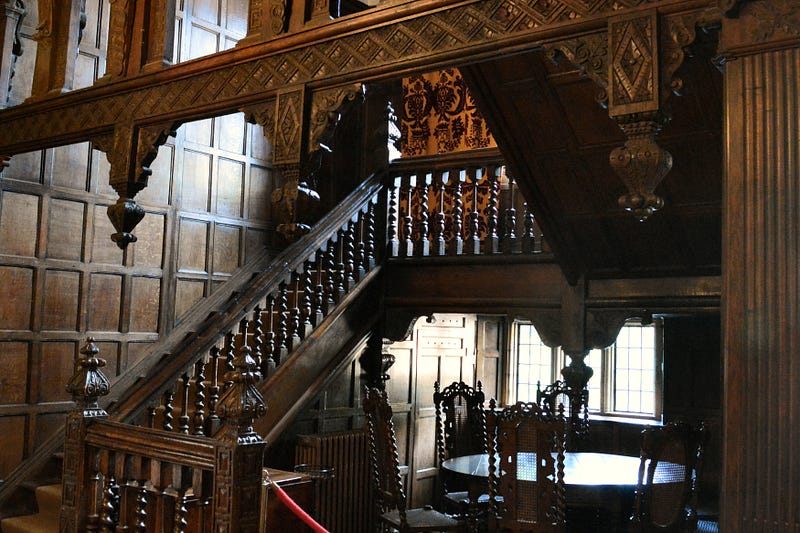
England retains some historic houses. My ideal staircase resides at one—Wakehurst Place.
I was there in December when the meadows were silver and the lake was green and the paths steamed with mist. Vast and disparate are the gardens with a rhododendron valley, an iris dell, a stream that leads to the lake with a bridge over the water where jaunty ducks glide silently. There’s a formal walled garden, a wisteria pergola, wide lawns, a Himalayan glade and a pinetum full of thin lofty trunks where the mood is dark green and the ground is soft with needles.
Amid these stands an Elizabethan mansion full of chimneys and gables and honey stone. It has a chapel and drawing rooms with enormous fireplaces and a solid front door with a portico. The staircase is wood paneled with elaborate carvings and steps that are wide but not too wide—not palatial. There are at least three right angles (alas, you cannot go up the stairs. Only the ground floor is open). I feel a frisson when I gaze upon it, as if like Lewis’ wardrobe, it leads to its own land, a place of solitude, where to dally is to dream and enter a liminal place where dreams become real.
I once did a writing prompt that consisted of writing about tables in your life. It was a great prompt; I recommend it if you are ever stumped, or you wish to uncork a host of concrete memories. Tables are fertile sources of memory because they are places of repose, of gatherings, of meals and games and conversation.
Unlike a table, a staircase is not a place to sit, to socialise or gather. It is a place of transience, connecting, leading, bridging, to be passed through, not a place to alight or linger: merely a means to a room. Up and down we go, never horizontal, unless we meet a half-landing and even then we are intent on physical progress.
This is the nub of staircases; destined to be elided as mere utilitarian. Most of them are purely functional. But I knew from an early age that staircases can be fey places, the in-between lands of story. And that’s what I coveted: a staircase with so many right angles it was a portal to the infinite where I could wander in a land as far and wide and deep as my imagination.


