
Life Is A Game Of Russian Roulette
Ergodicity* — How understanding this idea can improve your decision making in life, health and business.

Let’s play a game.
The game is called Russian Roulette. You may have heard of it before, or you may not.
The rules of the game are simple.
You and five other players are each given a gun. You empty the cylinder and put a single bullet back in. You spin the cylinder to randomise the position of the bullet.
You then take the gun to your head and pull the trigger.
Now before you tell me that’s crazy and you will never play such a game, let’s make it interesting.
If you survive, you win $6mn.
There are 6 chambers in a cylinder. This means you have a ⅙ chance of dying and an ⅚ chance of surviving.
Odds sound great, don’t they? Still, want to play? After all, 5 out of every 6 Russian roulette players recommend the game.
Now let’s change the game a little. Instead of playing once with five other players. Would you play the game six times in a row?
Chances are, no amount of money would make you play it 6 or more times. Because you intuitively know that if you play it more than once, you will be dead for sure.
Your outcome will be $0 and a hole in your head.
The outcome for the individual is very different from that of a group. The average for the group tells you very little about the individual experience.
Just like in Russian Roulette, some people are terrible at judging odds. And they apply the same mistakes to other areas of their life, such as relationships, careers or investing. Often leading to disastrous consequences.
In Russian Roulette, one loss means you die. Death is irreversible and extends into the future.
Irreversibility is counterintuitive and goes against what we learn in school — averages matter in the short and the long term. Averaging matters is often not true.
Be careful of averages
If you flip a coin (assuming it’s fair), it will come out 50% heads and 50% tails. This is true if you flip it infinite times. However, if you flip it ten times, it may come up as six times heads and four times tails. The fewer the flips, the higher the chances that the tally differs from the expected 50%. The more coin flips we have, the more the average of observed results converges to the expected value. This is called The Law Of Large Numbers.
We tend to assume the law of large numbers to be relevant. In reality, not so much for individuals. It requires a large number of trials. And in most real-life situations, we only have a limited number of them.
When an activity cannot be assumed repeatable to infinity, we should be wary of expecting to achieve its average outcome.
Outcomes
In Russian Roulette, the outcome you get by playing it six times in a row is different to the average outcome of 6 people playing it once.
Let’s say that six people play Russian roulette once each. On average, one person will die and five will win $6mn each. The total winnings as a whole are (5x$6mn) $30mn. Divide by the number of participants, 6, and that makes $5mn the expected outcome. Meaning if we did the experiment a bunch of times, each person on average is expected to make $5mn.
This expectation remains correct if we add more players to the game.
If we play with 600 players, we will have an average of 100 deaths (remember there is ⅙ chance of dying) and $3bn. Divide by 600 people and you still get $5mn.
The expected outcome is also called the population outcome.
Now let’s work out the average outcome for when you play Russian roulette on your own 6 times in a row.
Your individual expected outcome if you play Russian Roulette is also ⅙ chance of death and an expected outcome of $5mn. However, if you play it more than once, it begins to decrease. If you played this game infinitely, you guarantee your death
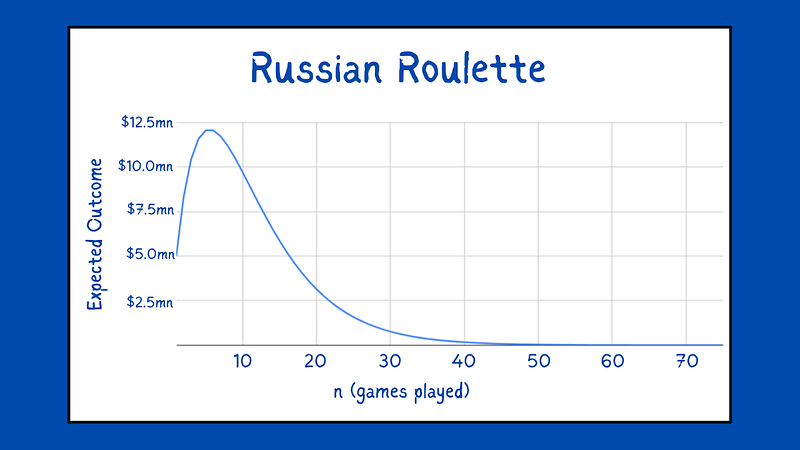
The chart shows your expected financial gains are from playing Russian Roulette many times. This is measured across one person and many repetitions. The term for this is time average outcome.
If the population outcome is similar to the time average outcome, the system is ergodic. Otherwise, it’s non-ergodic.
The implication of this is, in ergodic systems, you can use averages to make optimal decisions. In non-ergodic systems, you can’t.
Game over
In Russian Roulette, if you die, you won’t be able to pull any more triggers. Your future earnings are effectively $0.
You can only keep playing to win more money if you’re alive.
Any form of “game-over” situation voids future gains, bringing down the average. Anything that has the possibility of game-overs is a cause of non-ergodicity.
When permanent game-overs are possible, don’t rely on averages.
These game-overs are common. They include bankruptcies, injuries, severe depression, burnouts or breakups (romantic partners, business partners or friends).
Alright, so you may think, “I’m risk-averse, why would I care about Russian Roulette?”
The thing is, much of life follows similar mechanics to Russian Roulette. In which losses absorb future gains.
Let’s take fitness. The harder you exercise, the faster you progress. However, if you try too hard, you might irreversibly injure yourself. Irreversible damage to your spine may end your ability to exercise at all.
Another example is careers. The harder you work, the more chances you have for career success. However, work too many long hours, and you may damage your health, relationships or sanity. Once lost, these are hard or impossible to recover.
A single negative event can undo all your effort.
It’s not about being the best. It’s about being the best of those who survive.
In theory, performance determines success. The highest performing employee becomes the most successful one.
In practice, performance is subordinate to survival. It is the highest performing employee who doesn’t burn out that becomes the most successful.
The same applies to investing, business, relationships and so on.
Survival matters more than performance.
Over the short term, consequences that apply beyond the short term don’t matter. Over the long term, they do.
In the case of burnout at work, this is a phantom consequence. It’s not observable in the short term but it affects the long term. Smoking is the same. The daily observation seems very little, but in the long term, it leads to serious long-term consequences.
If we make decisions based on what is happening in small time periods and forget about phantom consequences, we will make bad decisions.
In any repeated activity, irreversibility absorbs future gains. Meaning you can’t extrapolate future outcomes solely from expected outcomes of the activity performed. You also need to consider the impact of irreversible consequences.
If you go to the gym, don’t attempt to reach the maximum amount of weights you can lift per session. Instead, maximise the amount you can achieve without risking any serious injury. One serious injury is enough to prevent you from lifting for months or even years.
Do not maximise growth regardless of survival. Instead, maximise growth while conserving survival.
Judgement
Irreversibility doesn’t imply you shouldn’t take risks. Instead, it means you should acknowledge the non-ergodic context and take risks that don’t impair your life if things go wrong.
How does it affect decision making? Well, in ergodic systems, you can use the population outcome to make optimal decisions. In non-ergodic systems, you can’t.
By understanding the application of ergodicity, it will help you avoid irreversible mistakes.
*For this article, Ergodicity is explained to be more accessible. The essence of the article is correct in its practical meaning but technically imprecise.
Thank you Foster CoWriting for helping me write and edit this piece.