
Life in Japan: Paying with Cash
Cash skills you didn’t know you needed.
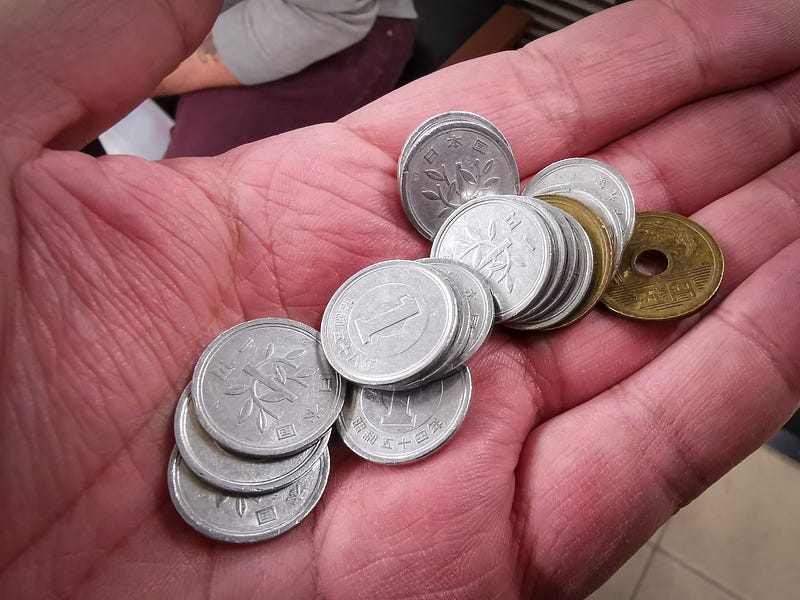
If you’re coming to live and work in Japan, one skill that you will need to get accustomed to is paying for things in cash.
Of course, you probably thought you had this skill down! I mean, you just hand over a 1,000 yen bill or two, and you’re done, right?
Wrong!
If you grew up in America, you probably are used to handing over a few paper bills, and receiving less than a dollar’s worth in change, which you just throw loosely in your pocket, and then stick in a jar to forget about when you get home.
When you come to Japan and do this, however, you will find yourself quickly amassing a huge number of coins. Especially those pesky 1, 5, and 10 yen coins. In my case, in the first few years of living here I amassed so many small coins that I had to start enlisting the help of my significant other to spend them all!
Yep, Americans don’t know how to spend change. I know, it’s hard to admit, but it became abundantly clear to me during my first year here. And apparently it’s not just me: the United States experienced a massive coin shortage during the pandemic, when the U.S. Mint was running at reduced capacity, simply because nobody in America knows how (or cares) to spend their pocket change.
In Japan, there are the following denominations of coins: 1, 5, 10, 100, and 500 yen. Paper bills start from 1,000 yen — roughly equivalent to a $10 bill. So, coins will become a bigger part of your life, and you’ll need to learn to spend them well.
In addition to this, there are a number of other tips and tricks that will help you to make the most of living in a cash-based society.
Here are my Cash Tips for expats in Japan!
- Over-pay! Let’s say you’re checking out at the combini near the office, and your total is 621 yen. Stop! Don’t just hand over that 1,000 yen bill! You’ve got 21 yen, don’t you? Right, you can hand over 1,021 and get rid of two 10-yen coins and a 1-yen coin. But we can do better. You’ve probably got a 100 yen coin as well, or a 50-yen coin and a bunch of 10’s perhaps. Pay 1,121 yen, and you can receive a single 500-yen coin as change, instead of four 100 yen coins! Awesome. You just exchanged anywhere from 4 to 11 coins and received a single, large-denomination coin in return. Make this a habit, and don’t feel bad about making people wait for you at the register. It’s your job to spend your change!
- 500-yen savings! Are you the type of person who just can’t budget and save? Here’s where that habit of throwing coins in a jar can actually help. A popular method of saving up large sums of money without thinking about it, is to use the 500-yen rule. It’s quite simple. You know that 500 yen coin you just got in tip #1? Every time you get one of those, you must put it in a jar, and forget about it until the jar gets full. With time, you’ll have several hundreds or even thousands of dollars worth of 500-yen coins that you can use to open up a Niisa account and start investing, keep as a rainy day fund, or put towards a large purchase.
- Paying for things at Convenience Stores Don’t have a Japanese credit card? I got by without one for the first several years I lived in Japan, believe it or not. You can often pay rent and large bills by directly sending money via ATMs (furikomi), and you can pay for many things from bills to online purchases at Kiosks in every convenience store here in Japan! Furthermore, many online stores offer cash on delivery as a payment option. If you are bad about over spending on credit cards and the like, you may want to intentionally go this route — it’s much easier to keep track of your spending when you physically hand over cash every time you spend it.
- Budgeting with Envelopes If you embrace paying with cash as I’ve done, you may also employ the “envelope method” of budgeting. Basically, you divide your monthly budget using envelopes, and cash. It might look something like this for a single person making 300,000 yen (approx. $3,000) a month: Invest (pay yourself first!) — 60,000 yen Rent — 90,000 yen Food & Consumables —60,000 yen Transportation — 20,000 yen Fun — 40,000 yen
The money is divvied up this way into respective envelopes, labelled as above, and cash is withdrawn at the start of the month and put into each envelope. If you wish to be really strict with your budget, you can even opt to subdivide, say, your daily food/consumables expense by 30, and withdraw from the envelope only the amount that you’re allowed to spend each day, putting just that in your wallet (plus maybe a 10,000 yen bill hidden somewhere for emergencies).
Final Thoughts
Having to use cash all of the time might seem like a pain at first, but if you want to keep track of your spending and start saving more, you’ll quickly come to appreciate and may even prefer it. Japan’s cash culture is likely part of the reason that people in Japan don’t tend to get deep into credit card debt, in stark contrast to the United States. So, embrace the opportunity to track more of your spending physically, and start doubling down on your financial goals!
And don’t forget to spend your change!


