
Life Changing Questions From The Genius of A Tiny Yellow Book - ‘Hell Yeah Or No’ by Derek Sivers
If you want a guide to life, this comes pretty close
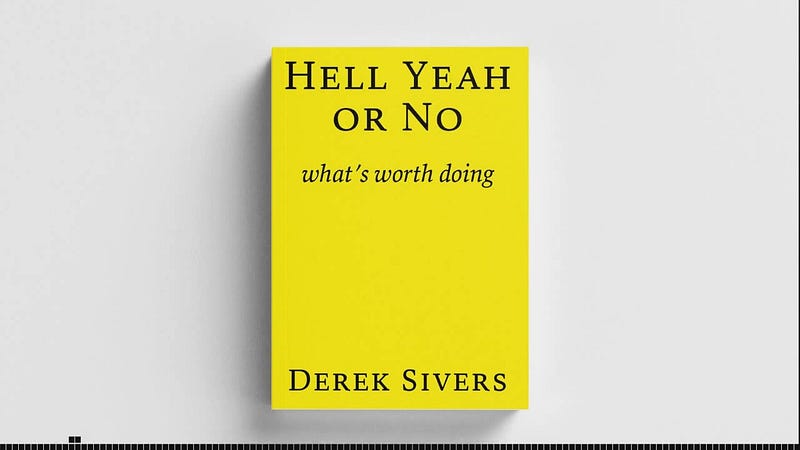
It’s a beehive in here. Maybe that’s why it’s yellow. Ideas. Ideas and more ideas.
Derek (the author) is a guy who’s had so much time to think without being under the pressure to earn lots of money, impress anyone, or earn fame. He is the only person I’ve come across that seems truly happy with everything. Even the proceeds from all his books go to charity.
This is the second book I’ve read from him. And it hasn’t disappointed.
It’s short, snappy. You can finish it in a couple of hours if you wanted — but the ideas are so big that it’s worth taking your time and thinking.
I have EIGHTY highlights from this book, making it the most highlighted book in my collection. And it’s also the shortest. That’s saying something.
Here’s what I’ve learned and implemented so far. There will probably another article or two on this because there’s just so much to share.
1. “What would you do if you didn’t need the money and didn’t need the attention?”
Not gonna lie, this question stumped me for a few days. I couldn’t believe how hard it was for me to remove these conditions from my mind. I felt like I was slipping out of a claustrophobic paper bag.
It was worth it.
My answer: write and share everything I know.
I’ll probably never make the same amount of money from writing as I have in corporate. But that’s okay. I’ve been writing for 8 months straight and the exercise of sitting down and getting the words out makes me happy. I find flow easy to achieve.
And I’ve been fortuntate to impact a few people I know — that’s made it even more worthwhile.
2. “No matter what you tell the world or tell yourself, your actions reveal your real values. Your actions show you what you actually want.”
This is leadership. It’s self-awareness. For everyone in their twenties reading this, you need to get this tattooed on the inside of your eyeballs. I could have avoided so many mistakes had I come across this earlier.
We’re not as good at communicating as we think. A lot of the time, we’re terrible at it.
3. “Be careful when you say you like or dislike something, because you could change your mind soon.”
About 8 years ago, I remember walking down the street after finishing a hard day of lectures. My friend, an exchange student from Botswana and I were talking about music. I’m a guitarist. I listened to rock, metal and everything that had a guitar solo. He listened to Rap and I didn’t get it.
I couldn’t believe people talking fast could be considered music. So many of them were off-key!
Now, you’ll see Drake, Jaden, and J. Cole at the top of my ‘most played’ lists. They’re my favourite artists. I don’t listen to rock at all now.
I can’t believe how I’ve changed! Maybe you have too.
4. “Your values change your focus. Being in love or making art pushes someone towards a present-focus. Ambition pushes someone towards a future-focus. Both mindsets are necessary. You need a present-focus to enjoy life. But too much present-focus can prevent the deeper happiness of achievement. (I call this “shallow happy” versus “deep happy”.)”
I’m keeping this in the back of my mind. I’ve felt unbalanced with this recently — I have friends who are only future focused and push back everything to save. To invest. But they are rich and can retire now. In their early thirties.
On the other hand I have a couple of hippy friends. They don’t work, they don’t invest and they don’t have much money — but they are supremely happy. All the time.
What’s the right way to do this? I’ve been confused. And I’ve been bouncing between the two extremes depending on who I’m spending more time with.
I like Derek’s way of thinking about it. Makes sense to me.
5. “Say no to almost everything. This starts to free your time and mind.”
This is why the book is titled “HELL YEAH OR NO”.
I’m sure there is an art to saying no without offending, but I’m yet to learn it. I need to be softer with the ‘no’. I don’t like lying, but it’s hard to say “I don’t want to come to your birthday party because I haven’t seen you for 6 months, Caren.”
Any tips?
Like I said, there’s plenty more where that came from. Here are all my notes from the book you can access for free. No login. No subscription pop-up.
If you find these points compelling, get a copy of the book here (https://sive.rs/n). All proceeds go to charity.
I hope this book helps you navigate life as it’s helped me.
Harry
P.S. If you enjoyed this, subscribe to my self-mastery letters. Build something great with your life.


