
‘Life begins at conception’ and other unhelpful assumptions…even if you believe them

To say that political coverage of evangelicals is dominated by those who champion Trump and conservative policies is an understatement in every sense of the word. Who doesn’t love reading about Franklin Graham’s appeal to support Trump during this “unjust inquisition” of impeachment investigation by praying for him AND buying a t-shirt?
However evangelicals interested in expressing their faith through more progressive policies are out there also competing for coverage. One such organization, The And Campaign, whose worthy mission to blend Biblical Values & Social Justice has circulated its 2020 Presidential Statement for signature. As someone sympathetic to this mission, I hoped to sign, but stopped short when several paragraphs down, the statement read…
“We believe in building a society that respects human dignity at all stages of life, including the unborn. . .It is essential that the sanctity of life at every stage, in particular in the womb, is defended vigorously. Abortion is a tragedy, not a social good, that should be vehemently discouraged rather than promoted.”
It’s not that I entirely disagree, but here’s the thing. It is troubling to me that even on the progressive left of Christianity, some feel compelled to impose a hierarchy of need on the question of abortion.
Why is it essential for the sanctity of the womb to be vigorously defended “in particular” — as though the unborn are due special consideration over other forms of life? Why imply that you are promoting abortion if you are not actively discouraging it?
And finally, why is it not possible for abortion to be BOTH a tragedy AND a social good?
In fact, it is those stories of women for whom abortions are reasons for both grief and gratitude that neither side of the debate is anxious to hear. Pro-choice advocates avoid dwelling on the prospect that abortions can be times of deep sadness and loss for the women who exercise that option. And pro-life advocates behave as though gratitude for that option is completely inconsistent with an abiding respect for life.
And yet, these are the stories most pertinent because they represent the complexity of the dilemma in all its humanity. In listening to moms like Robin Utz, Tamara Mann Tweel or Sarah Holland describe their experiences I find evidence of abortion as both tragedy and a social good.
So, while both sides of the abortion debate harbor inconsistencies, here I am most interested in those faulty assumptions held by pro-life advocates because of the unequivocal way in which faith is attached to the pro-life position.
Assumption #1. It was always so…
Throughout most of American history evangelicals remained largely silent on the issue of abortion. Even in the mid-1800s when abortion providers began to advertise in newspapers, evangelicals were noticeably absent from any crusades against abortion. Perhaps this is because others took up the cause nevertheless their influence had little to do with the decision of all 50 states to ban abortion by the 1900s.
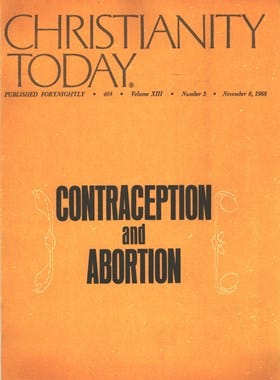
Whatever the reason, evangelicals remained disengaged as the abortion debate flared again in the 60s and 70s. In fact, the November 8, 1968 issue of Christianity Today featured a number of articles about abortion and contraception from various perspectives. It included an essay by Dallas Theological Seminarian Bruce Watke who argued the Bible gave no clear answer on the matter, but in fact he stated, that based on his reading of Exodus 21:22–24, “in contrast to the mother, the fetus is not reckoned as a soul.”
Upon considering the views of 25 evangelical scholars, the November issue concluded with “A Protestant Affirmation” and these words on abortion,
“Whether or not the performance of an induced abortion is sinful we are not agreed, but about the necessity of it and permissibility for it under certain circumstances we are in accord.”
Likewise, the Southern Baptist Convention, passed a resolution in 1971, stating “we call upon Southern Baptists to work for legislation that will allow the possibility of abortion under such conditions as rape, incest, clear evidence of severe fetal deformity, and carefully ascertained evidence of the likelihood of damage to the emotional, mental, and physical health of the mother.” The resolution was reaffirmed in 1974 after the passing of Roe v. Wade and then again in 1976.
Things changed by 1979 with the launch of the Moral Majority. While there is some disagreement as to whether abortion was truly the rallying cry the movement claims as its origin story, there is little question as to its current centrality in conservative Christian politics.
I don’t point to this as evidence of equivocation. Having been raised as a child in a church where the women made quilts from polyester fabric squares for the “homes for unwed mothers”, (a likely effective future contraception), I remember a commitment to the tragedy of abortion.
But I raise this to say — that at one point in our church history there was room for discussion. It was not always a settled issue. There was an acknowledgement that abortion, while not welcome, was on some level understandable, perhaps even forgivable.
Assumption #2. Where life begins…
No phrase shuts down the conversation like “life begins at conception”. The certainty of such a claim and simplicity it affords needs to be reckoned with if there is any room to be had for policy deliberation.
Let me say that I make no claim to know the answer to this question. Where along the path from fertilization to birth a soul unites with a body is an absolute mystery to me. Only God knows. And as Bruce Watke said, God has not been clear on the subject. He points to Genesis 2:7 where God breathes life into Adam’s nostrils as the closest biblical definition to be found for “when life begins”, particularly since this language reappears elsewhere in Scripture (e.g. Ezekiel 37: 4–10).
Side note: (For an interesting discussion on Psalm 139: 13–14 and the way in which it has been misinterpreted to defend life at conception, read Neil Carter’s summary of Watke’s arguments.)
Various demarkations of life have all been markers over the centuries — first breath, first heartbeat. Plato and Aristotle both distinguished between “formed” and “unformed” fetuses where the rights of either had to be considered within the greater welfare of society. Variations along this theme persist today with the concept of viability. In colonial America, abortions were legal until the “quickening” or that moment when the mother first felt the baby move.
Science is of little help. Even fertilization is far from instantaneous. As reproductive scientist Harvey Florman, once said, “Fertilization doesn’t take place in a moment of passion. It takes place the next day in the laundromat or the library.”
The point is all of these demarkations assume a qualitative difference occurs somewhere along the continuum from womb to birth. Even if we wanted to say life begins at conception, we don’t live that way. In a candid conversation on Pantsuit Politics, Sarah Holland and Dr. Tamara Mann Tweel discuss the effect of this spectrum.
They point out that there is something utterly disingenuous about behaving as though there is no difference between the loss of the unborn three months into a pregnancy as compared to that of a stillborn. Still greater difference between the loss of a three-month-old baby to that of a three year old child.
Once a qualitative difference is acknowledged then — what is it that distinguishes life from personhood, from citizenship?
Dr. Tweel makes the further observation that the certitude of the claim “life begins at conception” affords an unearned righteous exemption — an offramp from the hard navigating necessary to determine what it means to really be alive.
Assumption #3. Adoption Is Celebrated…
While statistics bear out that practicing Christians are more than twice as likely to adopt as the general population, pro-life clinics do not refer their pregnant clients to adoption agencies any more frequently than do pro-choice clinics. According to Chuck Johnson from the National Council for Adoption, both pro-choice and pro-life clinics refer only about 1% to an adoption agency. The harsh reality is that while adoption may be celebrated, birth mothers are not.
Talking with Newseek in 2010, Adam Pertman, then executive director of the Evan B. Donaldson Adoption Institute (which has since had to close its doors), described the discrepancy this way,

“Our society has lifted much of the stigma of single motherhood, but still finds it difficult to support a woman who is, as they see it, abandoning her child. These women are told: ‘How can you possibly give up your child? What kind of person could do that?’ So while adoption is listed as viable option, it’s a choice that’s rarely made.”
You would hope that might be different in Christian institutions, but not so according to Kelly Rosati, former vice president of Focus on the Family and now adoption consultant. In 2019, she told Christianity Today,
“I don’t think the church, as a whole, has any idea how disfavored adoption is generally, but especially not within the community of women who seek support at pro-life pregnancy centers.”
Assumption #4. It Only Takes One…
Aside from an immaculate conception or a scientific intervention, getting pregnant is not a solo activity. Behind every unwanted pregnancy is a male. And yet, as NY Times writers Michelle Oberman and David Ball point out, “Our entire abortion debate pits the fetus against the woman. Men are absent. They can shrug off an unwanted pregnancy as someone else’s problem, even though they contributed half the genetic material to the fetus.”
Again, both sides of the debate make this mistake. Neither side holds the male accountable in the same way as the female and for good reason, given the biological reality. Nevertheless, the reality is that the woman finds herself solely bearing the physical consequences of an act committed by two people. Is it not an undue burden to require her to shoulder the entire moral consequences? Are we not holding men and women to different moral standards in doing so?
Assumption #5. Rule by Fiat vs Rule by Grace…
In conclusion, in my research for this article I ran across an interesting point made by Tim Stafford in a well-argued essay for Christianity Today in 2003. In advocating for pro-life, Stafford claimed, “Roe v. Wade demonstrates that fundamental moral conflicts should not be decided by fiat. The absolute polarization we currently experience is directly traceable to the Supreme Court’s decision to take abortion out of politics and declare it a settled question. The discussion had been about where to draw the line among tragic choices; the justices erased the line completely and said there was no room for further discussion.” (italics mine)
I differ with Stafford here because it seems to me that the opposite was done by Roe v. Wade. By restoring choice, the Supreme Court ensured that there would be a discussion — that a negotiation could take place.
Reversing the court’s decision so that abortion is illegal is the ultimate fiat. We arrive at fiat by the assumptions discussed in this article.
- By ignoring the nuance historically afforded by earlier evangelicals in the political orientation over abortion.
- By insisting on the convenient simplicity of the designation of life at conception.
- By denying the stigma the church itself perpetuates for birth mothers.
- By ignoring the inequities between the moral standard set for men and women.
Instead of the rule of fiat, I would hope that evangelicals could learn to operate from the rule of grace. From the position that as tragic as abortion might be, there are times it may be a necessary social good. Theologian Stanley Hauerwas captured this when he wrote concerning abortion,
“It may be that issues such as abortion are finally not susceptible to intellectual ‘solution.’ I do not mean to suggest that we cease trying to formulate the problem in the most responsible manner possible, but rather that our best recourse may be to watch how good men and women handle the tragic alternatives we often confront in abortion situations. For no amount of ethical reflection will ever change the basic fact that tragedy is a reality of our lives. A point is reached where we must have the wisdom to cease ethical reflection and affirm that certain issues indicate a reality more profound than the ethical.”
Rule by grace.