avatarRay Wirth

Free AI web copilot to create summaries, insights and extended knowledge, download it at here

3809

Abstract

.jpeg"><figcaption>A riverside silver maple tree casts a long reflection. <a href="https://medium.com/@lesliegregory">Leslie Gregory</a> photo. Used with permission.</figcaption></figure><p id="83bd">Even in early spring, small rivers trap warmth and provide shelter from breezes. They’re adept at capturing and magnifying the growing light. Feeling pleasantly warm and delighted to have the sun on our faces, we headed upriver. Geese intermittently punctuated the stillness as they honked warnings to each other and reluctantly took flight. The slow-moving water reflected the intense blue of the March sky and the slender beauty of late winter trees.</p><p id="f538">In places, the river narrowed or was interrupted by rocks. We dug our paddles deeper and felt our boat surge forward through the current.</p><p id="1212">At the end of a mile, at a big bend in the shining, sunlit river, we rounded a large pyramid-shaped rock and then for the first time turned our bow downstream.</p><p id="ae8a" type="7">There we were . . . finally living life at the speed of the river — and not wishing to be anywhere else.</p><p id="d5dc">Once we were going with the current, we felt more relaxed. Even when we rested our paddles, the river still eased us along at a mile per hour. We were moving at the speed of the river. We felt a part of it, and of the quiet beauty surrounding us.</p><p id="1510">Hooded mergansers beat their way off the water — and headed downstream where we were sure to disrupt them again, and then again. As we rounded a bend, I whispered to Leslie and we froze until we drifted within ten feet of a beautiful pair of mallards — the iridescent green of the male’s head a tattoo on my memory.</p><p id="c49d">A little later, while we were drifting and snapping photos, a beaver slapped his tail 40 yards ahead, cautioning us against entering what he clearly believed was his section of river.</p><p id="abbb">We paddled over submerged beaver dams, through areas where tall trees crowded close to the riverbank, and through more open areas. The sunlight-blazoned river was the constant that moved with us.</p><h1 id="6733">Adrift in the marshland</h1><p id="5327">As we neared the pond, we paddled past a massive beaver lodge and took an 18-inch drop over a beaver dam. Then we entered the marshland. The frozen pond was on our left, the still-snowy marshland on our right, and a wide swath of bright spring river ahead.</p><figure id="5cdf"><img src="https://cdn-images-1.readmedium.com/v2/resize:fit:800/1*o1qiVIR3ng_pH53ZQIxXuw.jpeg"><figcaption>Adift on our ice-floe raft. <a href="https://medium.com/@raywirth">Ray Wirth</a> photo.</figcaption></figure><p id="81e4">Having decided to extend our adventure with a jaunt downriver, we passed the channel that leads to the pond. Even in the marshland, the current pushed us along. We paddled past a couple more beaver lodges and used the hull of our kayak to bisect a large chunk of slushy ice.</p><p id="942e">A larger, more intact ice floe was ahead. We dug our paddles deep and propelled the kayak up onto the ice floe, which, surprisingly, remained intact. So there we were, sitting in the yellow kayak, which was beached on a white ice floe in the midst of the winter-flattened, sun-spackled marshland. We could no longer reach the water with our paddles, so we rested, drifting with the ice floe, at exactly the speed of the river. There we were, in a too-brief series of moments, two <i>Huckleberrys</i> on a temporary raft, finally living life at the speed of the river — and not wishing to be anywhere else.</p><p id="c320" type="7">We said there warn’t no home like a raft, after all. Other places do seem so cramped up and smothery, but a raft don’t. You feel mighty free and easy and comfortable on a raft. — Mark Twain, Huckleberry

Options

Finn</p><p id="7cbe">As we neared the site of an old stone dam, we used our paddles to push the kayak back off the ice floe. We watched the ice floe drift downstream and then turned upstream to close the circle of our trip before the sun settled too much lower in the sky.</p><figure id="c2fe"><img src="https://cdn-images-1.readmedium.com/v2/resize:fit:800/1*tZHuB3xfe46Ow8Sf82yvpA.jpeg"><figcaption>Once the kayak was ashore, it was time to switch to our xc ski gear. <a href="https://medium.com/@raywirth">Ray Wirth</a> photo.</figcaption></figure><h1 id="6bd7">Skimming across the pond</h1><p id="9ab8">We decided to go ashore near a point at the south end of the pond. Paddling at top speed, we used our momentum to surf onto the snow and get as close to shore as possible. We were grateful for our knee-length neoprene boots which allowed us to get ashore without having wet feet.</p><figure id="451e"><img src="https://cdn-images-1.readmedium.com/v2/resize:fit:800/1*BOdXVBW_0pZFhDGtgAUE6g.jpeg"><figcaption>We hiked for a quarter mile along the shore of the pond, looking for a place we could safely get out onto the ice. <a href="https://medium.com/@raywirth">Ray Wirth</a> photo.</figcaption></figure><p id="1064">We tied the kayak to a tree, unloaded the ski gear, and stuffed our paddling gear into backpacks. Then we walked along the shore of the pond looking for a place we could get out on the ice. After a quarter mile, we found a place that looked promising.</p><figure id="7f86"><img src="https://cdn-images-1.readmedium.com/v2/resize:fit:800/1*oX1JXlFh7qLn6dWDOJeFHg.jpeg"><figcaption>The author insists he doesn’t always ski with a life jacket and paddles. <a href="https://medium.com/@lesliegregory">Leslie Gregory</a> photo. Used with permission.</figcaption></figure><p id="7710">After putting on our skis and shouldering our backpacks, we took a breath and skimmed out from the pond edge and onto the ice.</p><p id="0152">The ice had actually hardened up some from the previous day, so we felt fairly secure once we were out there. We enjoyed the muted sunset colors on our brief crossing. Once off the pond, we were able to ski up a woods road toward the paved road. A final stream crossing and then a few hundred yards of walking — and we were home.</p><p id="edde">The trip was just a few hours of a single afternoon, but it’ll last longer in my memory. Trips that combine the outdoors with two or more modes of muscle-powered travel — a little audacious, a little zany — always seem to leave us grinning. As we say to each other, “Good clean fun!”</p><p id="2630">I encourage you to try a multi-sport trip of your own. Not everyone lives near a pond and a river, and you can keep it simpler in terms of equipment, but chances are there’s a multi-sport adventure waiting for you close to home. You might pull out a map and consider how you could combine hiking and orienteering, hiking and biking, biking and paddling, or running and swimming. You get the idea!</p><p id="b52e">What multi-sport adventures have you been on, and what ones are you dreaming about?</p><p id="16ed">Click the link below to read about another outdoor adventure in Maine:</p><div id="c965" class="link-block"> <a href="https://readmedium.com/keeping-it-humble-on-the-bold-coast-24c4ac33e184"> <div> <div> <h2>Keeping it Humble on the Bold Coast</h2> <div><h3>A journey of the spirit along Maine’s most rugged shoreline</h3></div> <div><p>medium.com</p></div> </div> <div> <div style="background-image: url(https://miro.readmedium.com/v2/resize:fit:320/1*vRP9KNj0vBhrO6A8azN3GA.jpeg)"></div> </div> </div> </a> </div></article></body>

Life at the Speed of the River

An early spring multi-sport outdoor adventure
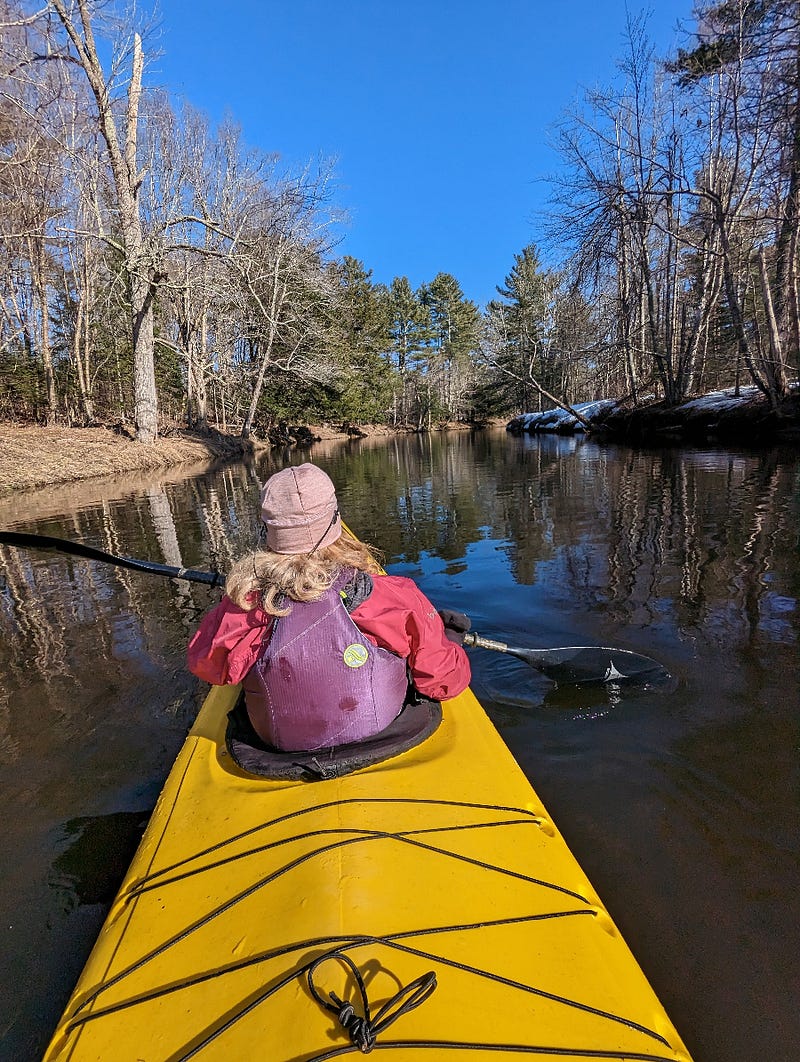
Savoring the spring sunlight and the quiet water of the upper river. Ray Wirth photo.

In a time when Instagram is overflowing with selfies of people pursuing extreme outdoor sports in exotic locations, it’s nice to affirm that great adventure can be found close to home.

At least once each spring, my partner Leslie and I like to drive several miles up the road, launch our kayaks, and paddle four miles down the river to our local pond. We then walk back to the house to close the circle.

We find that one-way trips and loop trips like this are good at providing a spirit of adventure. In comparison, out-and-back trips and trips to familiar places can end up feeling too scripted. When things are too scripted, we don’t keep our eyes open. We don’t notice things as much. We don’t have as much fun.

Adventure requires going off-script

This year, winter has lingered. As of late March, the pond still has a foot of ice. Meanwhile, the ascending spring sun has opened up the river, which curls like a dark serpent through the snowy woods. We were pretty sure — but not certain — the ice was out of the river. (What would happen if we reached a still iced-in section of the river? That’s a story for another time). The question of most concern: “How would we travel the final leg of the trip since the pond was covered in ice?”
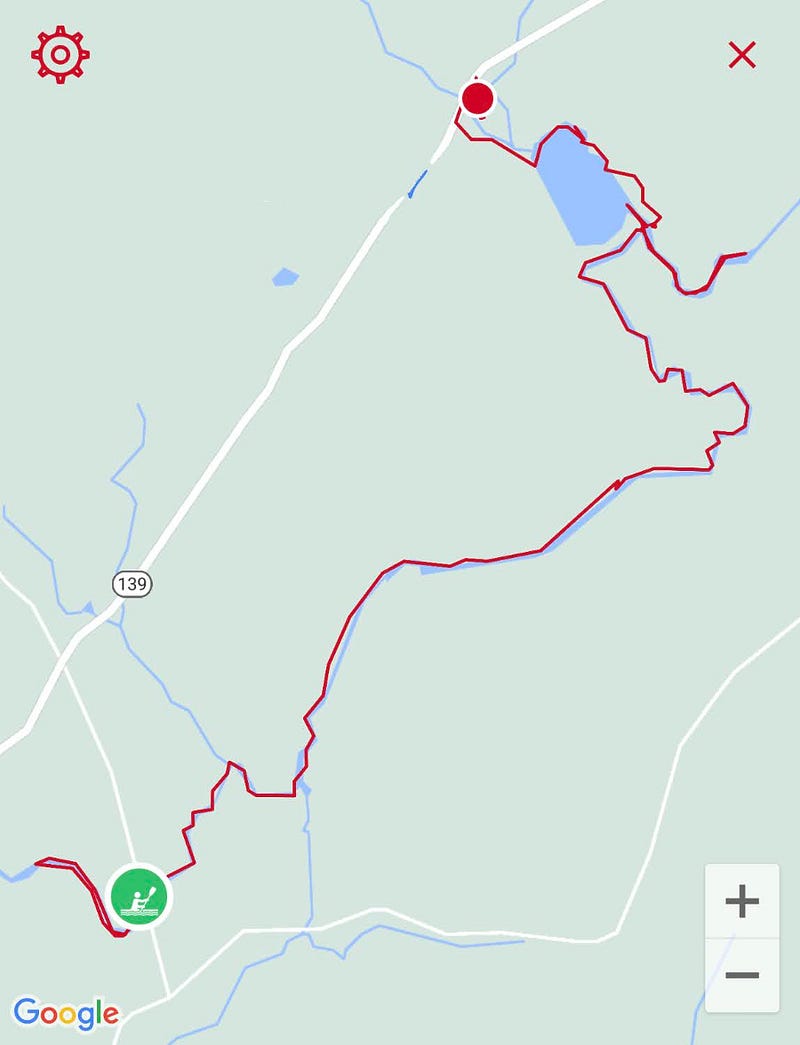
A map of our route. The green circle marks the put-in. The red circle marks our finish. Screenshot from Googlemaps.com

The complication was that since the spring melt had begun, the surface of the pond, especially around the edges, had become slushy. For good reason, we no longer trusted the ice. Skis allow travel over less supportive ice, so using skis would increase our margin of safety. In addition, we could travel over the shallower areas of the pond, so even if one of us went through the ice, it would be cold and inconvenient but not life-threatening.
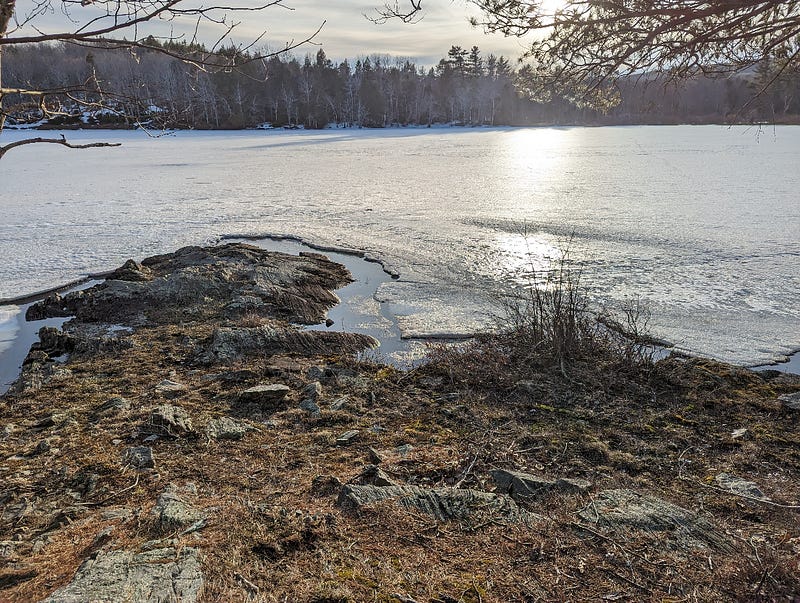
The ice melts first along the edge of the pond’s western shore. Ray Wirth photo.

Yes, the trip would be easier and more straightforward if we waited a few weeks until the ice came out of the pond. But once the idea of a paddle-ski trip hatched in our imaginations, it was hard to forget. However, a few questions remained. “Will we be able to pry the kayak trailer out from the middle of the lawn where it's buried in snow?” “Will cross-country skis fit inside the kayak?” “Will we be able to carry our paddling gear, once we’re on our skis?” Equally importantly, “Will we find a place where we can safely get out onto the ice?”

“Yes.” “Yes.” “We think so.” And, “We really have to hope so”— or it would be a long trek back to the house via a circuitous route.

Sunlight and the upper river

We launched from the snowy riverbank and — struck by the beauty of the afternoon— decided to paddle a mile or so upriver before making our trip back down.
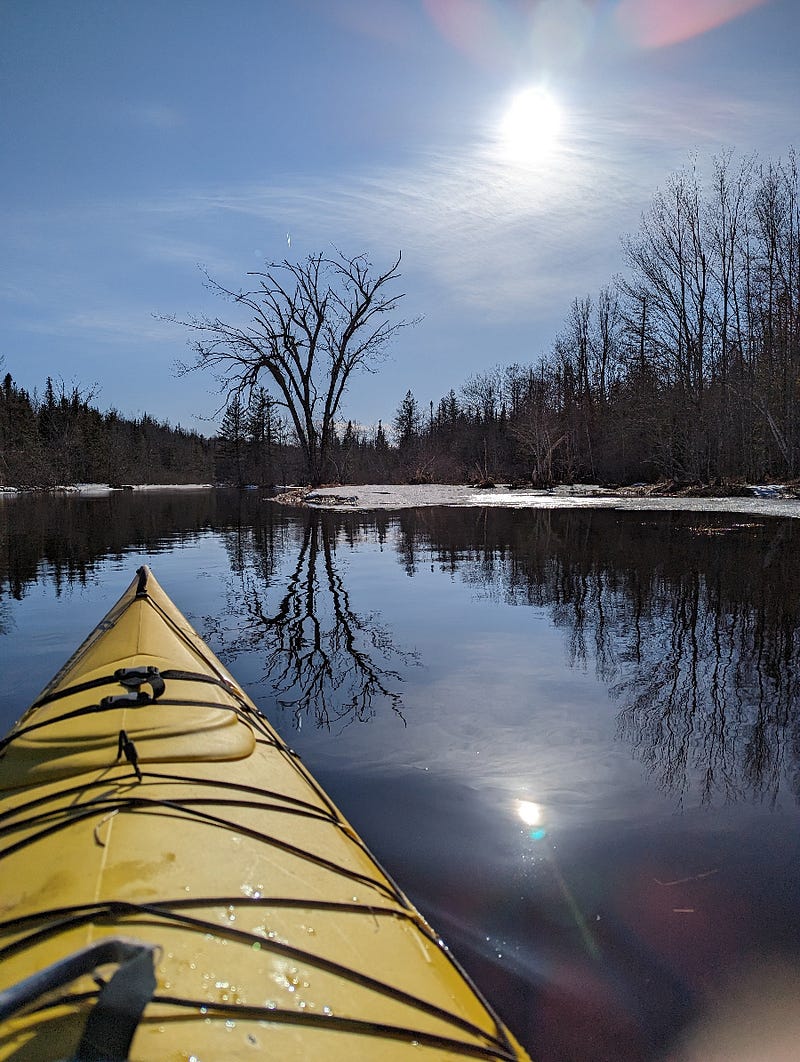
A riverside silver maple tree casts a long reflection. Leslie Gregory photo. Used with permission.

Even in early spring, small rivers trap warmth and provide shelter from breezes. They’re adept at capturing and magnifying the growing light. Feeling pleasantly warm and delighted to have the sun on our faces, we headed upriver. Geese intermittently punctuated the stillness as they honked warnings to each other and reluctantly took flight. The slow-moving water reflected the intense blue of the March sky and the slender beauty of late winter trees.

In places, the river narrowed or was interrupted by rocks. We dug our paddles deeper and felt our boat surge forward through the current.

At the end of a mile, at a big bend in the shining, sunlit river, we rounded a large pyramid-shaped rock and then for the first time turned our bow downstream.

There we were . . . finally living life at the speed of the river — and not wishing to be anywhere else.

Once we were going with the current, we felt more relaxed. Even when we rested our paddles, the river still eased us along at a mile per hour. We were moving at the speed of the river. We felt a part of it, and of the quiet beauty surrounding us.

Hooded mergansers beat their way off the water — and headed downstream where we were sure to disrupt them again, and then again. As we rounded a bend, I whispered to Leslie and we froze until we drifted within ten feet of a beautiful pair of mallards — the iridescent green of the male’s head a tattoo on my memory.

A little later, while we were drifting and snapping photos, a beaver slapped his tail 40 yards ahead, cautioning us against entering what he clearly believed was his section of river.

We paddled over submerged beaver dams, through areas where tall trees crowded close to the riverbank, and through more open areas. The sunlight-blazoned river was the constant that moved with us.

Adrift in the marshland

As we neared the pond, we paddled past a massive beaver lodge and took an 18-inch drop over a beaver dam. Then we entered the marshland. The frozen pond was on our left, the still-snowy marshland on our right, and a wide swath of bright spring river ahead.
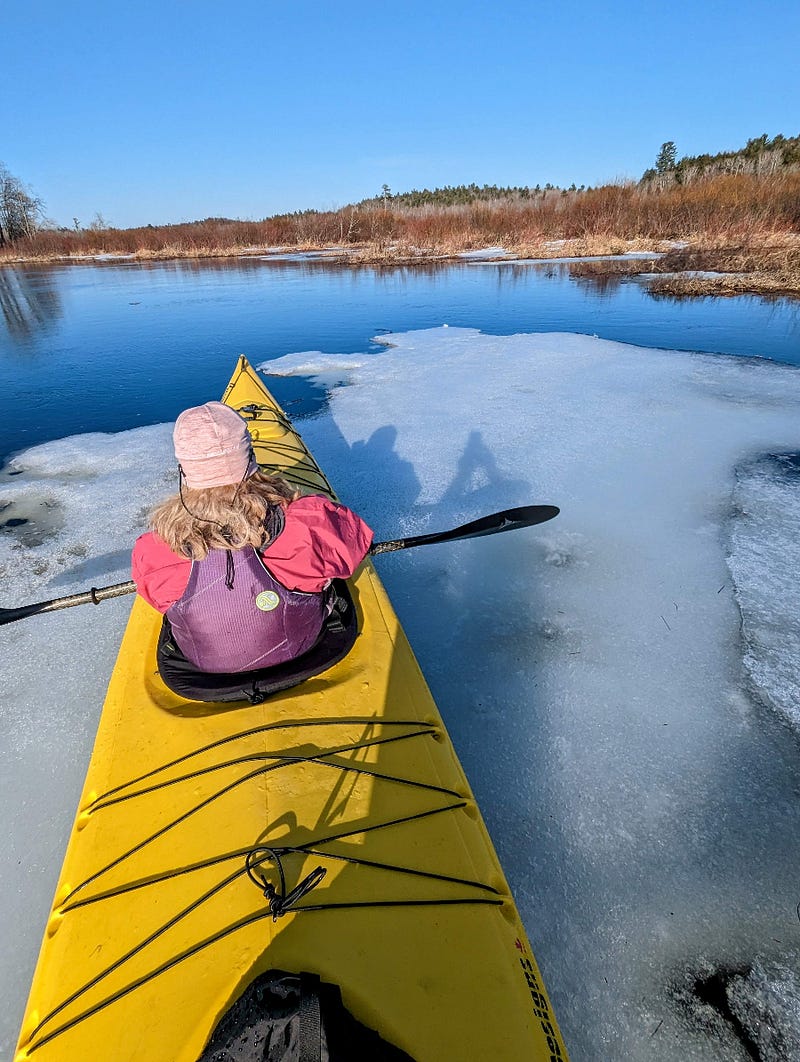
Adift on our ice-floe raft. Ray Wirth photo.

Having decided to extend our adventure with a jaunt downriver, we passed the channel that leads to the pond. Even in the marshland, the current pushed us along. We paddled past a couple more beaver lodges and used the hull of our kayak to bisect a large chunk of slushy ice.

A larger, more intact ice floe was ahead. We dug our paddles deep and propelled the kayak up onto the ice floe, which, surprisingly, remained intact. So there we were, sitting in the yellow kayak, which was beached on a white ice floe in the midst of the winter-flattened, sun-spackled marshland. We could no longer reach the water with our paddles, so we rested, drifting with the ice floe, at exactly the speed of the river. There we were, in a too-brief series of moments, two Huckleberrys on a temporary raft, finally living life at the speed of the river — and not wishing to be anywhere else.

We said there warn’t no home like a raft, after all. Other places do seem so cramped up and smothery, but a raft don’t. You feel mighty free and easy and comfortable on a raft. — Mark Twain, Huckleberry Finn

As we neared the site of an old stone dam, we used our paddles to push the kayak back off the ice floe. We watched the ice floe drift downstream and then turned upstream to close the circle of our trip before the sun settled too much lower in the sky.
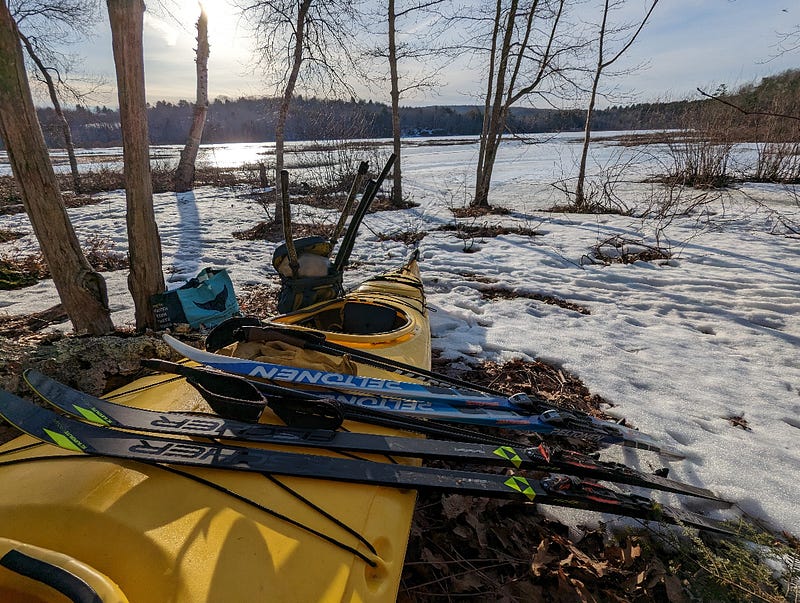
Once the kayak was ashore, it was time to switch to our xc ski gear. Ray Wirth photo.

Skimming across the pond

We decided to go ashore near a point at the south end of the pond. Paddling at top speed, we used our momentum to surf onto the snow and get as close to shore as possible. We were grateful for our knee-length neoprene boots which allowed us to get ashore without having wet feet.
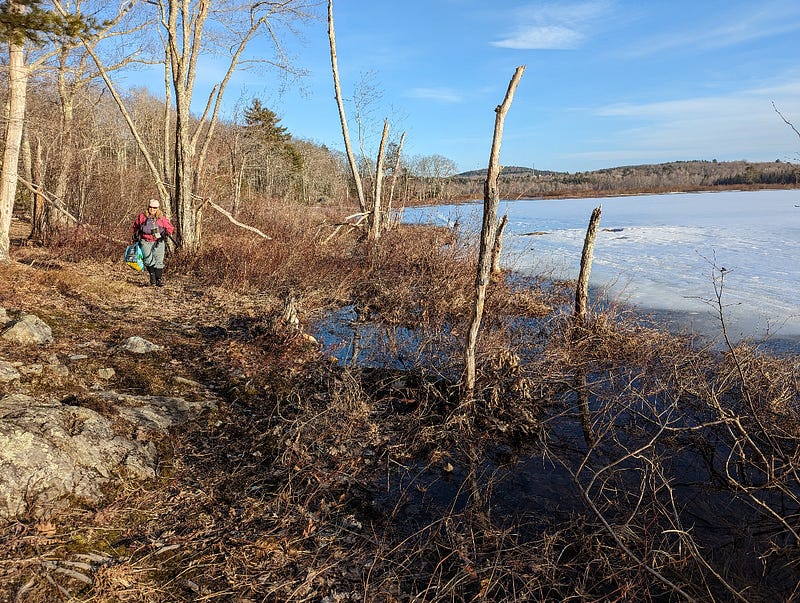
We hiked for a quarter mile along the shore of the pond, looking for a place we could safely get out onto the ice. Ray Wirth photo.

We tied the kayak to a tree, unloaded the ski gear, and stuffed our paddling gear into backpacks. Then we walked along the shore of the pond looking for a place we could get out on the ice. After a quarter mile, we found a place that looked promising.
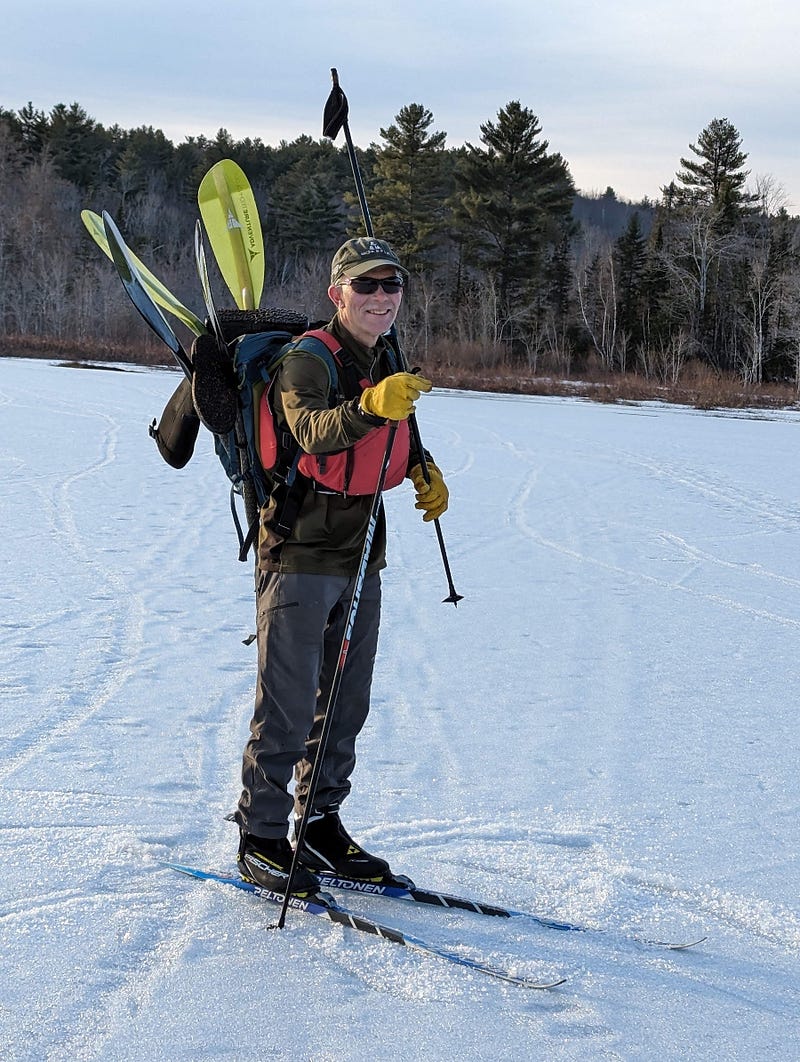
The author insists he doesn’t always ski with a life jacket and paddles. Leslie Gregory photo. Used with permission.

After putting on our skis and shouldering our backpacks, we took a breath and skimmed out from the pond edge and onto the ice.

The ice had actually hardened up some from the previous day, so we felt fairly secure once we were out there. We enjoyed the muted sunset colors on our brief crossing. Once off the pond, we were able to ski up a woods road toward the paved road. A final stream crossing and then a few hundred yards of walking — and we were home.

The trip was just a few hours of a single afternoon, but it’ll last longer in my memory. Trips that combine the outdoors with two or more modes of muscle-powered travel — a little audacious, a little zany — always seem to leave us grinning. As we say to each other, “Good clean fun!”

I encourage you to try a multi-sport trip of your own. Not everyone lives near a pond and a river, and you can keep it simpler in terms of equipment, but chances are there’s a multi-sport adventure waiting for you close to home. You might pull out a map and consider how you could combine hiking and orienteering, hiking and biking, biking and paddling, or running and swimming. You get the idea!

What multi-sport adventures have you been on, and what ones are you dreaming about?

Click the link below to read about another outdoor adventure in Maine:

Outdoors
Adventure
Kayaking
Travel
Photography
Recommended from ReadMedium