
Life and Death 5
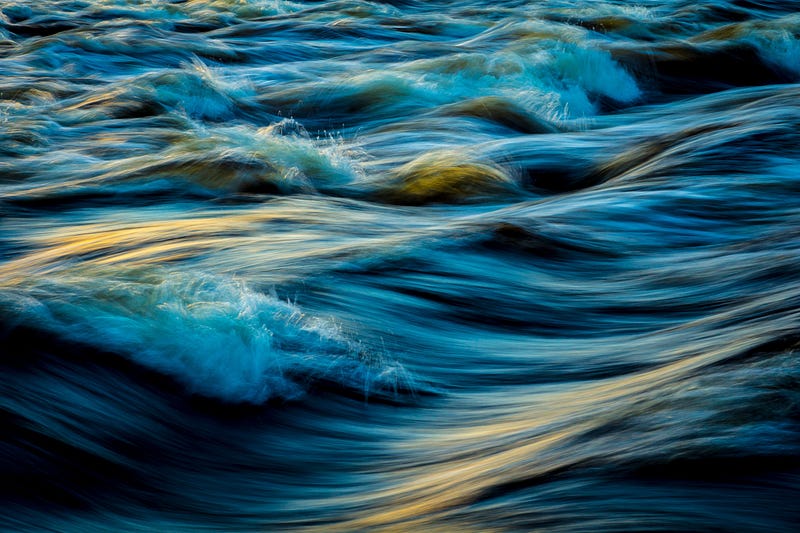
Time is a river.
Love as Pure Creativity
To exercise radical freedom, sickness of thought must be exorcised such that love leads thought.
We must die to a life of transcendence and be reborn in our Dionysian source.
Dionysian love is the force of pure difference and creativity.
Becoming is stronger than the stagnation of transcendent being. The power to create life and accept death lies with homo natura:
…he stands before the rest of nature… deaf to the siren songs of old metaphysical bird catchers who have been piping at him all too long, “you are more, you are higher, you are of a different origin.” (Beyond Good and Evil)
Transcendent reason, science, faith, religion, unbridled, are attempts to escape from the unordered and spontaneous in human nature: the sensible, affective and intuitive.
Self Destruction
The ethical and the political are inextricably linked.
In The Magic Mountain, once Castorp chooses his own path, that of love as the master of passion and reason, he descends from the magic mountain and returns to the flatlands of European society.
Time as duration on the magic mountain retreats into darkness, the affirmation of the temporal and its production of the spatial vanishes from sight, leaving only the meaninglessness of European society on the verge of total destruction.
The pure fool on the fence of what to believe, able to choose affirmation on the magic mount, is forced to face the nihilism of total war.
Castorp the soldier marches to his grave; he is ruined. Having entertained the will to power, he has been unable to embrace the pathless path. Or perhaps more accurately, he has been stopped in his tracks by the disease of the times. He has become “life’s problem child.”
The young man had indeed, in a stocktaking way, preoccupied himself with this or that among the subjective shadows of things; but the things themselves he had heeded not at all, having a wilful tendency to take the shadow for the substance, and in the substance to see only shadow. For this, however, we must not judge him harshly, since the relation between substance and shadow has never been defined once and for all. (The Magic Mountain)
The Music of Time
Music is the art of time as pure difference. Music is the leitmotif carved out in time as duration, connecting events of pure difference. It suspends spatial extension, goes beyond words; echoes in the heart, creates connections with the rhythm of the heart, revives the heart to its natural passions.
When the music is over, there is silence, and we are changed.
We either turn on the light of scientific time and forget we ever experienced pure duration. Or we balance all with love, the source of the deep, dreamless collective:
Instinct, primordial images and energies, the pure plane. Where we immerse in pure creativity.
Critical Freedom
To embrace critical freedom, to be reborn to pure difference, the purely immanent, we each must embark on a quest for life:
To awaken from the slumber of conformity and authority, and dive into the new and open.
To die to the world of objective truth and total authority is the first step to reawakening within and without on a plane of becoming.
Releasing from transcendence and duality, we embark on the trackless way of vitality and enchantment, without resolution.
We don the mask of the Dionysian minotaur following his or her own thread through the labyrinth to the open territory where the sun rises anew each day:
Time carries him as the river carries A leaf in the downstream water. No matter. The enchanted one insists And shapes God with delicate geometry. Since his illness, since his birth, He goes on constructing God with the word. The mightiest love was granted him Love that does not expect to be loved. (Borges, Baruch Spinoza)
Time is the substance from which I am made. Time is a river which carries me along, but I am the river; it is a tiger that devours me, but I am the tiger; it is a fire that consumes me, but I am the fire. (Borges, A New Refutation of Time)
I hope you enjoyed this article. Thanks for reading!
Tomas
Please join my email list here or email me at [email protected].
Excerpt from my forthcoming book, Becoming: A Life of Pure Difference (Gilles Deleuze and the Philosophy of the New) Copyright © 2021 by Tomas Byrne. Learn more here.


