
Essay | LGBT+ Civil Rights | Religious Liberty and Gay Rights | Title VII (Sex Discrimination)
LGBT Civil Rights Advance Another Step.
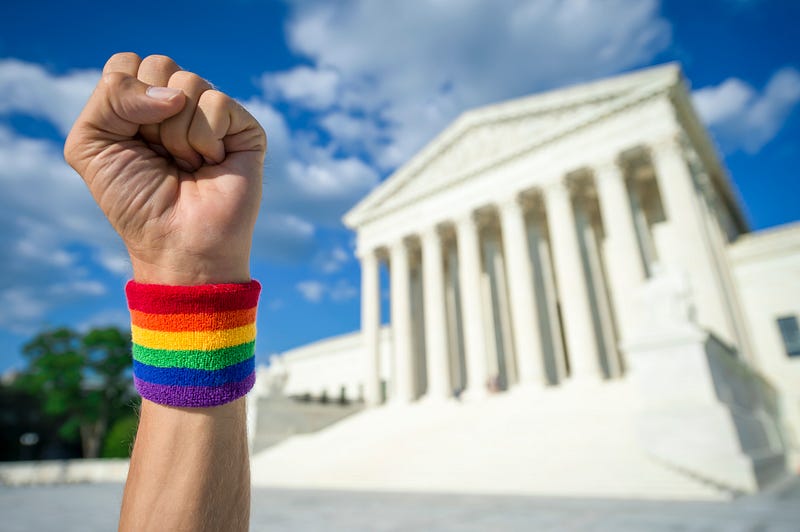
Bostock v. Clayton County, Georgia 579 U.S. ___ (2020)
On Monday, 15 June 2020, in a set of three consolidated cases, the Supreme Court ruled that the protections against employment discrimination in Title VII of the 1964 Civil Rights Act extend to sexual orientation and sexual identity.
The Court did not decide a constitutional issue but rather a federal statutory issue. Under that decision, it’s not the Constitution that protects LGBT people against employment discrimination but a law passed by Congress.
In Bostock v. Clayton County, Georgia, 597 U.S. ___ (2020) (download a PDF copy), a 6:3 decision, two of the Court’s conservative members (Chief Justice John Roberts and Justice Neil Gorsuch) joined the Court’s four liberal members (Justices Ruth Bader Ginsburg, Sonia Sotomayor, Elena Kagan, and Stephen G. Breyer) in holding that Title VII protects homosexual and transgender people against discrimination in employment.
Title VII makes it ‘unlawful . . . for an employer to fail or refuse to hire or to discharge any individual, or otherwise to discriminate against any individual . . . because of such individual’s race, color, religion, sex, or national origin.’ 42 U. S. C. §2000e-2(a)(1). Bostock, PDF copy supra, Syllabus p. 1. (retrieved 2020.06.15)
…
An employer violates Title VII when it intentionally fires an individual employee based in part on sex. … A statutory violation occurs if an employer intentionally relies in part on an individual employee’s sex when deciding to discharge the employee. Because discrimination on the basis of homosexuality or transgender status requires an employer to intentionally treat individual employees differently because of their sex, an employer who intentionally penalizes an employee for being homosexual or transgender also violates Title VII. Id. p. 2.
Justice Gorsuch wrote
An employer who fire[s] an individual for being homosexual or transgender fires that person for traits or actions it would not have questioned in members of a different sex. Sex plays a necessary and undisguisable role in the decision, exactly what Title VII forbids.
Those who adopted the Civil Rights Act might not have anticipated their work would lead to this particular result. Likely, they weren’t thinking about many of the Act’s consequences that have become apparent over the years, including its prohibition against discrimination on the basis of motherhood or its ban on the sexual harassment of male employees. But the limits of the drafters’ imagination supply no reason to ignore the law’s demands. When the express terms of a statute give us one answer and extratextual [ sic] considerations suggest another, it’s no contest. Only the written word is the law, and all persons are entitled to its benefit. Id., Opinion of the Court, p. 2.
The three cases that were consolidated are
Bostock v. Clayton County, Georgia, supra, 723 F. App’x. 964 (11th Cir. 2018)
Gerald Bostock was a Clayton County, Georgia, Child Services social worker who helped neglected and abused children. He alleged that he was fired after joining a gay softball league. See Civil Rights Law Protects Gay and Transgender Workers, Supreme Court Rules | New York Times, 15 June 2020, retrieved 2020.06.15.
The 11th Circuit held that Title VII did not extend to gay individuals and dismissed Bostock’s case. The Supreme Court reversed and remanded.
Altitude Express, Inc. v. Zarda, 883 F.3d 100 (en banc 2d Cir. 2018)
Donald Zarda was a skydiving instructor. He alleged that he was fired when his employer learned that he was gay. A female customer had expressed concerns about being strapped so closely to Mr. Zarda during a tandem dive. Hoping to reassure her, Zarda told her that he was “100 percent gay.” She complained to his employer.
Reversing the decision of a 3-judge panel, the 2d Circuit, sitting en banc, held that Title VII does protect gay individuals from discrimination in the work place based on sexual orientation. The Supreme Court affirmed.
R.G. & G.R. Harris Funeral Homes, Inc. v. Equal Employment Opportunity Commission, 884 F.3d 560 (6th Cir. 2018)
Aimee Stephens, a transgender woman, had presented for employment to the funeral home as a man. Later, she announced that she was a transgender woman and would be working in women’s clothing. She alleged that she was fired for being a transgender individual.
The 6th Circuit held that Title VII does protect a transgender individual from employment discrimination based on sexual identity. The Supreme Court affirmed.
Bostock is arguably a bigger win for LGBT+ people with broader effect than was Obergefel v. Hodges 576 U.S. 644 (2015) (marriage equality).
In Obergefel, the Court recognized a constitutional right to marriage, then held that LGBT+ people are protected in their enjoyment of that right by the 14th Amendment’s Due Process and Equal protection clauses. Bostock, recognized federal statutory protection of LGBT+ people against workplace discrimination on the basis of sexual orientation and transgender status.
Obergefel extends only to LGBT+ people who wish to marry. Bostock extends to all LGBT+ people in the workplace. Thus, Bostock is arguably of much greater import even though it recognizes just statutory protection as opposed to constitutional.
Furthermore, Bostock signals the new, conservative-dominated Court’s disinclination to overrule Obergefel. It hardly would have included LGBT+ people as a Title VII protected class if it intended in the future to overturn Obergefel.