
LIFE
Letting Go of Perfection
About the prisons we create for ourselves
En route to lunch I was introduced to a young, feeble female architect. She looked excited and quite terrified to meet me. She had sat in one of my lectures earlier that morning, where I discussed approaches to improve emotional health in building design. A colleague from the fraternity turned to speak in a hushed tone: “Just so you know these grown professionals feel sucker punched when a non-architect in a dress and pair of heels scolds and tells them their designs suck.”
Without looking at my friend, adjusting my heels, I coolly replied, “Black is black, white is white. If it sucks it sucks. Deal with it, darling.”
“Yes ma’am.” My friend elbowed my side. “You’re so deceiving. You look like a magnolia until you open your mouth. Then it’s all fire and nightmare. You’re more like a rafflesia.”
I turned to look at my dear friend, the chairman of the event. “That’s the nicest thing you’ve said to me this year. For nine years your organization has invited me only to hear me berate. It’s becoming a fetish. Believe me it’ll get worse next year if your buildings continue to look like erected graph papers and the suicide rate escalates.”
In my session, I expressed to a hall of professionals that consisted of architects, engineers, students and educators, my disappointment that local schools and detention centers for refugees resemble prisons. I shared studies to show that hospitals had too many blind spots that it increased fatigue, mishaps and accidental deaths. I remonstrated:
“I’m not asking ‘why is this the case?’ I’m asking ‘why is this still the case?’ Where is this talk of creative and social innovation? The term’s been heavily lobbied since 2012. We haven’t moved beyond its definition.”
Speaking as a design thinking trainer (at the time), my concern was mental health focusing on traumatic experiences. All across the city, we were building death traps and depression zones. This was pre-COVID times. Post-pandemic, we need better ventilation, breathing and creative social spaces other than hipster cafes. Co-working spaces failed to impress. There were cases of harassment and disruptions. We needed to do better.
The young female architect was part of the organizing committee, but my lecture triggered her to approach me. As she introduced herself, I could see she was extremely nervous. Based on my blunt criticism of her superiors I don’t blame her.
She looked like she was in her mid twenties, maybe younger. She wore a warm smile, but looked restless as if something bothered her. It was reflected on her skin. I could see breakouts and blemishes at her forehead and chin signifying stress, lack of sleep, undisciplined diet and lack of hydration. From her uneven concealer probably with an overused sponge instead of a brush, I could see she was hiding dark circles — a long spell of sleep deficiency.
Seeing her struggle for courage to introduce herself, I asked her if she would like to join me, the chairman and a few officials for lunch. She jumped at the offer and said yes.
While the officials were busy discussing politics, I took the liberty to ask the young woman questions about herself. I was casually profiling her to better understand why she was restless. After the men got up to refill their plates at the buffet spread, she blurted out: “How can you be certain that you’re living the life you’re supposed to have?”
I smiled. “That’s an interesting question. Why do you ask?”
“I watched you earlier and you seemed so sure and confident with what you’re doing. How do you do that?”
“Well, I practice what I believe in. I believe in my purpose.” I replied.
“How do you know your purpose?” She pressed on.
“I ask myself how I can help society improve based on what I can offer of myself. At times I wished I was an architect. But then again, I might end up like every other architect out there, like the ones I criticized this morning.” I laughed.
“Why do you say that?”
“Well, what I bring to the table today is based on where I sit and what I’ve done, as an art and communication person, not as an architect. I’m able to give my valuable input because I’m outside looking in.”
“How do you do that?”
“I enjoy listening to criticisms and learning from contrarians. You need them in everything, work and life for check and balance. That’s where the real learning takes place — by being among people who can bring something new to the table. That’s how I learned to find my purpose. I discovered I want to be part of creative and social innovation where I help strengthen weak communities, namely through arts, culture and education.”
The young lady proceeded to share her dilemma. She was struggling with her marriage, postpartum depression, and her loss of interest to be an architect. She had poorly invested in an art studio she rented with a friend who was now exiting the contract. All of these, and she was turning 27.
A week later I gave her a call. She sounded surprised to hear from me.
I told her I would like to rent her studio for a day to work on my batik art. I needed space to work on a two-meter silk fabric and she had all the equipment from wax, boiler to pigments. I was happy to pay extra for the materials although everything came with the fees.
At first she was excited, then she sounded anxious. “My studio is not in a good neighborhood. My studio has no air conditioning. I do have a fan but it gets warm in the afternoon. I also don’t have a coffee machine. I’m so sorry about this.”
I laughed. “Have you been to a batik workshop in the village?”
“Erm, no.”
“It’s typically at the back of a house and resembles a chicken coop. You’re lucky to have walls. Our best artisans come from these coops. Your place is high end for batik art, actually.”
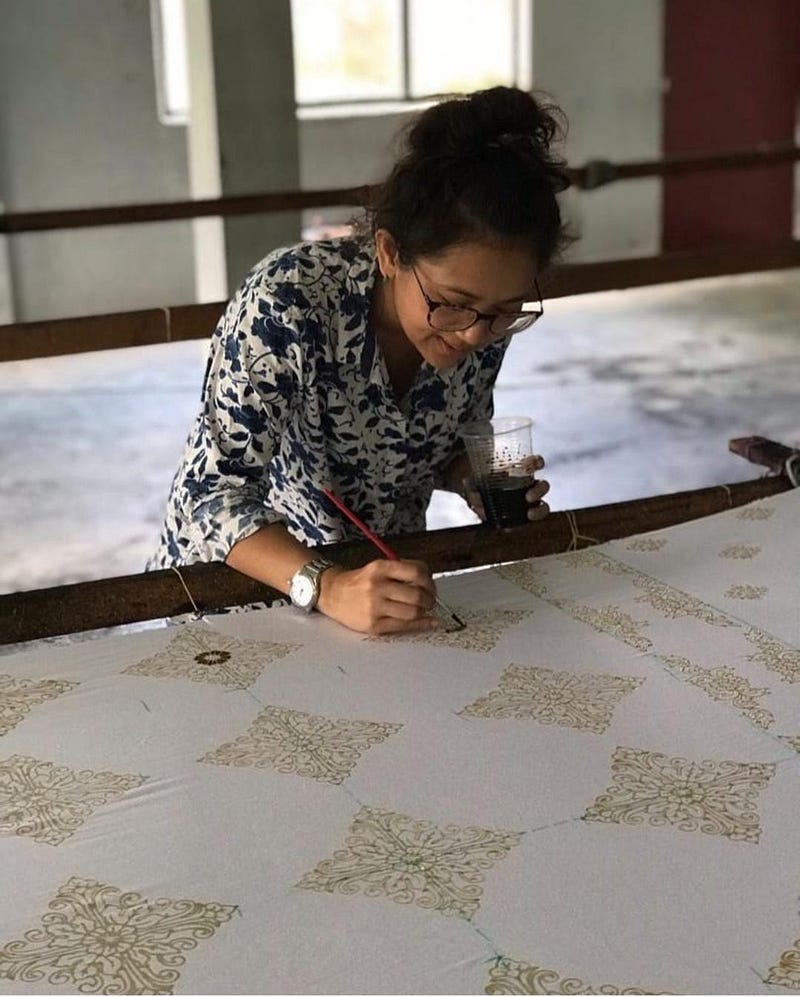
I typically produce my art in isolation. There’ll be music in the background but nothing loud and aggressive. Phrases and words from the lyrics can influence my imagination. Even with sweat trickling down my back, I am transfixed and transported to another dimension. I am alone but I am in the thick of conversations between an image to another, shifting and emerging from translucency to opacity. There is music in the room, there is music in my head, and there is music in my heart.
I am enraptured in a love affair with textures and pigments, speaking an eccentric personalized language not spoken by another. Hence, my preference for silence and isolation.
As I was about to start, the young woman asked if she could stay and watch me in action while she tidied the other section of the studio. My mind was already somewhere else when I gave her permission to stay. It was her studio after all. I was just her guest.
Taking a 2B pencil I drew a long scribble across the two-meter fabric. I then took a copper pen-like tool called canting, dipped it in a saucepan of melted beeswax, and drew freehand across the raw fabric.
Without realizing it, the young woman was standing at the edge of my frame, watching me intently. I proceeded to work, focused on the music and drifted through my own thoughts.
“I’m sorry to interrupt you sis Tasha, but I really need to ask, what’s going through your mind right now?”
I straightened my back and circled my neck to ease the muscle tension.
“The truth? Nothing. It’s a clear open space.” I replied.
“But you’re drawing. You must have an image in your mind as you’re doing this.” She sounded intrigued but looked bewildered.
“I have nothing in my head. I’m just running my hand across the fabric swayed by the music. I let it lead me. Where thinking as in logical thought is concerned, my brain’s asleep.”
I continued to move my hand across the fabric for a good hour before wrapping up to prepare for pigment. I switched my canting to a handful of brushes and sponges.
“You mean nothing is planned?” The young lady seemed to be gasping.
“Nope.”
“Don’t you need a sketch or a stencil beforehand? A color palette printed out as reference?”
“Nope.”
“Aren’t you afraid to make mistakes?”
“Since I started, I’ve made many. But who’s counting.” I started brushing the colors on my stretched silk fabric.
“What if you ruin the whole piece? And it’s silk!”
“It’s art. You can’t ruin an artwork. It just becomes something else than what you started with. That’s the whole point. That’s where the fun is. If you ask me, I have no idea what I’m doing. I’m doing this because it feels great. Liberating.”
“I’ve been wanting to do batik art but I’m always scared to ruin the fabric. It’s too expensive to screw up. I’m still sketching for the perfect design.”
“When you’re doing art, don’t think like an architect or an engineer. This is where you release yourself from any constraints. Be free. No rules. Explore and connect with yourself. Don’t think of mistakes. Whatever happens, just improvise from there. Art is forgiving.”
“My problem is I need to know where I’m heading. I don’t like making mistakes. I’m scared of making mistakes.”
“Mistakes, like death, are unavoidable. That’s why I love making art. I don’t have a destination. I stop when I feel it’s done. I can make as many mistakes as I want and I still get a productive outcome from it. Unless I accidentally painted a vortex and Lucifer comes out of my canvas, it’s all good. No one gets hurt. Everything, from start to finish, is one beautiful process.”
“I can’t imagine doing what you’re doing. Freehand and not having a sketch to begin with.”
“Have you tried?”
“Not yet.”
“You should. Then tell me.”
“What about flaws?”
“Celebrate them.”
“What do you mean?”
“The Mona Lisa has innumerable flaws yet people think the painting is awesome. It’s not even finished. Da Vinci himself didn’t think much of it, dragged his feet to finish it which he never did. ‘Art is never finished, only abandoned’ he said. Overrated piece if you ask me. Probably why it was hung in the Fontainebleau bathroom for more than 100 years. Like The Mona Lisa, perfection is an illusion, a grossly disproportionate perception of public approval and acceptance of beauty. Perfection will just stress you out because nothing will ever be good enough. That’s what drove many artists mad. I do no such things. I do this to enjoy myself.”
“I think that’s my problem, right there.”
“Throw logic out of the window when you do art. Let go and enjoy. Trust the process.”
“I think you solved half of my life’s problems.” The young woman burst out laughing.
“Not me. You did. I just presented you with a different point of view. How you digest it is up to you.”
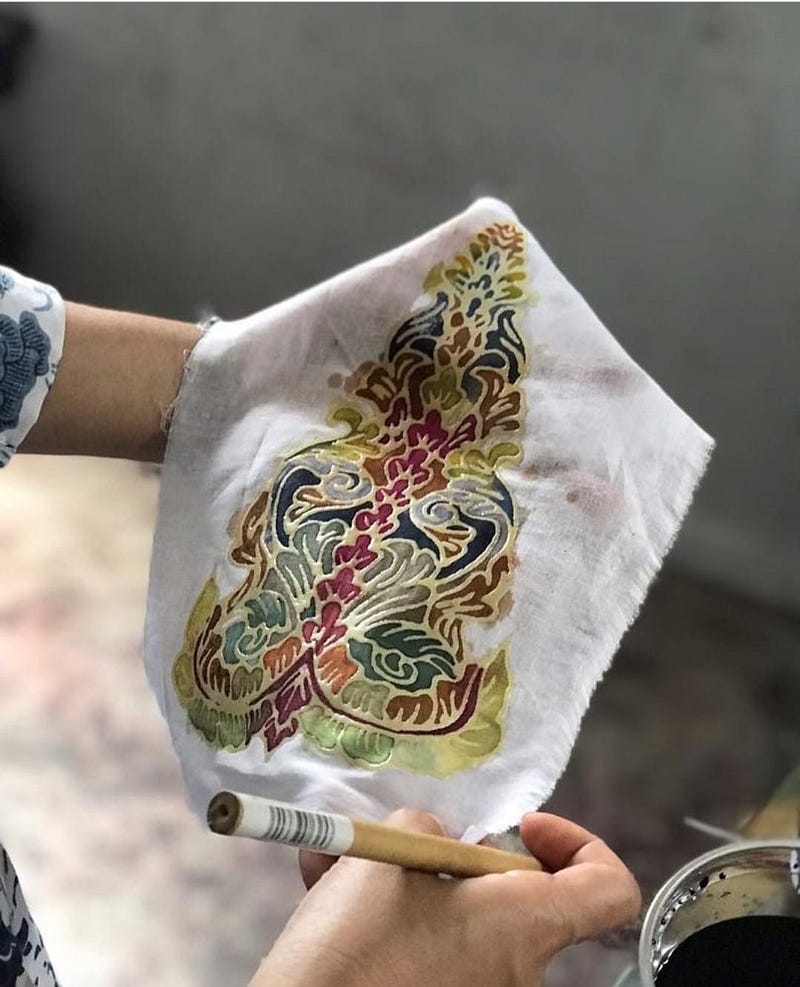
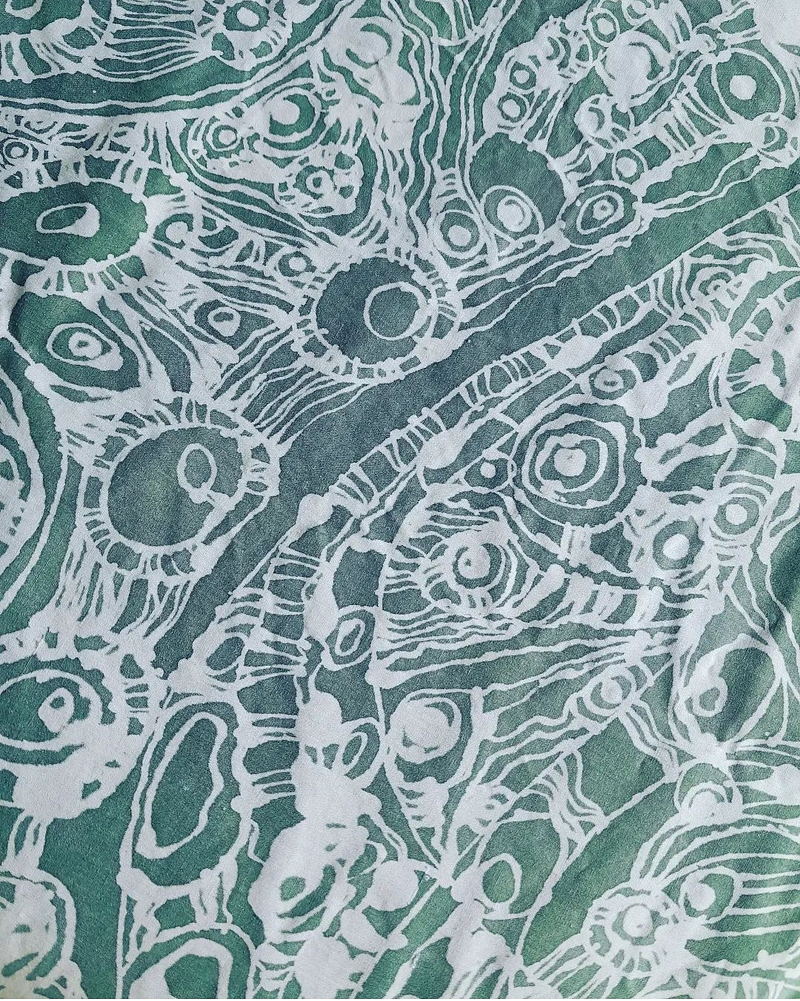
I continued to rent the young woman’s studio on several more occasions. Eventually she picked up her own canting and joined me to do batik art.
I suggested she record herself painting, convert it into a time-lapse video. This way, she could watch herself in action, observe and marvel at producing nothing into something. She did, and it became a new creative release for her.
Eventually, she braced herself to post her time-lapse videos online. From there, she was inspired to innovate them into art tutorials. She became a celebrated artist. I guess the apt term for it these days would be a social media influencer.
We still keep in touch now and then. I’d ask about her life and where it’s heading. She’d reply with sparks of joy in her voice, “It’s all happening like a surprise and an explosion. Scary and daunting at times, but I’m enjoying it! I’m teaching people batik art. Never thought I’d go down that road.”
That was the beginning of Novakbatik, a modern contemporary batik brand in Malaysia led by founder and friend Farah Mohan.
There’s a lot of fear in the unknown. But there’s also a lot of hidden spectacles behind its door. Life is short to stand in front of it and speculate the What ifs.
People often say curiosity killed the cat, there’s also the possibility that it didn’t. That’s why a cat struts and sashays with grace and composed elegance with its proverbial nine lives.
Perhaps it’s to my own amusement, but I much rather take the risks and tackle it like a two-meter fabric and smooth paint across just to see where that action takes me. The world may frustrate me with its politics, and I berate modern experts because they can’t design buildings that make people happier. But it won’t stop me from listening and learning from them.
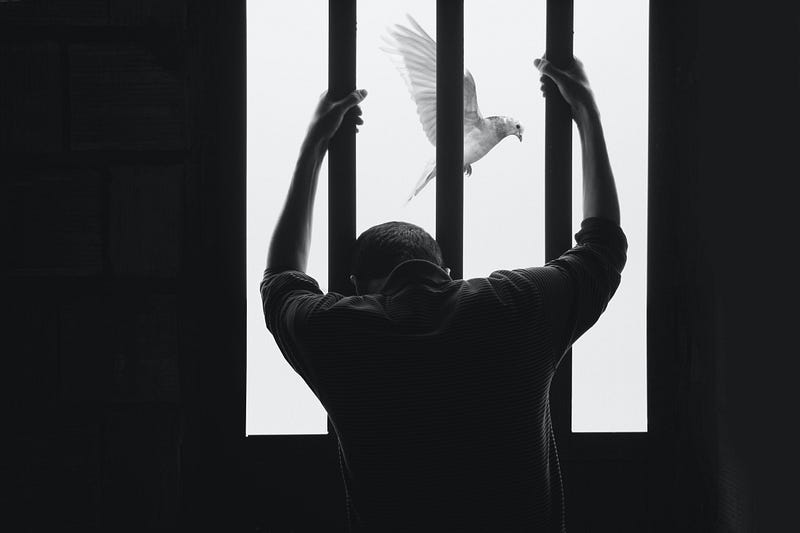
There are 15 prisons around the world that offer me hope. Bastoy in Norway resembles a holiday resort with recreational activities like horseback riding and fishing. Pondok Bamboo in Indonesia provides a safe haven for women with grooming and beauty treatment programs. Aranjuez in Spain prioritizes families to be together. Sollentuna in Sweden looks like a Sheraton suite focused on emotional and physical comfort. All of these are designed to improve rehabilitation and remind society that humans, within the boundaries of reason and thought, are not perfect, but a constant work-in-progress.
These prisons have transformed how offenders are perceived, but more importantly, afforded freedom in a restricted area. By doing so, we are allowing them to communicate and maintain contact with the outside world. We allow them family, compassion, empathy, dignity, repentance, hope and forgiveness.
But to those outside these prison walls who have committed no crime, why then create your incarceration that tortures your soul through the ills of perfection? If your work and your life demean and suffocate you, where do you go for freedom? Where is your happy space?
Though I find him remarkable, I don’t agree with Da Vinci. An artwork is never finished to be abandoned, but continues as a different interpretation. I’m no Da Vinci who was a perfectionist. I don’t fancy driving myself into madness by specifics and measurements. I’m just an artist who likes to deconstruct, explore, and experiment to music in a studio because it simply feels marvelous.


