
Let’s Talk About Money — Specifically, How to Make Loads Of It
Not all side hustles are equal. Do not make the mistake of exchanging your day job for another job.

A business is different from being self-employed.
You finally muster up the courage to flip over your keyboard, stomp out of your grey cubicle, and march down to the corner office.
You shove open the door to your boss’s office, it bangs against the wall and ricochets, almost braining you. But you manage to avoid the boomerang as you skip a step forward and fix your boss with a glare, hoping you look as intimating as you think.
Screwing up your red blotchy face, you scream the two words that fill your stomach with dread but make your heart feel light for the first time in years.
I Quit.
You do not have a business
So you have quit your day job. Left the rat race. You are the hamster that got off the wheel.
You pool your savings together and start the bakery store you always dreamt of. The flower shop. The consultancy firm. You dream of riches and how you are going to make it big now that you control your destiny.
You tell everyone you have started a business, or so you think. But you are wrong. A business is different from being self-employed.
To explain, let’s talk about the only ways to make money on this planet, using my modified cash flow quadrant.
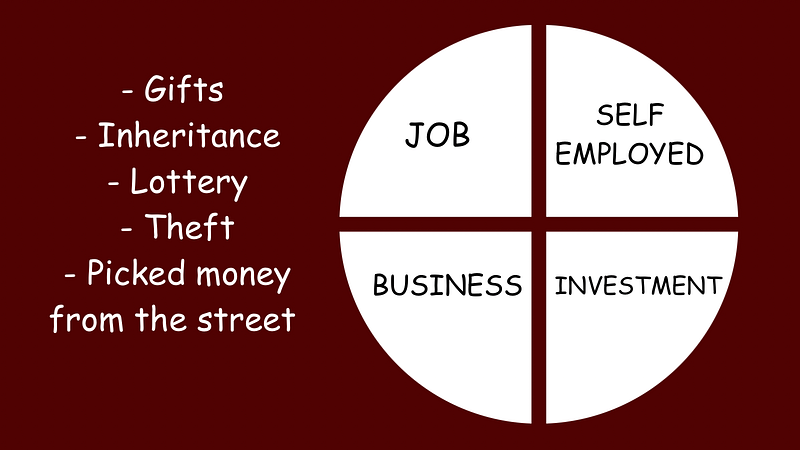
If you have heard of the cash flow quadrant, then this does not look any different except for the options outside the quadrant. But we won’t be focusing on those options as they are non-replicable random occurrences that most people can’t rely on.
The options within the quadrant are the means of income anyone can plug into.
How cash flows from one pocket to another.
Asset makes money.
Asset makes money.
Hold those 3 words in mind, because it’s the fundamental principle of the whole quadrant. An asset is something that gives value. You give that value to someone else and they pay you in return.
That thing that gives value could be as concrete as sexual intercourse and as ephemeral as making someone laugh. As far as the recipient finds it valuable, and an agreed-upon price is paid, it’s an asset.
For the cash flow quadrants, irrespective of the sector, it works on the same principle. The only difference is that the type of asset changes from one quadrant to another.
The secret most solopreneurs do not know about
The asset of a self-employed person is not different from the asset of a job owner.
This is why being self-employed is different from having a business.
At a job, your sole asset is yourself. You exchange the knowledge or skill you have for money/income. Even if it means just opening doors for people, that action is valuable enough that someone hired you and paid you to do it. At a job, someone else determines what you do, when to do it and how much you would be paid for it.
Being self-employed is similar to having a job. Your sole asset is yourself, still. You might be in charge of determining what you do, when you want to do it and how much you will charge for it. But being self-employed is still the same as exchanging a single asset for income. That single asset is you.
A business is different. So also is investment. The principle of a business or investment is that you have developed assets that make you money. You are no longer your sole asset, rather, you control and manage other assets.
What is an asset?
- Books you have written, songs you have sung, digital courses you have created, houses you rent out, people you employ, money you lent out to a bank or gave to a company via the stock exchange.
A. If a teacher stands in front of a classroom and teaches a course, he has a job.
B. If a YouTuber creates a video teaching the very same course, he has a business. That video is an asset that keeps making money.
A. If a baker makes a cake that is bought and eaten, she is self-employed.
B. If she writes a cookbook that contains the recipe, she has a business. She has created an asset that keeps making money whether she bakes anymore or not.
A. If a copywriter writes a post for a client and gets paid for it, he is self-employed. He determines what he wants to work on, when he wants to work on it and how much he wants to charge, which is great. The gig economy is great. But, it’s no different from owning a job except you can determine your working hours and rate.
B. If a copywriter writes a post on his website with affiliate links that people can buy stuff off of, he has a business, because he has created an asset.
Cash flow can be imagined as a tap. Either the tap continually flows as a result of a done and dusted effort, such as in a business or investment. Or the effort is required time and time again for the tap to flow.
Having your eggs in 4 baskets
You can make loads of money from a job as well as a business. Most athletes are in the job quadrant. They get hired by the sporting club where they play their sport and they get paid loads.
However, have you ever heard of a broke athlete? Yep. Because that athlete was his only asset, and once he stopped putting in the effort, once he stopped playing the sport, the tap stopped flowing. But if he invested his money or started a business, then the cash flow will continue from those other quadrants.
Saving is not considered a cash flow because savings is like a dam, there’s no flow, just stored money.
As an everyday person, what can you do?
If you are in the job quadrant, you can improve your cash flow by increasing the value of the asset you already have. Increasing your values as an asset means you attract a better salary, with likely more work.
That’s why people go back to school or try to get some certification, to prove their value has gone up and that they deserve to be paid more.
If you are self-employed, you can improve your cash flow by increasing the value you give. You can make and sell more of the items you are selling, or take on more gigs or clients. But you will burn yourself out trying to do more to make more money.
- Or, you can be smart and consider incorporating or fully switching over to the other aspect of the quadrant. So if you work at a job and invest your money in the stock market, you are effectively living in 2 quadrants.
- If you work a job, invest in the stock market and offer to sell handmade jewellery online, you are living in 3 quadrants.
- But, if you work a job, invest in the stock market, offer paid talks and have written a couple of books, you are living in all 4 quadrants.
Now, do you need to reside in all 4 quadrants?
For some people, they are only investors. For some, they are only business owners. Some only have a job. And others are self-employed till they die. But it’s also possible to incorporate more than 1 quadrant into your income flow.
Three reasons why you should own a business or investment
If you have a job or are self-employed, I would advise you to try and turn on the cash flow tap in the business or investment quadrant. Why?
- When your sole asset is you, that’s like putting all your eggs in one basket. If you trip and fall, there goes all your eggs. You are one illness or incapacitation away from running out of income if your only source of income is a job or being self-employed.
- Owning a business or investment is like having a hen house, you don’t need to worry if you mistakenly smash your basket on the floor. You still have chickens laying eggs.
- You will grow old one day and being your sole asset means retiring your asset. Savings are good, a pension is nice. But if you have multiple assets not dependent on your continued effort, whether you are 92 or even dead, your assets will keep making money for you in your old age or for your next of kin after you die.
Addition versus Multiplication
To bring it all together, the core principles of making lots of money are —
- Assets make money.
- Whether at a job or self-employed, you are the only asset.
- You can increase the money you make in two ways — by addition or multiplication. 3+3 = 6 but 3x3 = 9.
- The addition method involves increasing your value as the single asset you own. Get some training, earn a new certification, get a new job or role. You will attract a bigger income.
- The multiplication way involves increasing the number of assets you own. You will attract a bigger income that requires less effort to maintain.
Thanks to the internet, there are so many ways to create assets, consider exploring them.
If you enjoy my writing, you can get exclusive information on what I am up to next and what I am learning about in the world of writing by subscribing to my bi-monthly newsletter. See you in the inbox.


